Protective Put
Updated Aug 29, 2026
- Outlook
- Bullish, with downside insurance
- Max Profit
- Unlimited (stock gain minus premium)
- Max Loss
- (Cost basis − put strike) + premium paid
- Breakeven
- Cost basis + premium paid
- Complexity
- Beginner
On this page
A protective put pairs shares you already own with a purchased put option, acting as insurance against a decline in the stock. It puts a floor under the position at a known level in exchange for an upfront premium, while leaving the upside open if the stock keeps rising.
How a Protective Put Is Built
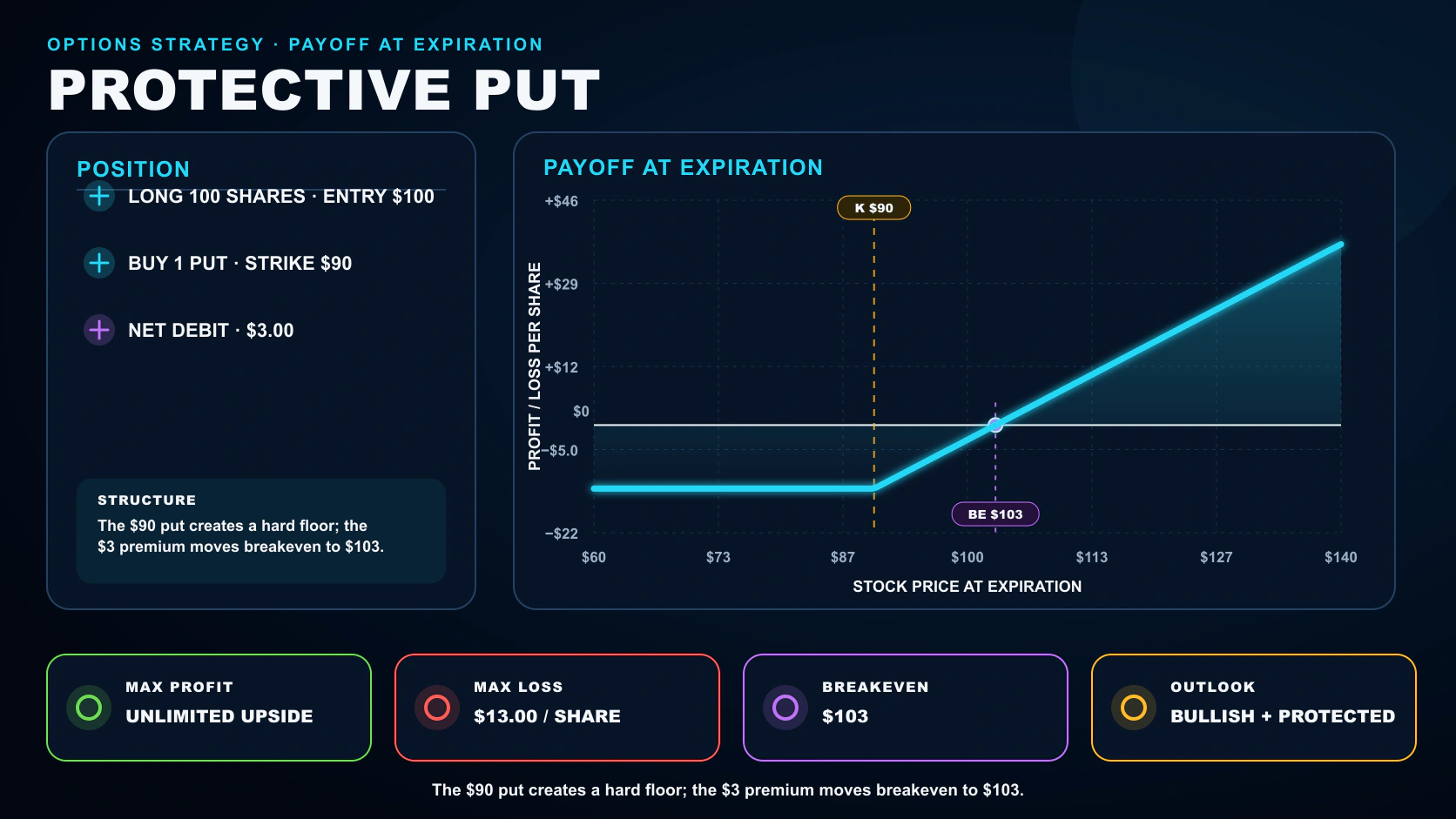
The position combines 100 owned shares with one purchased put, generally at a strike below the current stock price. Buying the put gives the holder the right to sell 100 shares at the strike price at any point before expiration, which sets a floor under the value of the stock position for as long as the put is held.
Because the put is purchased rather than sold, there is no assignment risk on this leg — the holder alone decides whether and when to exercise it. The cost is the premium paid, which behaves like an insurance premium: it is paid up front and is gone whether or not the “insurance” is ever used.
Payoff at Expiration
| Stock price at expiration | Put value (1 contract) | Total position value (100 sh + put) |
|---|---|---|
| $0 | $9,000 | $9,000 (floor holds) |
| $85 | $500 | $9,000 (floor holds) |
| $90 (put strike) | $0 | $9,000 |
| $101.50 (breakeven) | $0 | $10,150 |
| $120 | $0 | $12,000 |
Max Profit, Max Loss, and Breakeven
- Max profit: unlimited. Above breakeven, the position gains dollar-for-dollar with the stock, minus the premium already paid.
- Max loss: (stock cost basis − put strike) + premium paid. This loss is locked in at the strike and does not get worse even if the stock keeps falling, since the put’s gain offsets further share losses dollar-for-dollar below the strike.
- Breakeven: stock cost basis + premium paid per share.
When Traders Use a Protective Put
A protective put suits an investor who wants to stay long a stock through a specific period of elevated risk — earnings, a binary regulatory decision, a macro event, or simply a period of high volatility — without selling shares and giving up a long-term position or triggering a taxable sale. It’s common on volatile names, such as biotech or high-growth stocks, where a single headline can move the price sharply in either direction.
Key Risks
- It costs money, every time: the premium is a real, recurring expense if the put is rolled forward each cycle to maintain continuous protection. Over many cycles, that cost adds up and reduces long-run returns compared with simply holding the stock unprotected.
- The put can expire worthless: like any long option, if the stock doesn’t fall below the strike, the entire premium is lost with no payout — the same time-decay risk that a long call carries.
- The floor is not zero loss: a protective put limits the loss to a defined amount, but that amount can still be meaningful; it is insurance against catastrophic loss, not a guarantee of profit or breakeven.
- Strike and expiration selection matter: a strike too far below the current price leaves a wide gap of unprotected loss before the floor kicks in, and an expiration that is too short can leave the position uninsured right when it matters.
Worked Example
An investor owns 100 shares of XYZ bought at $100 ($10,000) and buys the $90 put expiring in 60 days for $1.50 per share ($150 for the contract). The effective cost basis becomes $101.50, which is also the breakeven.
If XYZ falls to $85, the shares are worth $8,500 but the put is worth $5.00 per share ($500), for a combined position value of $9,000 — the same floor that holds no matter how far below $90 the stock falls. Total loss versus the original $10,150 cost is $1,150, matching (cost basis − strike) + premium = (100 − 90) + 1.50 = $11.50 per share. If XYZ instead rises to $120, the put expires worthless, but the shares are worth $12,000, for a profit of $1,850 after the $150 premium — the upside is unlimited above breakeven.
FAQs
How is a protective put different from a stop-loss order?
A stop-loss triggers a market sale once a price is touched, but it can suffer slippage or fail to fill at the intended price during a gap or a fast market. A protective put guarantees the right to sell at the strike price regardless of how far the stock gaps down, at the cost of paying a premium up front.
Does buying a put protect against overnight gaps?
Yes. Because the put is a contractual right to sell at the strike, it protects against gap-down moves the same way it protects against a gradual decline — unlike a stop order, which can be gapped through.
Should I buy an at-the-money or out-of-the-money put?
An at-the-money put costs more but protects from the current price; an out-of-the-money put is cheaper but leaves a wider band of unprotected loss before the floor takes effect. The choice depends on how much of a decline the investor is willing to absorb before the insurance activates.
Is a protective put the same as a collar?
A collar adds a short call on top of a protective put, using the premium collected from the call to help pay for the put. That lowers or eliminates the net cost of the insurance but caps the upside, unlike a plain protective put.
What happens if the stock keeps falling well below the strike?
Nothing changes for the total position value — the put’s gain continues to offset the stock’s loss dollar-for-dollar below the strike, which is exactly why the maximum loss is fixed rather than open-ended.
Is buying a protective put the same as buying a plain long put?
The put itself behaves identically either way, but a protective put is paired with existing stock ownership to define a floor for that position, while a long put bought on its own is typically a bearish, standalone directional bet with no offsetting stock position.
Conclusion
A protective put is a straightforward way to define the worst case on a stock position without selling it, at the cost of an upfront premium that behaves like any other insurance cost — paid whether or not it is used. It’s best reserved for periods of genuine, identifiable risk rather than run continuously, since the repeated cost of rolling protection can eat meaningfully into long-run returns. For a way to help offset that cost using a covered call, see the collar, and for a broader look at position sizing and risk controls, see basic options risk management.