Butterfly
Updated Aug 29, 2026
- Outlook
- Neutral — expects the stock to pin near one strike
- Max Profit
- Strike width minus net debit
- Max Loss
- Net debit paid
- Breakeven
- Lower strike plus net debit, and upper strike minus net debit
- Complexity
- Intermediate
On this page
A long butterfly is a four-contract, three-strike spread built for a stock that a trader expects to sit near a specific price through expiration. Using calls (a long call butterfly) or puts (a long put butterfly) with equally spaced strikes, the trade caps both the maximum profit and the maximum loss, trading away the open-ended reward of a straddle in exchange for defined, limited risk.
How a Long Call Butterfly Is Built
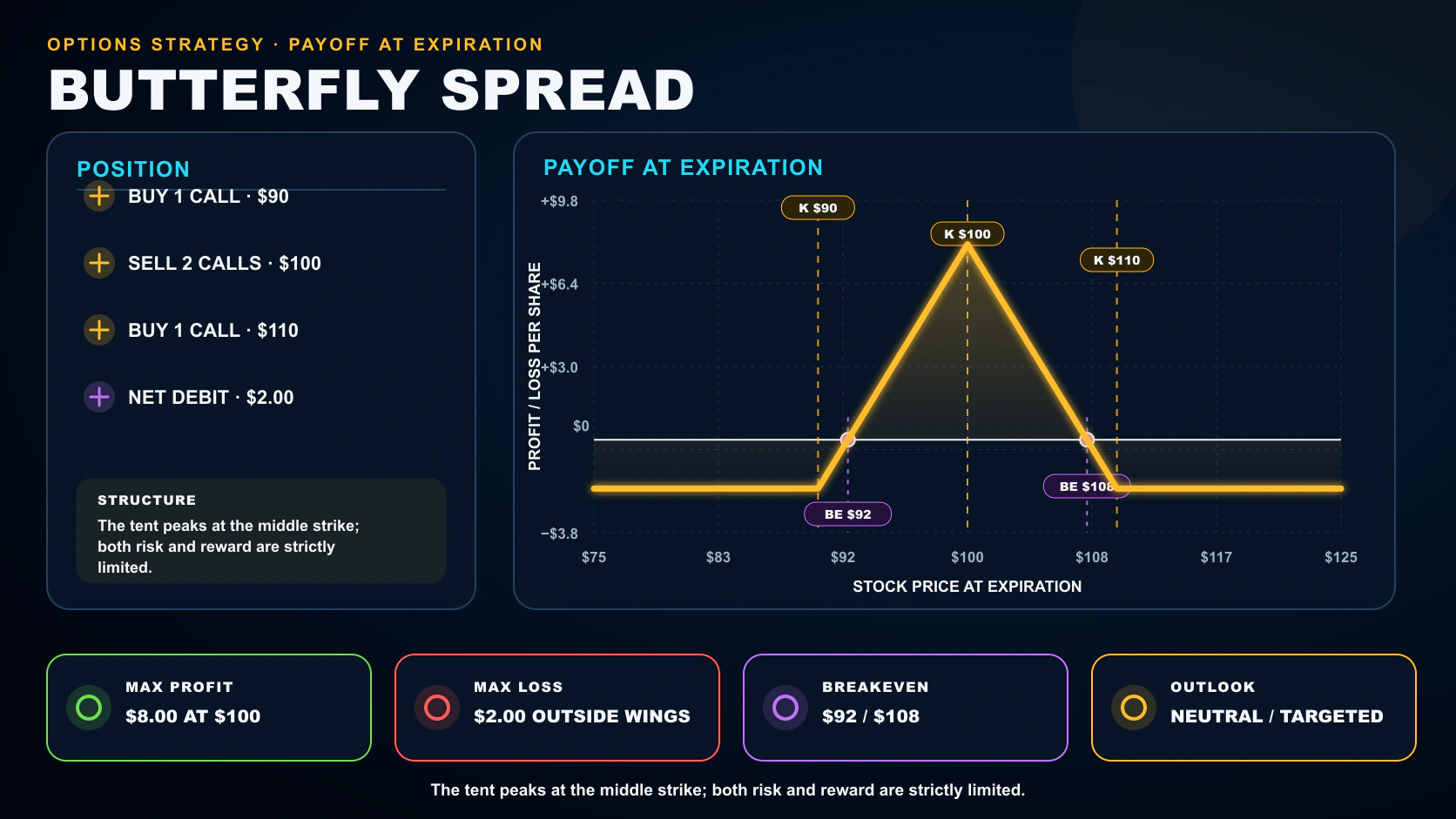
A long call butterfly combines three strikes, all on calls, all with the same expiration: buy one call at a lower strike, sell two calls at a middle strike, and buy one call at a higher strike, with the strikes equally spaced (for example, 5 points apart at each step). Because the two premiums you buy generally cost less combined than the two you write, the position opens for a net debit — money paid out, not collected.
Example: stock XYZ is trading at $100.
| Leg | Action | Price | Cash Flow |
|---|---|---|---|
| 95 call | Buy 1 | $7.00 | −$700 |
| 100 call | Sell 2 | $4.00 each | +$800 |
| 105 call | Buy 1 | $2.00 | −$200 |
| Net Debit | −$100 | ||
The net debit is $1.00 per share, or $100 total for the four contracts that make up one butterfly (100 shares per contract). That $100 is the entire amount at risk.
Payoff at Expiration
- Maximum profit: the distance between adjacent strikes minus the net debit, achieved if the stock closes exactly at the middle strike ($100). In the example that is ($100 − $95) − $1.00 = $4.00 per share, or $400 total.
- Maximum loss: the net debit paid — $100 in the example — if the stock finishes at or below the lower strike ($95) or at or above the higher strike ($105), since all three calls then either expire worthless or the position’s value nets to zero.
- Two breakevens: the position turns profitable only between two prices bracketing the middle strike.
Breakeven formulas, in words:
Lower breakeven = lowest strike + net debit
Upper breakeven = highest strike − net debit
In the example: lower breakeven is $95 + $1.00 = $96; upper breakeven is $105 − $1.00 = $104. The stock needs to finish between $96 and $104 for the trade to show any profit, with the full $400 gain only exactly at $100.
Payoff Table
| Stock Price at Expiration | Position Value at Expiration | Profit/Loss (per butterfly) |
|---|---|---|
| $90 (at/below lower strike) | $0 | −$100.00 (max loss) |
| $96 (lower breakeven) | $100 | $0.00 |
| $100 (middle strike) | $500 | +$400.00 (max profit) |
| $104 (upper breakeven) | $100 | $0.00 |
| $110 (at/above upper strike) | $0 | −$100.00 (max loss) |
Position value is the long 95 call’s intrinsic value, minus twice the short 100 call’s intrinsic value, plus the long 105 call’s intrinsic value; profit/loss subtracts the $100 net debit from that value.
When Traders Use This Strategy
A long butterfly fits a trader who has a specific price target and expects the stock to sit near it through expiration — often after a move has already happened and the trader expects consolidation, or when a stock tends to gravitate toward a round number or a well-defined technical level. Because the maximum loss is small and known in advance, it is also used as a lower-risk alternative to a short straddle by traders who want to express the same "stock goes nowhere" thesis without unlimited risk.
Main Risks
- Precision required for full profit: the maximum gain only occurs if the stock lands almost exactly on the middle strike, a narrow target. Most outcomes land somewhere between breakeven and max loss.
- Time decay works both ways: as expiration nears, the position generally gains value if the stock is near the middle strike (helping the trade) but loses value fast if the stock has drifted away from it.
- Four legs, four commissions: a butterfly involves four contracts (or a wing/body/wing entry that some brokers price as two spread orders), each with its own bid-ask spread; on a trade with a modest maximum profit, transaction costs are a meaningful drag.
- Early assignment on the short middle strike: the two short calls at the middle strike can be assigned early if they move in-the-money, particularly around ex-dividend dates, which can force an unplanned stock position before expiration.
Butterfly vs. Condor
A condor is a butterfly with the single middle strike split into two separate strikes, creating a wider profit zone instead of a single peak. It generally costs more to achieve the wider range and pays less at its best-case price than a butterfly with the same outer wings, trading peak profit for a larger margin of error.
FAQs
What is the maximum loss on a long butterfly?
The net debit paid to open the position — never more, regardless of how far the stock moves in either direction.
What is the maximum profit on a long butterfly?
The distance between adjacent strikes minus the net debit, earned only if the stock closes exactly at the middle strike at expiration.
Can a butterfly be built with puts instead of calls?
Yes. A long put butterfly uses the same structure — buy one lower put, sell two middle puts, buy one upper put — and has the same risk/reward profile as the call version at the same strikes.
Why is a butterfly considered lower risk than a straddle?
A long butterfly’s maximum loss is capped at the small net debit paid, while a short straddle used for the same "stock stays put" thesis carries unlimited upside risk and very large downside risk. The butterfly gives up some potential reward for that protection.
What happens if the stock finishes exactly at one of the outer strikes?
The position is worth close to zero and the trade realizes close to its maximum loss — the net debit paid. The profitable zone sits strictly between the two breakeven points, inside the outer strikes.
Is a butterfly cheap to trade?
The net debit itself is typically small relative to the stock price, but the trade has four legs, each with its own commission and bid-ask spread, so transaction costs matter more here than on a single-leg trade of similar size.
Conclusion
The long butterfly offers a defined-risk way to bet on a stock pinning near a specific price, capping the loss at a small net debit while capping the reward at the width between strikes. It rewards precision — the payoff is best exactly at the middle strike and fades quickly on either side — which makes it a tool for a specific price thesis rather than a general-purpose neutral strategy.