Reversal
Updated Aug 29, 2026
- Outlook
- Market-neutral, arbitrage only
- Max Profit
- A few cents to a few dollars per share, fixed at entry
- Max Loss
- Effectively none from price movement if held to expiration
- Breakeven
- Not applicable — position is built to lock in a fixed profit at entry
- Complexity
- Advanced
On this page
A reversal, also called a reverse conversion, is the mirror image of a conversion: instead of targeting an overpriced call, it targets a put that is overpriced relative to the call and the stock. It combines short stock with a synthetic long position — a long call and a short put at the same strike and expiration — so the short stock and the synthetic long cancel out, leaving a small, fixed arbitrage profit if the mispricing is real. Like the conversion, this is a put-call-parity trade built for market makers and professional desks, not a realistic retail strategy, and it carries an extra practical hurdle: you have to be able to borrow and short the stock in the first place.
How a Reversal Is Built
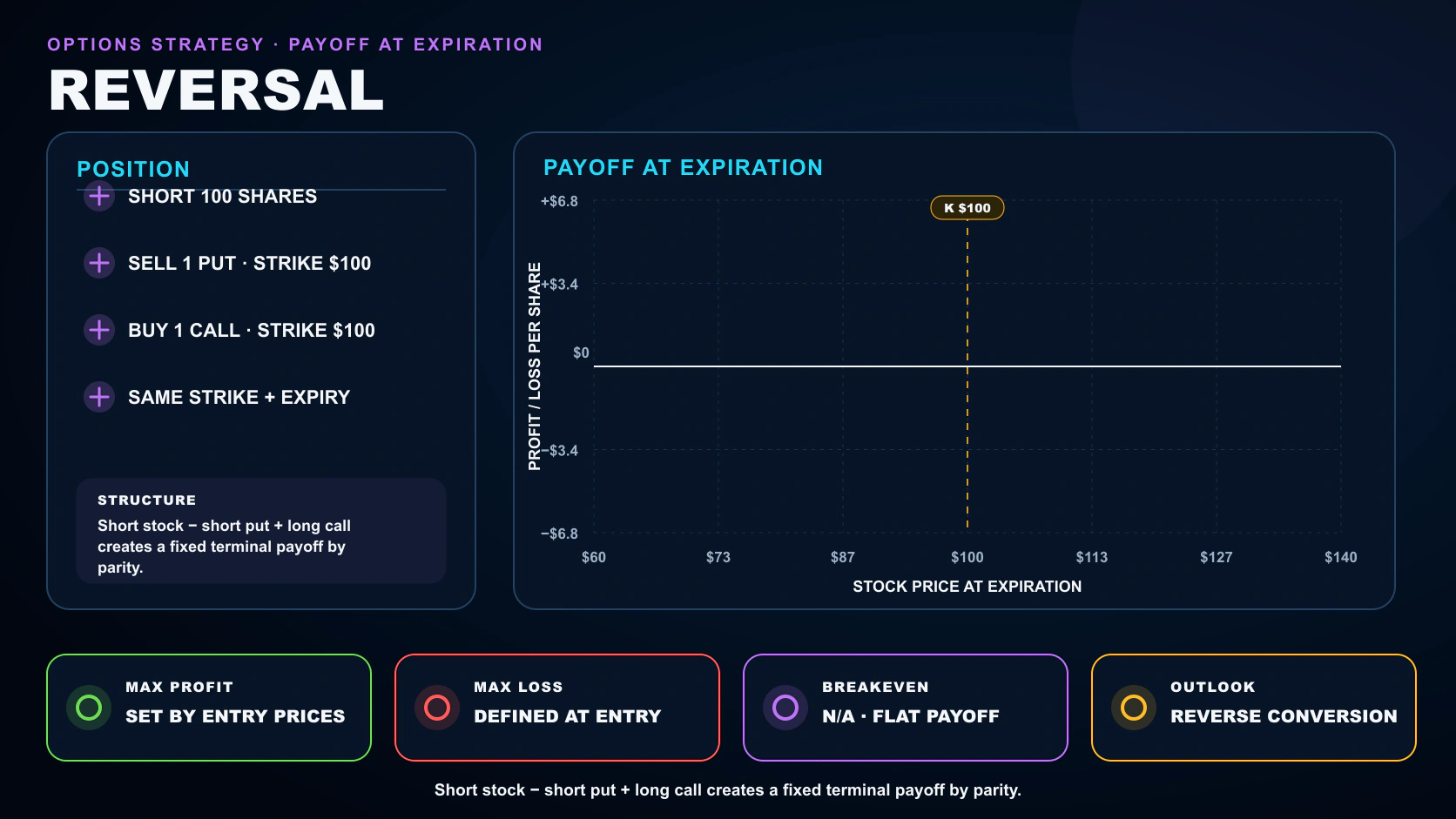
A reversal has three legs, all at the same strike price and expiration date: short 100 shares of the underlying stock (borrowed and sold), long 1 call at strike K, and short 1 put at the same strike K. The long call and short put together form a synthetic long stock position (long call + short put = synthetic long). Pairing that synthetic long with the actual short stock creates a fully hedged position — the two offset regardless of where the stock goes between now and expiration.
The Put-Call Parity Relationship
The same parity relationship used for conversions applies here, just approached from the other side:
Call price − Put price ≈ Stock price − Strike price (adjusted for carry cost and dividends)
A reversal is attractive when the put is priced too rich relative to the call and the stock — the opposite mispricing from a conversion. Selling the richer put, buying the cheaper call, and shorting the stock to hedge captures that gap. As with the conversion, the captured gap is the entire profit — there is no directional view on the stock built into the trade.
Payoff at Expiration
Because the short stock and the synthetic long always move in exactly offsetting directions, the position's expiration value is fixed regardless of where the stock lands:
- If the stock finishes above the strike, the long call is exercised, buying stock at the strike to close the short position.
- If the stock finishes below the strike, the short put is assigned, buying stock at the strike to close the short position.
Either way, the short stock is effectively covered at the strike price at expiration, and the profit is whatever mispricing was captured at entry, net of borrow costs and any dividends paid out while short.
Max Profit, Max Loss, Breakeven
| Max Profit | Fixed at trade entry — the size of the mispricing between the put, the call, and the stock, typically a few cents to a few dollars per share before costs. |
| Max Loss | Effectively none from market movement, since the short stock and synthetic long offset. Real losses come from commissions, spreads, stock borrow fees, early assignment, or unexpected dividend payments while short exceeding the captured edge. |
| Breakeven | Not a meaningful concept here — the position is constructed so its expiration value is locked in at entry, not contingent on the stock's path. |
Worked Example
ABC trades at $100.00. The August 100 call and put are quoted as follows:
| Option | Bid | Ask |
| August 100 Call | $4.70 | $5.00 |
| August 100 Put | $5.20 | $5.50 |
With the stock at the strike, the call and put should be priced close to identically once financing and dividends are accounted for. Here, the put's $5.20 bid looks rich relative to the call's $5.00 ask. Selling the put at $5.20 and buying the call at $5.00 brings in a $0.20-per-share credit on the options, before the stock leg. Shorting the stock at $100.00 to hedge locks that $0.20 per share in as profit, or $20.00 on 1 contract (100 shares), because the three legs together fix the stock's effective sale price at the $100 strike no matter where it ends up — before commissions on three legs and the bid-ask spread already built into the quotes.
That $20 gross edge has to clear stock borrow fees for the life of the trade, commissions on the stock trade plus both options, and any dividend paid while the stock is held short. On an easy-to-borrow, large-cap name those costs alone can exceed the entire edge; on a hard-to-borrow name, borrow fees can run into double-digit annualized percentages and turn a theoretical profit into a real loss quickly.
When Traders Use It
Like the conversion, the reversal is primarily a market-maker and arbitrage-desk tool for neutralizing inventory risk while capturing small, high-volume pricing edges. A desk that ends up net short puts as a byproduct of making markets might reverse that exposure by shorting stock and buying a call, closing out directional risk while banking a small edge. For a retail trader, the added requirement of locating and borrowing shares — with the borrow fee eating directly into an already thin edge — makes this even less practical than a conversion.
Main Risks
- Stock borrow availability and cost: you must be able to locate and borrow shares to short, and the borrow fee is charged for as long as the position is open. On hard-to-borrow names this fee alone can exceed the entire arbitrage edge.
- Transaction costs dominate the edge: three legs (stock, put, call) each carry commissions and a bid-ask spread that typically exceed a retail-sized mispricing.
- Early assignment on the short put: if the put is assigned before expiration, stock is purchased at the strike, which closes the short stock position earlier than planned and can disrupt the intended outcome.
- Dividend risk: a short seller owes any dividend paid on the borrowed stock; an unexpected dividend or special dividend can quickly erase a thin edge.
- Recall risk: the lender of the borrowed shares can recall them at any time, forcing an early buy-in that may not align with the options' expiration.
FAQs
Is a reversal a good strategy for retail traders?
Generally no, and it is arguably harder than a conversion because it also requires shorting stock. Borrow fees, recall risk, and commissions typically consume whatever parity edge exists.
How is a reversal different from a conversion?
A conversion is long stock, long put, short call, targeting an overpriced call. A reversal is short stock, short put, long call, targeting an overpriced put — mirror-image structures built on the same parity logic.
Why does shorting stock add risk that a conversion doesn't have?
Short stock requires borrowing shares, which carries a fee, the risk the shares get recalled before you're ready to close, and the obligation to pay any dividends declared while the position is open.
Can a reversal lose money even though it's called an arbitrage?
Yes. The market-risk component is designed to be neutral, but borrow fees, commissions, spreads, early assignment, and dividend surprises are all real costs that can turn a theoretical profit negative.
Does a reversal require special account permissions?
Yes — shorting stock requires a margin account with short-selling approval, and writing the short put typically requires a higher options approval level than simple long options.
Conclusion
A reversal completes the put-call parity picture alongside the conversion, showing how an overpriced put can be arbitraged against short stock and a long call. The added requirement to borrow shares — with its fee, recall risk, and dividend obligation — makes it even less accessible to retail accounts than a conversion. Its practical value for most traders is conceptual: understanding why puts, calls, and short stock are priced relative to each other, not as a trade to actually place.