Conversion
Updated Aug 29, 2026
- Outlook
- Market-neutral, arbitrage only
- Max Profit
- A few cents to a few dollars per share, fixed at entry
- Max Loss
- Effectively none if held to expiration and priced correctly
- Breakeven
- Not applicable — position is built to lock in a fixed profit at entry
- Complexity
- Advanced
On this page
A conversion is an arbitrage structure, not a directional or income trade. It combines long stock with a synthetic short position — a long put and a short call at the same strike and expiration — so the stock and the synthetic short cancel each other out, leaving behind a small, locked-in profit if the options were mispriced relative to the stock. It is worth understanding conceptually because it explains why option prices stay tethered to the underlying stock through put-call parity, but it is realistically a market-maker and professional-trading-desk strategy rather than something a retail account can profitably run.
How a Conversion Is Built
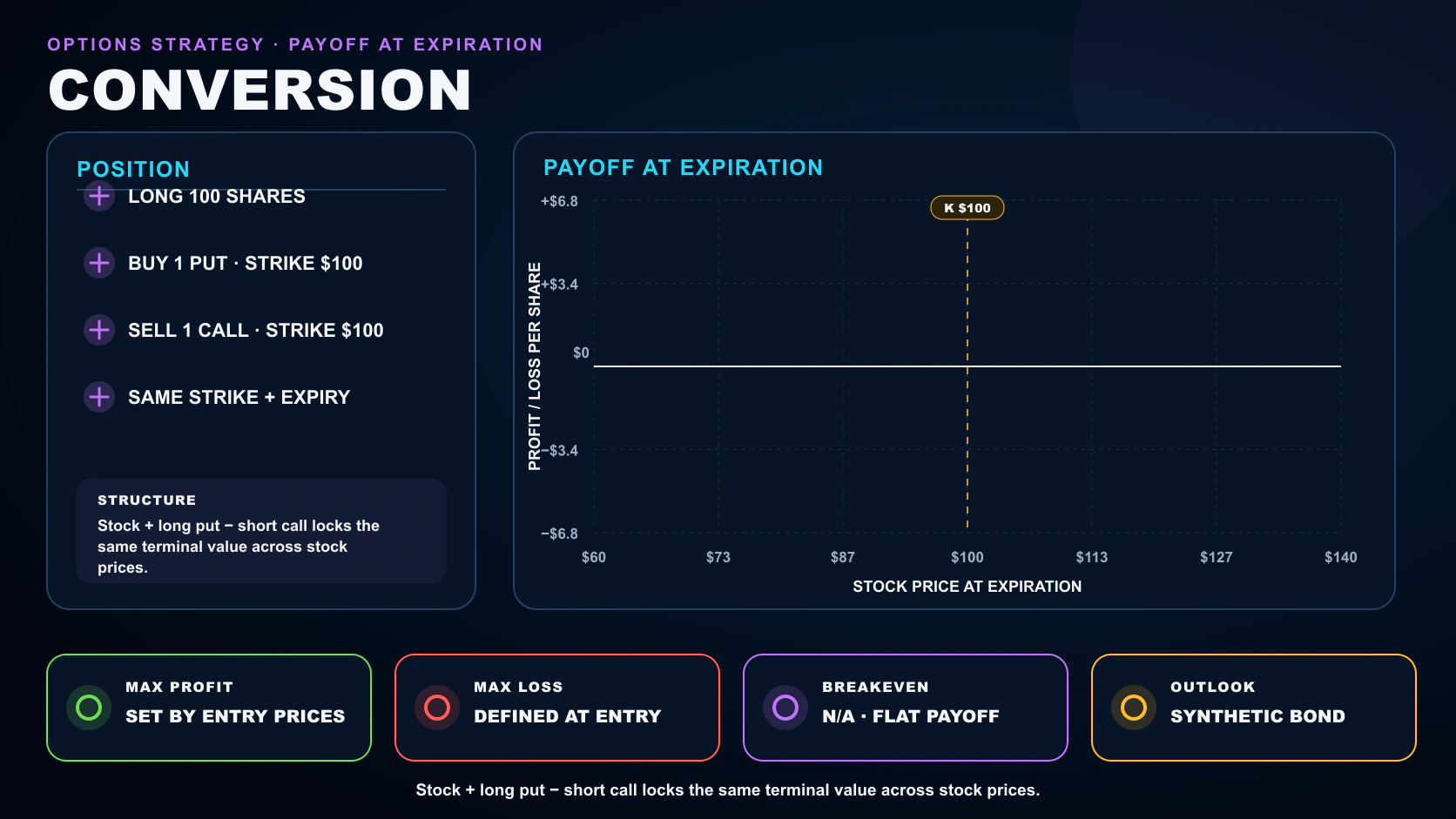
A conversion has three legs, all at the same strike price and expiration date: long 100 shares of the underlying stock, long 1 put at strike K, and short 1 call at the same strike K. The long put and short call together form a synthetic short stock position (long put + short call = synthetic short). Pairing that synthetic short with the actual long stock creates a fully hedged position — the stock's price movement is offset by the options, whatever happens to the share price between now and expiration.
The Put-Call Parity Relationship
The pricing logic rests on put-call parity, which says that for options at the same strike and expiration:
Call price − Put price ≈ Stock price − Strike price (adjusted for carry cost and dividends)
When the left and right sides of that equation drift apart — because the call is priced too rich relative to the put, given the stock's price and financing costs — a trader can buy the stock, buy the put, and sell the call to capture the difference. That captured difference is the entire profit of the trade; there is no directional bet on the stock anywhere in the structure.
Payoff at Expiration
Because the long stock and the short synthetic stock always move in exactly offsetting directions, the position's value at expiration is fixed regardless of where the stock ends up:
- If the stock finishes above the strike, the short call is assigned and the stock is sold at the strike; the long put expires worthless.
- If the stock finishes below the strike, the long put is exercised and the stock is sold at the strike; the short call expires worthless.
Either way, the stock is effectively sold at the strike price at expiration. The trader's profit is whatever mispricing was captured at entry, adjusted for the net cost of carrying the stock (financing) and any dividends received along the way.
Max Profit, Max Loss, Breakeven
| Max Profit | Fixed at trade entry — the size of the mispricing between the options and the stock, typically a few cents to a few dollars per share before costs. |
| Max Loss | Effectively none from market movement, since the stock and synthetic short offset. Real losses come from commissions, bid-ask spreads, early assignment complications, or dividend surprises exceeding the captured edge. |
| Breakeven | Not a meaningful concept here — the position is constructed so its expiration value is locked in at entry, not contingent on the stock's path. |
Worked Example
ABC trades at $100.00. The August 100 call and put are quoted as follows:
| Option | Bid | Ask |
| August 100 Call | $5.20 | $5.50 |
| August 100 Put | $4.70 | $5.00 |
With the stock at the strike, put-call parity says the call and put should be priced almost identically (ignoring small financing and dividend adjustments). Here, selling the call at its bid of $5.20 and buying the put at its ask of $5.00 nets a $0.20-per-share credit on the options, before the cost of buying the stock. On 1 contract (100 shares), that is $20.00 of gross edge — before commissions on three separate legs (stock, put, and call) and the bid-ask spread already embedded in those quotes.
That $20 is the entire profit potential of the trade. A retail commission schedule charging even $0.65 per option contract plus a stock ticket, combined with the fact that the quotes above already reflect a bid-ask spread a retail order would have to cross, can consume all or most of that edge. This is why conversions are effectively invisible to retail traders in liquid, efficiently priced names — professional market makers with exchange-level rebates and near-zero marginal transaction costs are the ones who can actually capture parity mispricings at this scale.
When Traders Use It
In practice, conversions are run by options market makers and arbitrage desks to manage inventory and lock in tiny, high-volume edges across thousands of contracts, not to generate meaningful profit per trade. A market maker who is short calls as a byproduct of making markets might convert that exposure by adding stock and a put, closing out risk while banking a small edge. For a retail trader, the honest takeaway is that this structure is worth understanding for what it teaches about pricing, not worth trying to trade — the mispricings it targets are usually too small and too short-lived to survive retail costs.
Main Risks
- Transaction costs dominate the edge: three legs (stock, put, call) each carry commissions and a bid-ask spread; for retail-sized edges, those costs alone typically exceed the mispricing being captured.
- Early assignment on the short call: if the call is assigned before expiration — most commonly just before an ex-dividend date — the stock is called away early, which can disrupt the intended locked-in outcome and force an unplanned unwind of the remaining put.
- Dividend risk: unexpected dividend changes or timing shifts alter the carry-cost side of put-call parity and can erase a thin edge.
- Execution/legging risk: all three legs need to be filled at or near the prices used to calculate the edge; if the market moves while legs are being filled one at a time, the anticipated edge can disappear or turn into a loss.
FAQs
Is a conversion a good strategy for retail traders?
Generally no. The profit per trade is tiny by design, and retail commissions, bid-ask spreads, and slower execution typically consume the entire edge. It is best treated as a concept to understand rather than a trade to place.
What is the difference between a conversion and a reversal?
A conversion is long stock, long put, short call. A reversal is the mirror image — short stock, short put, long call. Conversions target overpriced calls relative to puts; reversals target overpriced puts relative to calls.
Why doesn't this arbitrage just disappear if it's risk-free?
It largely does, in liquid markets, almost immediately — that is why the profit margin is so thin. Market makers compete to capture parity mispricings within seconds, which is what keeps option prices tethered to the stock price.
Do I need to own the stock to do a conversion?
Yes — the long stock leg is what distinguishes a conversion from a plain synthetic short position. Without it, you would simply have a directional bet rather than a hedged arbitrage.
Can a conversion lose money?
The market-risk component is designed to be neutral, but commissions, spreads, early assignment, and unexpected dividend changes can all turn a theoretically profitable conversion into a real-world loss.
Conclusion
A conversion is a textbook illustration of put-call parity rather than a practical retail trading strategy. Understanding how the long stock, long put, and short call offset each other explains why option prices move in lockstep with the stock and clarifies what a "synthetic short" position actually is. For real trading decisions, most retail traders are better served by directional or income strategies where the expected edge is large enough to survive commissions and the bid-ask spread.