Bull Call Spread
Updated Aug 29, 2026
- Outlook
- Moderately bullish
- Max Profit
- Spread width − net debit paid
- Max Loss
- Net debit paid
- Breakeven
- Lower strike + net debit paid
- Complexity
- Intermediate
On this page
A bull call spread buys a call at a lower strike and sells a call at a higher strike, same expiration, to lower the cost of a bullish bet at the price of capping how much it can make. It’s a defined-risk, defined-reward way to trade a moderate upward move without paying full price for an uncapped long call.
How a Bull Call Spread Is Built
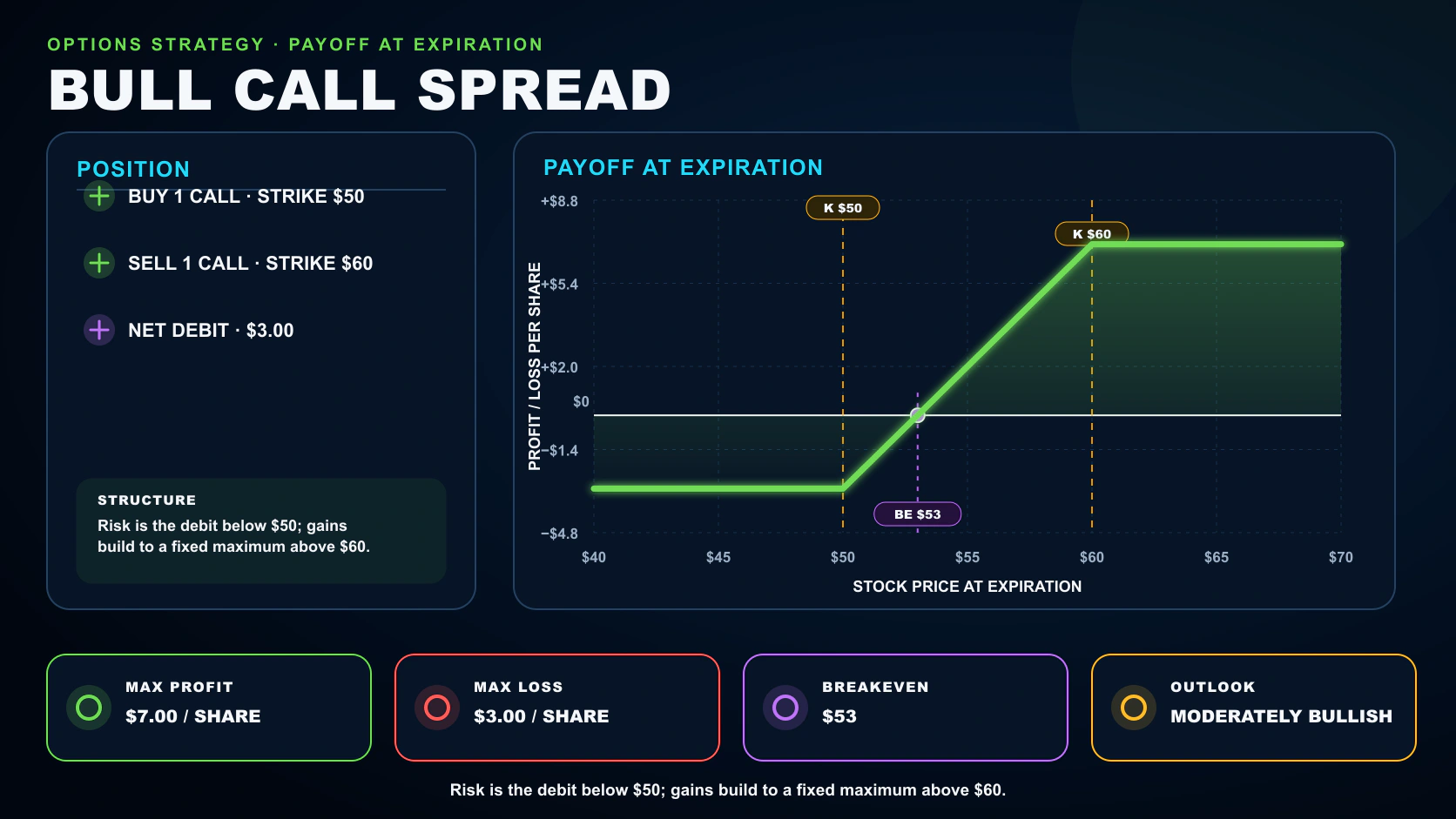
The trade has two legs opened at the same time, same expiration: buy one call at a lower strike, and sell one call at a higher strike. The premium received from the short call partially offsets the cost of the long call, so the position is opened for a net debit — money paid out of pocket — that is always smaller than buying the long call alone.
Selling the higher-strike call is what caps the upside: once the stock is above that strike at expiration, gains on the long call are offset dollar-for-dollar by losses on the short call, so profit stops growing beyond that point.
Payoff at Expiration
| Stock price at expiration | Long $50 call | Short $60 call | Net P/L (1 spread) |
|---|---|---|---|
| $45 | $0 | $0 | -$490 (max loss) |
| $50 (long strike) | $0 | $0 | -$490 (max loss) |
| $54.90 (breakeven) | $4.90 | $0 | $0 |
| $60 (short strike) | $10.00 | $0 | +$510 (max profit) |
| $65 | $15.00 | -$5.00 | +$510 (max profit, capped) |
Max Profit, Max Loss, and Breakeven
- Max profit: the width between the two strikes minus the net debit paid, realized when the stock is at or above the higher strike at expiration.
- Max loss: the net debit paid, realized in full if the stock is at or below the lower strike at expiration.
- Breakeven: lower strike + net debit paid per share.
When Traders Use a Bull Call Spread
A bull call spread suits a trader who is bullish but not looking for an outsized, unbounded move — someone comfortable capping the upside in exchange for a lower cost and a lower breakeven than an outright long call would require. Because the maximum loss is the debit paid, it also appeals to traders who want a defined-risk way to express a moderate directional view without the larger premium outlay of a single long call.
Key Risks
- Assignment risk on the short leg: the short call can be exercised early any time it is in the money, which is more likely just before an ex-dividend date. An early assignment can leave the trader short 100 shares while still holding the long call, requiring a quick adjustment.
- Capped upside: if the stock rallies far beyond the short strike, all of that additional gain is given up — the spread caps profit at the same level regardless of how high the stock goes.
- Both legs must be managed together: closing only one leg (for example, letting an assignment happen without also exercising or selling the long call) can turn a defined-risk position into an unplanned, larger exposure.
- Full loss is still possible: if the stock stays flat or falls, the entire net debit can be lost, the same as with a plain long call, just for less money at risk.
Worked Example
XYZ trades at $53.70. A trader buys the $50 call for $5.90 per share and sells the $60 call for $1.00 per share, both expiring the same date. The net debit is $4.90 per share, or $490 for one spread (one long contract plus one short contract). Breakeven is $54.90 ($50 + $4.90).
If XYZ finishes at or below $50, both calls expire worthless and the full $490 debit is lost. If XYZ finishes at $60 or higher, the long $50 call is worth at least $10.00 per share while the short $60 call offsets any value above $60, capping the spread’s value at $10.00 per share, or $1,000 for the contract — a profit of $510 after the $490 debit. That $510 maximum profit does not increase no matter how far above $60 the stock trades at expiration.
FAQs
How is a bull call spread different from a bull put spread?
A bull call spread is opened for a net debit using calls; a bull put spread is opened for a net credit using puts. Both profit from a rising or flat-to-higher stock and have defined risk, but the cash flow and margin treatment at entry differ.
Why sell the higher-strike call instead of just buying the lower-strike call alone?
Selling the higher-strike call collects a premium that reduces the total cost and lowers the breakeven versus a plain long call, in exchange for giving up any profit above the higher strike.
What if only my short call gets assigned early?
The trader is suddenly short 100 shares at the short strike while still holding the long call. Most traders close the position or exercise the long call immediately to resolve the resulting short stock exposure rather than leave it open.
How do I choose the strikes and width?
A narrower spread costs less and has a smaller maximum profit; a wider spread costs more but has more room for profit if the stock rallies hard. The width should reflect how far the stock is realistically expected to move by expiration.
Is the maximum loss really limited to the debit paid?
Yes. Because both legs expire on the same date and the long call’s value always exceeds or equals the obligation on the short call at any stock price, the position cannot lose more than what was paid to open it.
Conclusion
A bull call spread trades some upside potential for a lower cost and a lower breakeven than an outright long call, with both the best and worst outcomes fixed the moment the trade is opened. It works best when a trader has a specific, moderate price target rather than an open-ended bullish view. For an aggressive alternative built for a large move, see the call back spread; for the bearish mirror image of this trade, see bear put spread.