Short Straddle
Updated Aug 29, 2026
- Outlook
- Neutral — expects little movement
- Max Profit
- Total premium received
- Max Loss
- Unlimited upside, very large on the downside
- Breakeven
- Strike plus total premium (up), strike minus total premium (down)
- Complexity
- Advanced
On this page
A short straddle sells a call and a put at the same strike price and expiration, collecting two premiums up front in exchange for taking on risk that is unlimited on the upside and very large on the downside. It is one of the riskiest common option strategies, and it is a mirror of the long straddle: where the buyer needs a big move, the seller needs the stock to go nowhere.
Unlimited Risk, Stated Up Front
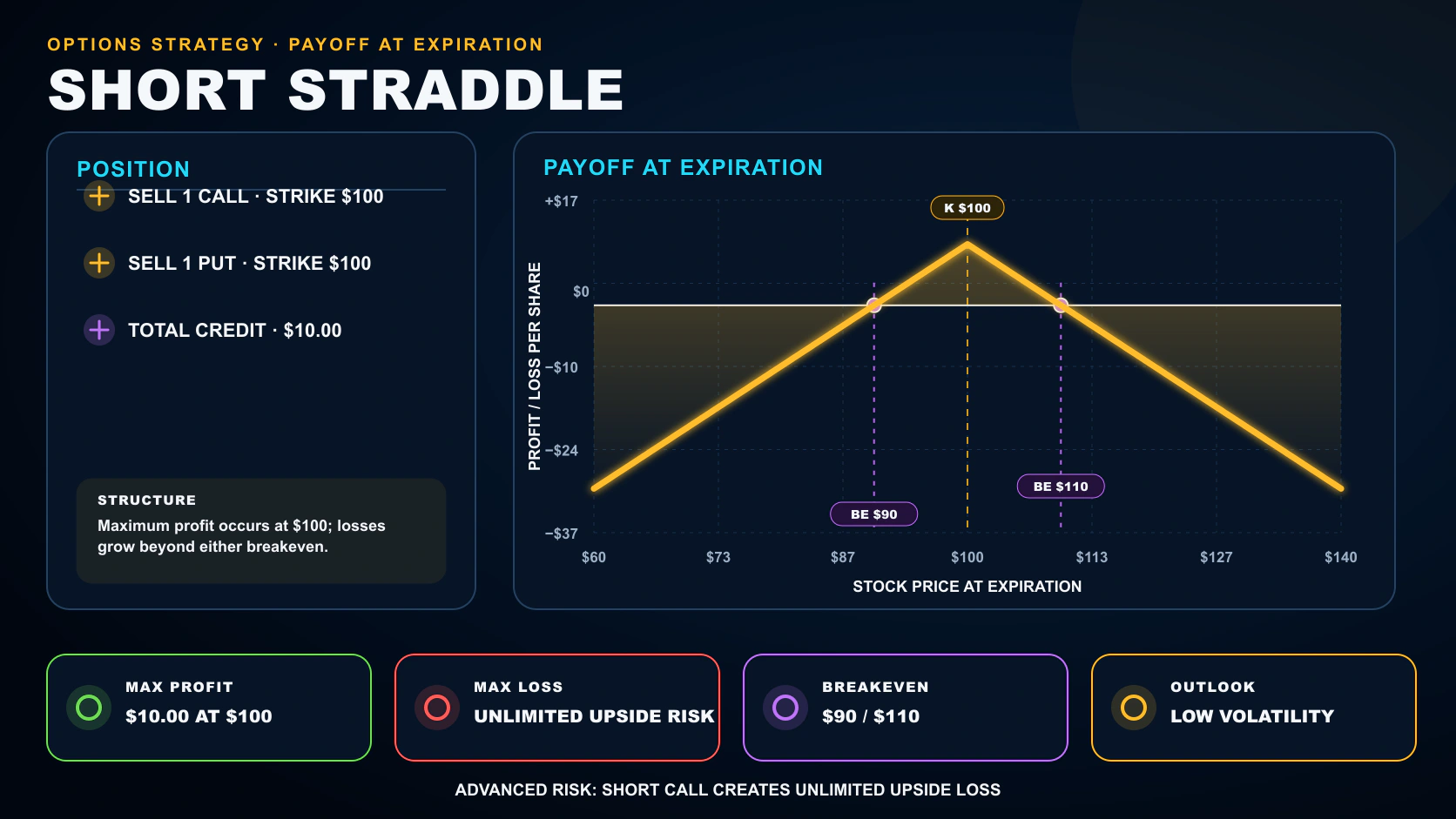
Before anything else: a short straddle has a defined, capped maximum profit but no cap on the loss side. If the stock rallies hard, the short call has no ceiling and losses grow without limit. If the stock collapses toward zero, the short put loss is very large even though it is technically bounded by the stock reaching $0. This is not an "income" strategy in the sense of clipping a coupon — it is a bet that carries tail risk large enough to wipe out far more than the premium collected, and it should be sized and margined accordingly. Brokers require significant margin for exactly this reason, and either leg can be assigned early if it goes in-the-money, particularly the call around dividend dates.
How a Short Straddle Is Built
To open a short straddle you sell one call and one put on the same stock, same strike, same expiration — typically at-the-money. You receive the combined premium immediately as a credit to your account.
Example: stock XYZ is trading at $100. You sell the 100 call for $4.00 and the 100 put for $3.50, collecting $7.50 per share, or $750 for one contract of each leg (100 shares per contract) before commissions. That $750 credit is the most you can ever make on this trade — it is realized in full only if the stock closes exactly at $100 at expiration, so that both options expire worthless.
Payoff at Expiration
- Maximum profit: the total premium received — $750 in the example — achieved only if the stock finishes exactly at the $100 strike.
- Maximum loss: unlimited on the upside (a stock can keep rising indefinitely against the short call) and very large on the downside (bounded only by the stock falling to $0 against the short put).
- Two breakevens: the position stays profitable only between two prices; beyond either one, losses start and keep growing.
Breakeven formulas, in words:
Upside breakeven = strike price + total premium received
Downside breakeven = strike price − total premium received
In the example: upside breakeven is $100 + $7.50 = $107.50; downside breakeven is $100 − $7.50 = $92.50. Between $92.50 and $107.50 the trade is profitable, with the full $750 gain only exactly at $100. Outside that range, losses accumulate dollar-for-dollar with the stock’s move, without limit on the upside.
Payoff Table
| Stock Price at Expiration | Call Intrinsic Value | Put Intrinsic Value | Profit/Loss (per contract pair) |
|---|---|---|---|
| $80 | $0.00 | $20.00 ($2,000) | −$1,250.00 |
| $92.50 (downside breakeven) | $0.00 | $7.50 ($750) | $0.00 |
| $100 (strike, best case) | $0.00 | $0.00 | +$750.00 (max profit) |
| $107.50 (upside breakeven) | $7.50 ($750) | $0.00 | $0.00 |
| $130 | $30.00 ($3,000) | $0.00 | −$2,250.00 |
Net profit/loss above equals the $750 premium collected minus the combined intrinsic value the seller must pay out on the two short legs at expiration — note that a $22.50 rally past the upside breakeven already produces a $2,250 loss, with no ceiling if the stock keeps climbing.
When Traders Use This Strategy
Experienced traders sometimes use a short straddle when they expect a stock to trade in a tight range and implied volatility looks elevated relative to how much the stock is likely to actually move — for example, after an anticipated catalyst has already passed. It is not a beginner strategy: it requires margin approval, active risk management, and a plan for a stock that gaps against the position overnight, when there is no chance to close or adjust before the loss is locked in.
Main Risks
- Unlimited loss on a rally: there is no ceiling on how high a stock can go, so the short call carries open-ended risk.
- Very large loss on a decline: a sharp drop, including an overnight gap on bad news, can produce a loss many multiples of the premium collected.
- Assignment risk on both legs: either short option can be assigned early if it moves in-the-money, forcing you to deliver shares you don’t own (call) or buy shares at the strike (put) before you intended to close.
- Margin calls: open-ended risk means substantial margin that can increase sharply if the trade moves against you, potentially forcing a close at the worst time.
- Two commissions, two spreads: both legs carry their own transaction costs, a real drag on a trade with a fixed, modest maximum profit relative to the risk taken.
Short Straddle vs. Long Butterfly
A trader who likes the "stock stays near a price" thesis but does not want open-ended risk often looks at the long butterfly instead. A butterfly caps both the maximum profit and the maximum loss at the cost of a lower, less favorable payoff — it trades the short straddle’s larger income potential for defined risk.
Short Straddle vs. Short Strangle
The short strangle sells an out-of-the-money call and an out-of-the-money put at different strikes rather than one at-the-money strike. It collects less premium than a straddle but gives the stock a wider range to move in before either side goes in-the-money — a common way to dial down (not eliminate) the risk described above.
FAQs
What is the maximum profit on a short straddle?
The total premium received when the trade is opened, realized in full only if the stock closes exactly at the strike price at expiration.
What is the maximum loss on a short straddle?
Unlimited on the upside, since a stock’s price has no ceiling and the short call loses money without limit as the stock rises. On the downside the loss is very large but technically bounded, since a stock cannot trade below $0.
Is a short straddle a good income strategy?
It generates a premium credit, but framing it purely as "income" understates the risk — a single large adverse move can erase many multiples of the premium collected. It is better understood as selling volatility with open-ended tail risk than as steady income.
Can I be assigned early on a short straddle?
Yes. Either the short call or the short put can be assigned any time it is in-the-money before expiration, particularly the call around ex-dividend dates. Assignment risk applies to both legs independently.
How much margin does a short straddle require?
Margin requirements are substantial and vary by broker, since the position carries undefined risk. Requirements typically scale with the underlying’s price and volatility and can increase if the trade moves against you.
Conclusion
A short straddle can look attractive on a quiet chart because it collects two premiums at once, but the honest picture is a trade with a capped, modest maximum gain set against unlimited upside risk and very large downside risk. It belongs in the hands of traders who understand margin, can monitor and adjust positions actively, and have a specific plan for a large adverse move — not as a passive way to generate income.