Condor
Updated Aug 29, 2026
- Outlook
- Neutral — expects the stock to stay in a range
- Max Profit
- Net credit received
- Max Loss
- Strike width minus net credit
- Breakeven
- Short put strike minus net credit, and short call strike plus net credit
- Complexity
- Intermediate
On this page
A condor uses four strikes on the same expiration to build a wide profit zone instead of a single peak, which is what separates it from a butterfly. The version most commonly traded today is the iron condor: a short put spread combined with a short call spread, opened for a net credit, that profits if the stock stays between the two inner (short) strikes. A related but distinct trade, the long call condor, builds the same four-strike shape entirely out of calls for a net debit. This guide documents the iron condor in detail and explains how the long call condor differs.
How an Iron Condor Is Built
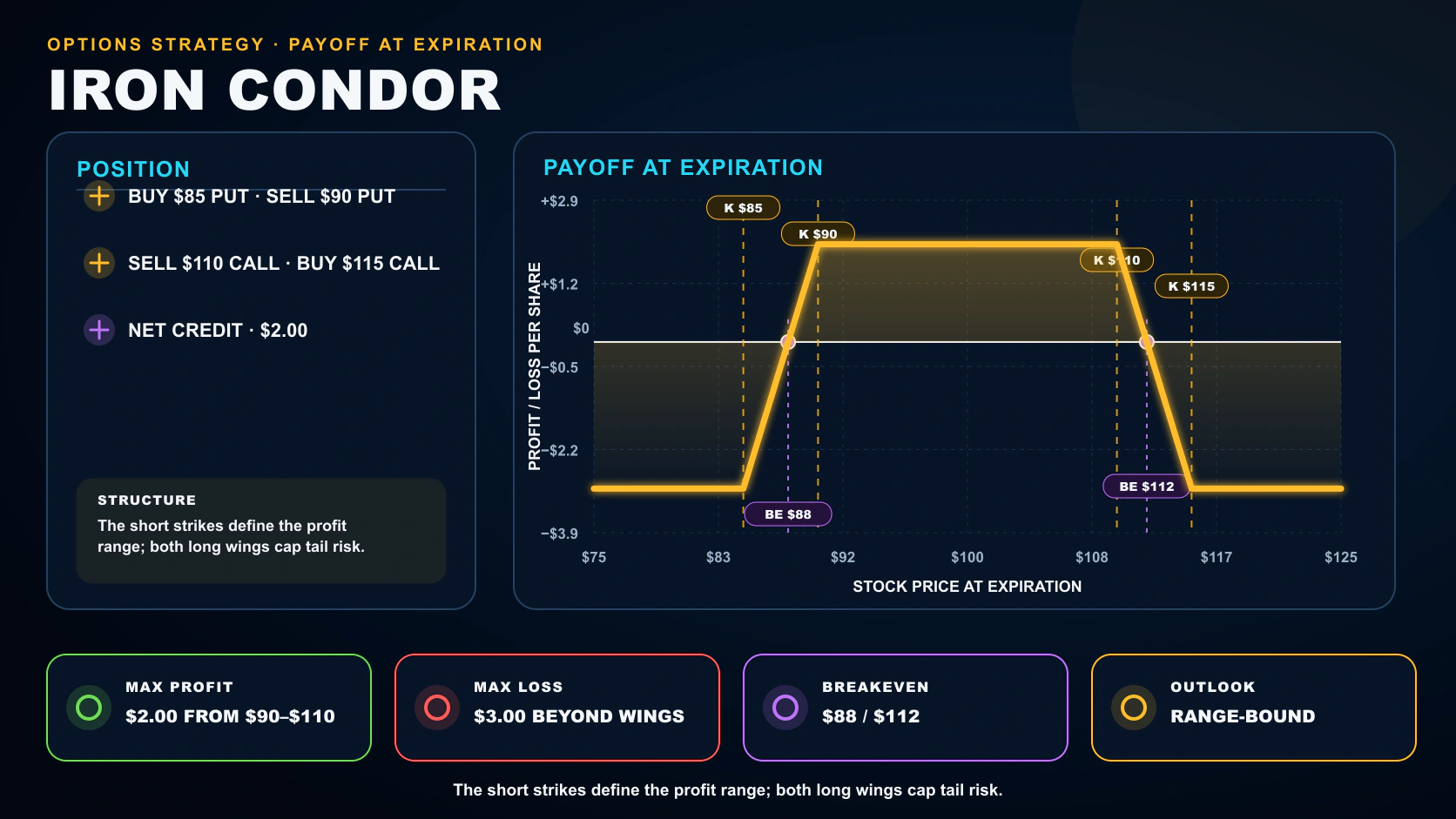
An iron condor combines a bull put spread and a bear call spread on the same stock and expiration: sell one out-of-the-money put and buy a further out-of-the-money put below it (the put spread), and sell one out-of-the-money call and buy a further out-of-the-money call above it (the call spread). Both spreads are sold for a net credit, and the long options at the outer wings cap the risk on each side.
Example: stock XYZ is trading at $100.
| Leg | Action | Price | Cash Flow |
|---|---|---|---|
| 85 put | Buy 1 | $1.00 | −$100 |
| 90 put | Sell 1 | $2.00 | +$200 |
| 110 call | Sell 1 | $2.00 | +$200 |
| 115 call | Buy 1 | $1.00 | −$100 |
| Net Credit | +$200 | ||
The net credit is $2.00 per share, or $200 total for the four contracts (100 shares per contract). Both wings are 5 points wide (85–90 and 110–115), which keeps the maximum possible loss symmetric on each side.
Payoff at Expiration
- Maximum profit: the net credit received — $200 in the example — earned anywhere the stock closes between the two short strikes, $90 and $110, since all four options then expire worthless.
- Maximum loss: the width of either spread minus the net credit. Both spreads are 5 points wide here, so maximum loss is $5.00 − $2.00 = $3.00 per share, or $300, if the stock closes at or beyond either long wing ($85 or below, $115 or above).
- Two breakevens: bracketing the short strikes, marking where losses begin.
Breakeven formulas, in words:
Lower breakeven = short put strike − net credit
Upper breakeven = short call strike + net credit
In the example: lower breakeven is $90 − $2.00 = $88; upper breakeven is $110 + $2.00 = $112. The stock stays profitable anywhere between $88 and $112, with the full $200 profit anywhere between the short strikes of $90 and $110 specifically.
Payoff Table
| Stock Price at Expiration | Put Spread Value | Call Spread Value | Profit/Loss (per condor) |
|---|---|---|---|
| $80 (below long put) | −$500 (max width) | $0 | −$300.00 (max loss) |
| $88 (lower breakeven) | −$200 | $0 | $0.00 |
| $90–$110 (between short strikes) | $0 | $0 | +$200.00 (max profit) |
| $112 (upper breakeven) | $0 | −$200 | $0.00 |
| $120 (above long call) | $0 | −$500 (max width) | −$300.00 (max loss) |
Profit/loss equals the $200 net credit minus whatever the losing spread costs to settle at expiration, capped at that spread’s $500 width.
The Long Call Condor, for Comparison
A long call condor builds the same wide-plateau payoff shape entirely out of calls, for a net debit instead of a credit: buy one lower-strike call, sell one call at a lower-middle strike, sell another at a higher-middle strike, and buy one upper-strike call. Its maximum loss is the net debit paid; its maximum profit is the width between adjacent strikes minus that debit, earned anywhere between the two middle strikes; its breakevens are the lowest strike plus the debit and the highest strike minus the debit. Traders favor the iron condor far more often, since selling premium against two capped-risk wings is generally easier to manage than a four-leg all-call debit spread.
When Traders Use This Strategy
An iron condor suits a trader who expects a stock to trade in a range through expiration — after a volatility-inducing event has passed, or simply during a quiet stretch — and wants defined, known risk rather than the unlimited risk of a short strangle. The wide short-to-short profit zone and capped risk are why it’s a popular way to sell premium without taking on open-ended exposure.
Main Risks
- Capped profit against a larger defined loss: the maximum loss ($300 here) exceeds the maximum profit ($200), a common feature of credit spreads — the trade needs to be right more often than it’s wrong to work over time.
- Assignment risk on the short strikes: the short put or short call can be assigned early if it moves in-the-money, particularly the call around ex-dividend dates.
- Four legs, four commissions: each contract carries its own bid-ask spread and commission on entry and exit, a meaningful cost against a modest fixed maximum profit.
- Gap risk near the wings: a large overnight move can put both legs of one side deep in-the-money at once, complicating an orderly exit near expiration.
Condor vs. Butterfly
A butterfly uses a single middle strike instead of two, producing a narrower, taller profit peak rather than the condor’s flatter, wider plateau. A condor generally has a lower maximum profit than a similarly-sized butterfly but a much larger range of stock prices over which that profit is earned.
FAQs
What is the maximum profit on an iron condor?
The net credit received when the trade is opened, earned in full if the stock closes anywhere between the two short strikes at expiration.
What is the maximum loss on an iron condor?
The width of either spread minus the net credit received. Unlike a short strangle, this loss is capped by the long options at the outer wings — it cannot grow beyond that fixed amount.
What is the difference between an iron condor and a long call condor?
The iron condor combines a short put spread and a short call spread for a net credit. The long call condor builds the same four-strike shape entirely with calls for a net debit. Both cap risk and share a similar payoff shape, but the cash flow direction and option types differ.
Can an iron condor be built with unequal wing widths?
Yes, though equal widths (as in the example) are common because they keep the maximum loss the same on both sides. Unequal wings shift the risk and credit toward one side of the trade.
Is an iron condor riskier than a short strangle?
No — an iron condor caps its maximum loss with the long options at the outer wings, while a short strangle has unlimited upside risk and very large downside risk. The iron condor collects less net premium in exchange for that defined risk.
Conclusion
The iron condor gives traders a way to sell premium against a range-bound thesis with risk that is capped and known from the moment the trade is opened, at the cost of a maximum profit that is smaller than the maximum loss. Understanding it as a spread-versus-spread credit trade — distinct from the all-calls, net-debit long call condor — makes clear why it has become the more commonly traded version of the strategy.