Call Options
Updated Aug 29, 2026
- Outlook
- Bullish
- Max Profit
- Unlimited above breakeven
- Max Loss
- Premium paid
- Breakeven
- Strike price + premium paid
- Complexity
- Beginner
On this page
A long call is the simplest bullish options position: pay a premium today for the right to buy 100 shares at a fixed strike price before expiration. It costs less than buying the stock outright and limits the downside to the premium paid, but it comes with a deadline, so being right about direction is not enough on its own — the move has to happen before expiration.
How a Long Call Is Built
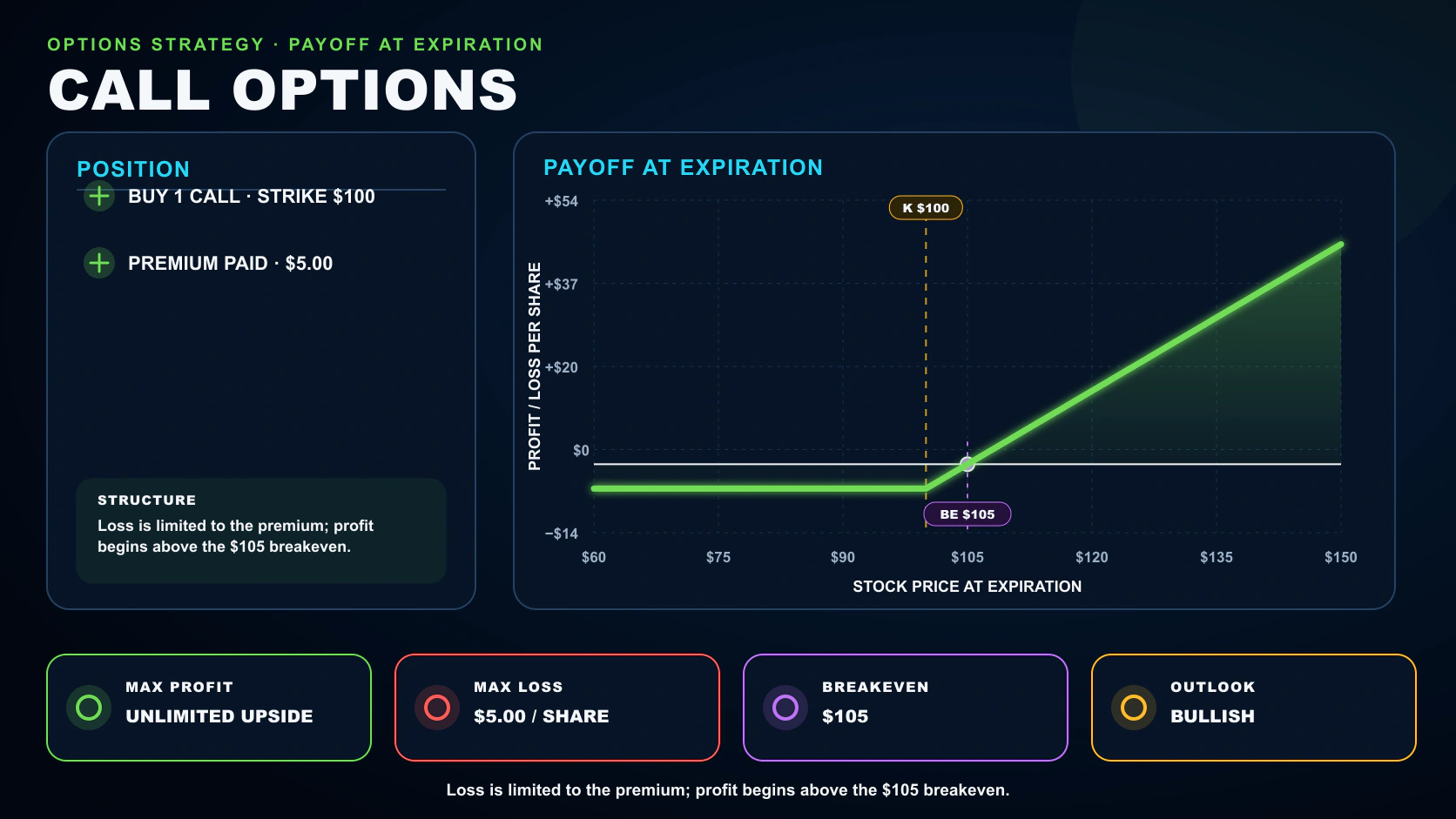
Buying a call means paying a premium to the option seller for the right, but not the obligation, to buy 100 shares of the underlying stock at the strike price on or before expiration. The buyer’s risk is fixed at the moment of purchase: the most that can be lost is the premium paid, no matter how far the stock falls. The seller (the option writer) takes the other side of that risk in exchange for collecting the premium up front.
Traders can buy calls with strikes at, above (out-of-the-money), or below (in-the-money) the current stock price, and choose an expiration date that gives the anticipated move enough time to play out. A shorter-dated, further out-of-the-money call is cheaper but needs a bigger, faster move to pay off; a longer-dated or in-the-money call costs more but is less exposed to a single catalyst’s timing.
Payoff at Expiration
At expiration, a call is worth its intrinsic value — the amount the stock price is above the strike — or zero if the stock is at or below the strike. Time value has fully decayed away by that point, so nothing else about the trade matters.
| Stock price at expiration | Call value | Profit/loss (1 contract) |
|---|---|---|
| $45 | $0.00 | -$150 (max loss) |
| $50 | $0.00 | -$150 (max loss) |
| $55 (strike) | $0.00 | -$150 (max loss) |
| $56.50 (breakeven) | $1.50 | $0 |
| $60 | $5.00 | +$350 |
| $65 | $10.00 | +$850 |
Max Profit, Max Loss, and Breakeven
- Max profit: theoretically unlimited. Profit grows dollar-for-dollar with the stock above breakeven, with no ceiling.
- Max loss: the premium paid, and nothing more. That loss is realized in full if the stock finishes at or below the strike at expiration.
- Breakeven: strike price + premium paid per share. Below that price at expiration the position loses money; above it, the position is profitable.
When Traders Use a Long Call
A long call fits a trader who expects a stock to rise meaningfully within a defined window — around an earnings date, a product launch, or a broader breakout — and wants leveraged upside without committing the capital that buying the shares outright would require. Because the loss is capped and known up front, it also suits a trader who wants defined risk rather than the open-ended downside of owning stock on margin or shorting it.
Key Risks
- Time decay (theta): the option loses value every day that passes without the stock moving, and that decay accelerates as expiration nears.
- Being right but too early: a stock can go on to hit the target price weeks after the call expires. Since the option has a hard deadline, correct direction with bad timing can still produce a full loss of premium.
- Implied volatility crush: calls bought ahead of a known event, such as earnings, are often priced with elevated implied volatility. A modest favorable move can fail to offset the volatility drop right after the event, especially for short-dated options.
- Expiring worthless: if the stock is at or below the strike at expiration, the entire premium is lost — there is no partial credit for a near miss.
Worked Example
XYZ trades at $50 per share. A trader buys one XYZ $55 call expiring in 60 days for $1.50 per share, or $150 for the contract (1.50 × 100 shares). The breakeven price is $56.50 ($55 strike + $1.50 premium).
If XYZ is below $55 at expiration, the call expires worthless and the trader loses the full $150. If XYZ rises to $60, the call is worth its intrinsic value of $5.00 ($60 − $55), or $500 for the contract — a profit of $350 after subtracting the $150 premium. If XYZ climbs to $65, the call is worth $1,000, for an $850 profit. There’s no cap on how far this can run if the stock keeps climbing before expiration.
FAQs
Can a long call lose more than the premium paid?
No. Once the premium is paid, the position cannot lose more, regardless of how far the stock falls. That fixed, known-in-advance risk is one of the main reasons traders buy calls instead of buying stock on margin.
What happens if my call is in the money at expiration?
Most brokers automatically exercise options in the money at expiration, converting the contract into 100 long shares at the strike price. Check your broker’s exercise policy and buying power beforehand, since an unwanted exercise can tie up more cash than expected.
Should I exercise the call or just sell it?
Selling the call to close the position almost always captures more value than exercising, since it keeps any remaining time value that exercising would throw away. Exercise is rarely the better choice except right at expiration.
How does implied volatility affect a long call?
Higher implied volatility makes calls more expensive because a wider range of outcomes is priced in. Buying calls right before a known catalyst often means paying an IV premium that can evaporate right after the event, working against the position even if the stock moves the right way.
Is a long call the same as owning the stock?
No. A call is a leveraged, time-limited substitute for stock ownership — it pays no dividends and carries no voting rights, and it expires — but it also requires far less capital and cannot lose more than the premium paid.
What’s the difference between a long call and a bull call spread?
A long call has unlimited upside but costs more in premium. A bull call spread sells a higher-strike call against the long call, lowering the cost and the breakeven at the price of capping the maximum profit.
Conclusion
A long call offers a straightforward way to express a bullish view with limited, known risk, but that simplicity comes with a real cost: time decay and implied volatility both work against the position from day one. Weigh the strike and expiration against how much time the expected move actually needs, and never risk more premium than you’re prepared to lose in full. For a way to generate income from calls rather than buy them outright, see the covered call; for a bullish trade that collects premium instead of paying it, see the naked put. New to options? Start with calls and puts.