Put Ratio Spread
Updated Aug 29, 2026
- Outlook
- Neutral, expecting the stock to settle near the short strike
- Max Profit
- Strike width plus net credit received (or minus net debit paid), at the short strike
- Max Loss
- Large and growing dollar-for-dollar below breakeven, capped only when the stock hits zero
- Breakeven
- Short strike minus strike width minus net credit received (or plus net debit paid)
- Complexity
- Advanced
On this page
A put ratio spread buys puts at a higher strike and sells a larger number of puts at a lower strike, usually in a 1-by-2 ratio, for a net credit or a small net debit. It profits most if the stock drifts down toward the short strike and sits there through expiration. The part that separates this from a simple vertical spread is the extra short put: because you sell more puts than you buy, one of the short puts is completely naked, and that naked exposure means losses below the short strike can become large. This is an advanced, high-risk strategy that should never be confused with its long-volatility cousin, the put back spread.
How a Put Ratio Spread Is Built
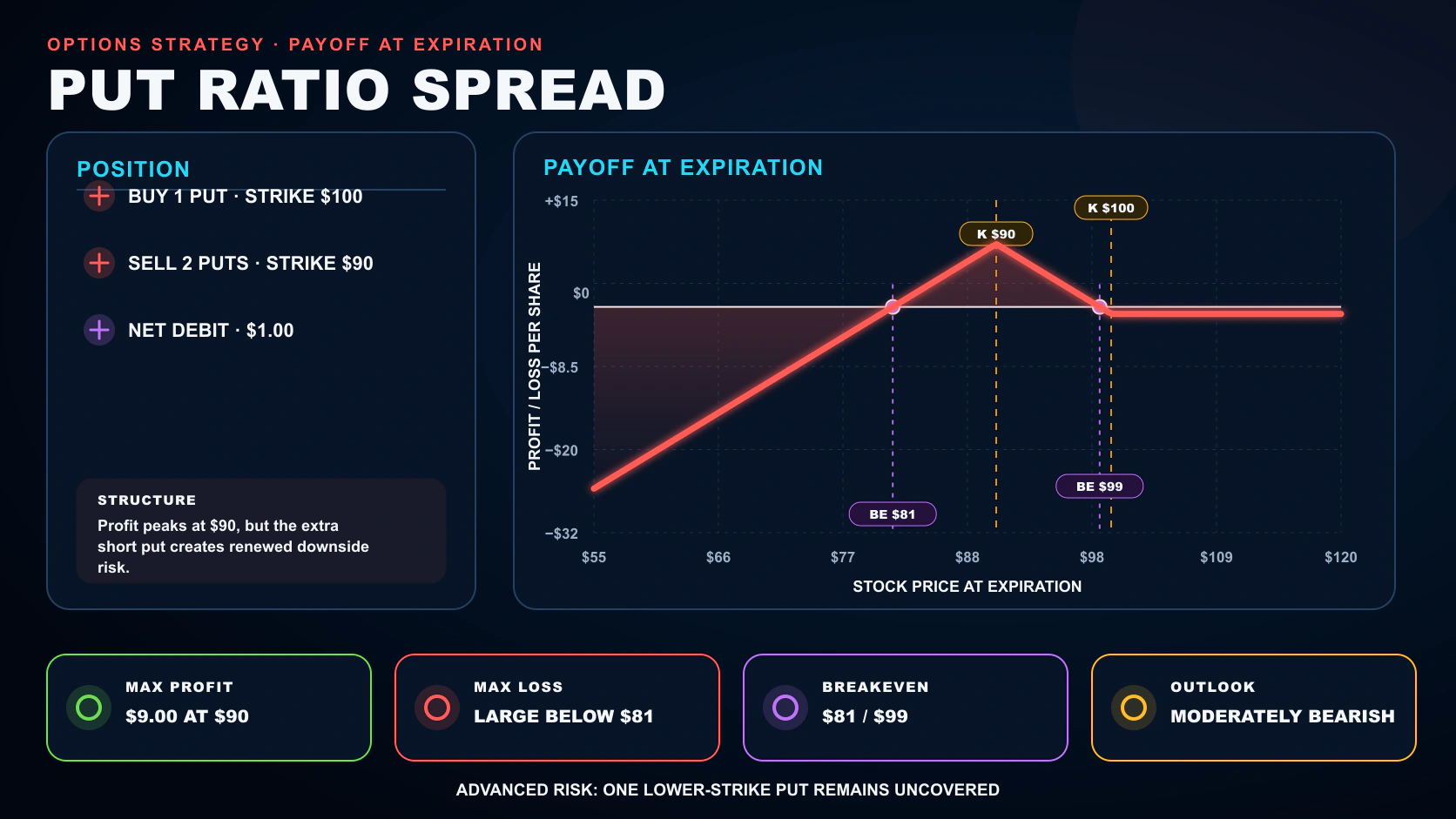
The most common version, a 1-by-2 put ratio spread, has two legs at the same expiration: buy 1 put at a higher strike (K1), and sell 2 puts at a lower strike (K2, below K1). The premium from selling two puts typically exceeds, or nearly offsets, the cost of the single long put, so the trade is usually opened for a small net credit (occasionally a small net debit, depending on strikes and implied volatility skew). One of the two short puts is "covered" by the long put — together they behave like a normal bear put spread. The second short put has nothing offsetting it: it is fully naked, and it is the source of this strategy's outsized downside risk.
Payoff at Expiration
Three zones matter at expiration. At or above the long strike (K1), both puts expire worthless and profit equals whatever net credit was collected (or the position loses the small net debit paid). Between the two strikes, the long put gains value as the stock falls while the short puts stay out of the money, so profit grows the closer the stock gets to the short strike, peaking exactly at K2. Below the short strike, the long put's value is fully offset by one of the short puts, but the second, naked short put loses value dollar-for-dollar as the stock keeps falling — with a 1-by-2 spread, losses grow $1 per share for every $1 the stock falls below the short strike; a wider ratio (1-by-3, for example) would lose even faster.
Max Profit, Max Loss, Breakeven
| Max Profit | (Long strike − short strike) + net credit received (or − net debit paid), realized if the stock finishes exactly at the short strike at expiration. |
| Max Loss | Large and growing dollar-for-dollar as the stock falls below the breakeven price. Technically capped only because a stock cannot trade below zero — it is not truly unlimited the way a naked short call's risk is, but it can still be a very large loss relative to the credit collected. |
| Breakeven | Short strike − (long strike − short strike) − net credit received (or + net debit paid). This is the single downside breakeven that matters; above it, at every stock price, the position is at or above breakeven. |
Worked Example
ABC trades at $80.00. You expect the stock to drift lower over the next several weeks but not collapse. You buy 1 ABC 75 put for $3.00 and sell 2 ABC 65 put for $1.60 each.
| ABC trading @ $80.00 | |
| Buy 1 ABC 75 Put @ $3.00 | ($300.00) |
| Sell 2 ABC 65 Put @ $1.60 | $320.00 |
| Net credit | $20.00 |
On a per-contract basis (1 long put + 2 short puts, 100 shares each):
- Above $75 at expiration: all puts expire worthless. You keep the $20.00 net credit.
- At $65 at expiration (max profit): the 75 put is worth $10.00 ($1,000.00) and the two 65 puts expire worthless. Profit = $1,000.00 + $20.00 credit = $1,020.00.
- Downside breakeven: $65 − ($75 − $65) − $0.20 = $54.80. Below $54.80, the position loses money, and every $1.00 further decline in the stock costs about $100.00 per spread (the one naked short put), before commissions.
- At $40.00, for example: the 75 put is worth $35.00, and each 65 put is worth $25.00 (two of them, $50.00 total). Net value = $35.00 − $50.00 = −$15.00 per share, or −$1,500.00 per spread, plus the $20.00 credit collected = a loss of roughly $1,480.00 on a spread that only ever collected a $20.00 credit.
That last line is the point of understanding this strategy before trading it: a $20.00 credit is exposed to a loss more than seventy times its size if the stock falls hard enough. Multi-leg commissions on the long put and both short puts, plus the bid-ask spread on each leg, further erode the modest credit collected up front.
When Traders Use It
Put ratio spreads suit traders with a specific, moderately bearish thesis: they expect the stock to fall to roughly a certain level and stabilize there, not crash through it. Selling the extra put lowers or eliminates the net cost of the long put, which can make the trade attractive when the trader is fairly confident the stock will not fall much further than the short strike, in exchange for taking on the tail risk of a much larger decline.
Main Risks
- Naked short put exposure: the defining risk. One of the two short puts has no offsetting long option, so a sharp, sustained decline produces losses far larger than the credit collected.
- Assignment risk: short puts can be assigned any time they are in the money. With two short puts, assignment can mean buying 200 shares at the short strike — a significant capital commitment.
- Margin requirements: brokers require margin well beyond what the net credit collected would suggest; this is not a strategy for a basic cash account.
- Easy to confuse with a put back spread: a put back spread buys more puts than it sells and is a long-volatility trade that profits from a big move down, with limited risk. A put ratio spread does the opposite — sells more than it buys — and wants the stock to stay near the short strike instead. Mixing the two up means mixing up which side carries the naked exposure.
FAQs
What makes a put ratio spread different from a bear put spread?
A bear put spread buys and sells one put each, so risk is fully defined and limited to the net debit paid. A put ratio spread sells an extra put, which lowers or eliminates the debit but adds a large, naked downside risk the bear put spread doesn't have.
Can a put ratio spread lose money if the stock goes up?
Only in a limited way. If the stock rises above the long strike, both puts expire worthless and the most you lose is any net debit paid (or you keep the net credit if one was collected). The dangerous risk is entirely to the downside.
Why would a trader accept this downside risk for a small credit?
Typically because they hold a specific view that the stock will decline only moderately, to around the short strike, and consider a sharp further decline unlikely. That view can be wrong, which is why this is an advanced strategy rather than a routine income trade.
How much margin does a put ratio spread require?
More than the net credit would suggest. Because one short put is naked, brokers typically calculate margin as if that put were an uncovered short put, requiring meaningful buying power reserved against assignment.
What ratio besides 1-by-2 is common?
1-by-2 is most common, but some traders use 1-by-3 or wider for a larger credit and steeper naked exposure. The more puts sold relative to puts bought, the faster losses accelerate below the short strike.
Conclusion
A put ratio spread trades a small, defined credit for a large, only-technically-capped downside risk, and that trade-off has to be the first thing a trader internalizes before using it. It rewards a precise, moderately bearish forecast — the stock settling near the short strike — and punishes a forecast that turns out too optimistic about how far the decline goes. Given the margin requirements and the naked short put at its core, this strategy is best reserved for experienced traders who fully model the downside before placing the trade, not for anyone drawn in by the modest credit alone.