Calendar Spread
Updated Aug 29, 2026 · Reviewed by Terence Scott, founder
- Outlook
- Neutral, expecting the stock to stay near the strike short-term
- Max Profit
- Not a fixed formula, depends on implied volatility at the front expiration
- Max Loss
- Net debit paid to open the spread
- Breakeven
- Approximate, depends on volatility; not a single fixed price
- Complexity
- Intermediate
On this page
A calendar spread — also called a time spread or horizontal spread — profits from the passage of time itself rather than from a directional move in the stock. It is built from two options at the same strike and the same type (both calls or both puts) but different expiration dates, and it works best when the stock sits close to the strike as the near-term option expires. Unlike most spreads in this series, a calendar spread has no clean maximum-profit formula, because its value at the front expiration depends on the far option's remaining implied volatility, not just on the stock price.
How a Calendar Spread Is Built
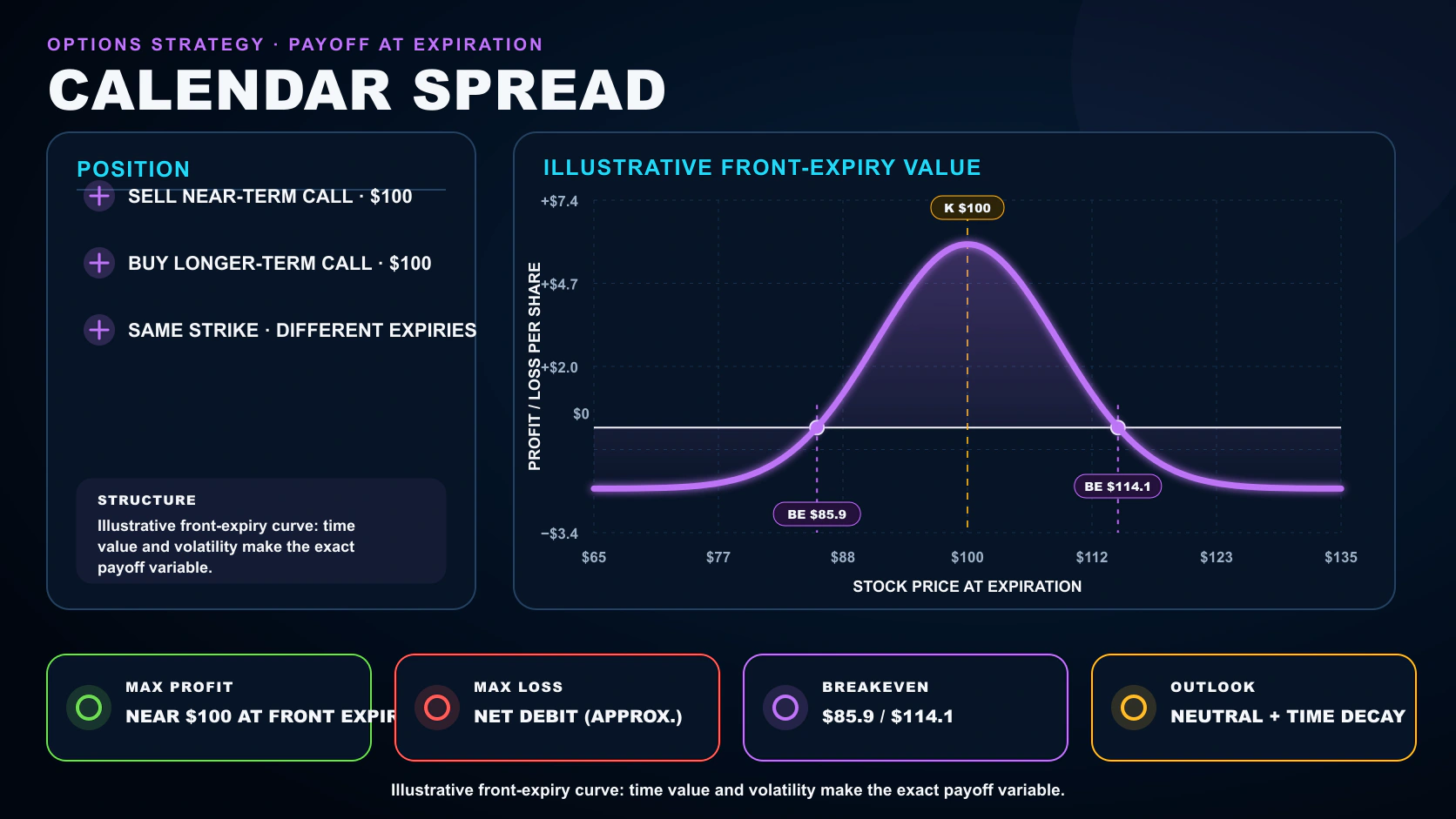
A long calendar spread (the standard version) has two legs at the same strike: sell 1 near-term option (the "front month") at strike K, and buy 1 longer-dated option (the "back month") at the same strike K. Both legs are calls, or both are puts — the strategy works either way and the two versions behave similarly near the strike. The trade is opened for a net debit, since the longer-dated option always carries more time value than the shorter-dated one at the same strike. That net debit is the most you can lose.
The name "horizontal" spread comes from how option chains are traditionally laid out: expiration months run left to right while strike prices run top to bottom — so a spread across expirations at one strike is horizontal, while a spread across strikes within one expiration, like a bull call spread, is vertical.
Why It Works: Uneven Time Decay
Time decay (theta) accelerates as an option approaches expiration and is more pronounced, in percentage terms, on shorter-dated options. A calendar spread is short the fast-decaying near leg and long the slower-decaying far leg, so if the stock stays near the strike, the near leg loses value faster than the far leg — widening the spread between them and increasing the position's value.
The best outcome is the stock sitting almost exactly at the strike when the near-term option expires worthless, leaving the trader still holding the valuable longer-dated option to sell or hold further. A large move away from the strike in either direction hurts the position, because it pushes both options toward the same in-the-money or worthless outcome and narrows the spread between them.
Max Profit, Max Loss, Breakeven
| Max Profit | No fixed formula. It depends on the far option's implied volatility and remaining time value when the near option expires — higher implied volatility on the far leg at that point means a more valuable spread. Traders estimate it with an options pricing model rather than a simple calculation. |
| Max Loss | Limited to the net debit paid to open the spread, realized if the stock moves far enough from the strike that both options end up worthless (for calls, a large decline) or both deep in the money with the same intrinsic value spread as at entry. |
| Breakeven | Not a single fixed price. There is an approximate range around the strike where the position is profitable at the front expiration, but its exact edges shift with implied volatility, so it is best checked with a pricing model or broker's risk graph rather than a formula. |
Worked Example
ABC trades at $90.00. You believe the stock will stay roughly range-bound over the next month, then possibly move more afterward. You sell the June 90 call for $3.00 and buy the July 90 call for $4.50.
| ABC trading @ $90.00 | ||
| June (near) | July (far) | |
| ABC 90 Call price | $3.00 | $4.50 |
| Time to expiration | 4 weeks | 8 weeks |
The net debit is $4.50 − $3.00 = $1.50 per share, or $150.00 on 1 contract (100 shares) — this is the maximum possible loss, plus commissions on both legs.
Suppose four weeks pass and ABC is still at $90.00 right as the June call expires worthless. The July 90 call, now with four weeks left instead of eight, might be worth around $3.20 if implied volatility held steady (an illustrative estimate from a pricing model, not a hand calculation). The spread is now worth $3.20, up from the $1.50 paid, for a gain of about $1.70 per share, or $170.00 per contract, before commissions. If implied volatility had instead dropped sharply, the July call could be worth noticeably less even with the stock unchanged — this is the position's long-vega exposure. If ABC had instead moved to $75.00 or $105.00, both calls would be worth very little relative to their original spread, and the position would likely show a loss approaching the full $150.00 debit.
When Traders Use It
Calendar spreads suit traders who expect a stock to be quiet in the near term — consolidating after a move, or simply lacking a catalyst — but who are not ready to make a longer-term directional call. They are also used to position ahead of an anticipated rise in implied volatility on the back-month option, since the far leg's value benefits disproportionately from an IV increase. Traders sometimes roll the position forward by closing the expiring near leg and selling a new near-term option against the same long back-month option.
Main Risks
- Long vega, cuts both ways: the position benefits from rising implied volatility on the back-month option and is hurt by falling implied volatility, independent of where the stock trades. A volatility crush after an anticipated event can hurt even if the stock barely moves.
- Directional risk despite being called "neutral": a sharp move in either direction away from the strike works against the position, since it collapses the time-value spread the trade depends on.
- Early assignment on the short near leg: if the near-term option goes in the money, especially for calls approaching an ex-dividend date, it can be assigned before expiration, leaving the trader with an unplanned stock position alongside the remaining long option.
- Two-leg commissions: opening and later closing or rolling a calendar spread means commissions on both legs each time, which erodes returns on smaller positions.
FAQs
What's the difference between a calendar spread and a vertical spread?
A calendar (horizontal) spread uses the same strike at two different expirations. A vertical spread, like a bull call spread or bear put spread, uses two different strikes at the same expiration.
Why is there no simple max-profit formula for a calendar spread?
Because the position's value when the near-term option expires depends on what the longer-dated option is worth at that moment, and that depends on implied volatility, not just stock price. That makes it fundamentally different from spreads whose expiration value is fixed by strike prices alone.
Does a calendar spread need the stock to stay perfectly still?
No, but it works best when the stock stays reasonably close to the strike. Moderate movement is tolerable; large moves in either direction erode the position's value.
What happens if my short near-term option gets assigned early?
You take on a stock position (short shares if a call was assigned, long shares if a put was assigned) alongside your remaining long option. Most traders close or adjust the position promptly rather than carry the unplanned stock exposure.
Is a calendar spread the same as a diagonal spread?
Not quite. A calendar spread uses the same strike at both expirations. A diagonal spread uses different strikes and different expirations, blending features of both vertical and calendar spreads.
Conclusion
A calendar spread is a time-decay and volatility trade dressed up to look like a simple strike bet. Its defined, limited risk (the net debit) makes it approachable, but its lack of a clean maximum-profit formula means it rewards traders who are comfortable thinking in terms of implied volatility, not just stock price. Anyone running one should watch the far leg's implied volatility as closely as the stock price itself, and plan for early assignment risk on the short near-term leg.