Covered Call
Updated Aug 29, 2026
- Outlook
- Neutral to moderately bullish
- Max Profit
- (Strike − cost basis) + premium, capped
- Max Loss
- Cost basis − premium (stock can fall to zero)
- Breakeven
- Cost basis − premium received
- Complexity
- Beginner
On this page
A covered call pairs 100 shares of stock you already own with a call option you sell against them, collecting premium in exchange for capping how much you can make if the stock rallies hard. It’s a widely used income-oriented strategy, but it does not reduce the underlying risk of owning the stock — a sharp decline can still produce a large loss, cushioned only by the premium collected.
How a Covered Call Is Built
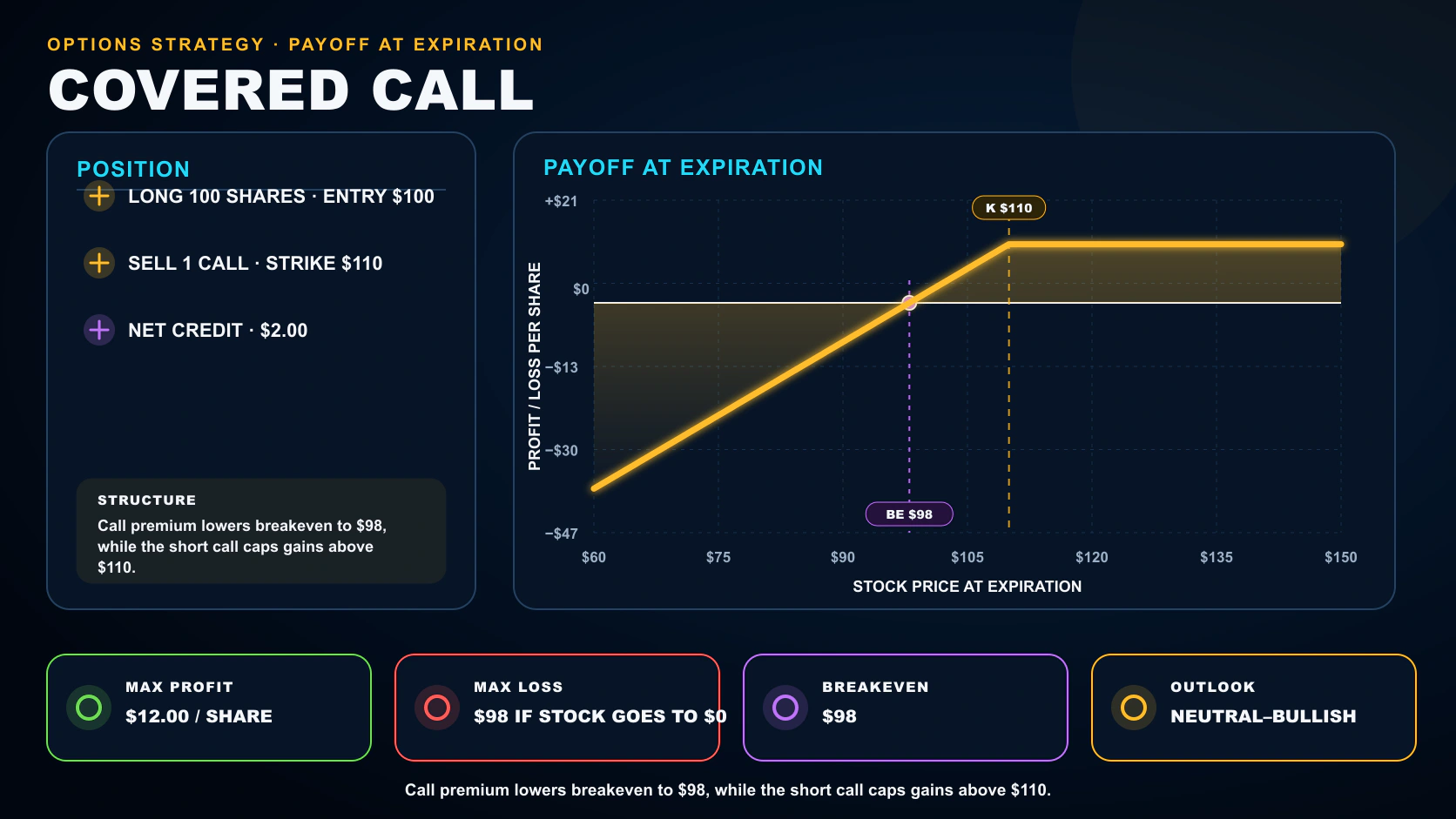
The position has two parts: own (or buy) 100 shares of stock, then sell one call option against those shares, typically at a strike above the current price. Selling a call obligates the writer to deliver 100 shares at the strike price if the option is exercised, and owning the shares already “covers” that obligation — there’s no need to buy stock on the open market to fulfill it, unlike a naked call.
Most covered call sellers choose an out-of-the-money strike and a relatively near expiration, since time decay works in the seller’s favor and shorter-dated options lose time value faster relative to their price.
Payoff at Expiration
| Stock price at expiration | Outcome (100 shares + 1 short call) |
|---|---|
| $35 | Shares worth $3,500, down $1,500 from cost basis; the $150 premium offsets part of the loss |
| $48.50 (breakeven) | Loss on shares exactly offset by the premium received |
| $55 (strike) | Shares called away at $55; maximum profit realized |
| $65 | Shares still called away at $55; same maximum profit — the extra $1,000 of stock upside is forfeited |
Max Profit, Max Loss, and Breakeven
- Max profit: (strike price − stock cost basis) + premium received, capped. This is realized if the stock is at or above the strike at expiration and the shares are called away.
- Max loss: substantial. If the stock falls to zero, the loss is the full cost basis minus the premium collected — the premium is a small cushion, not real protection.
- Breakeven: stock cost basis − premium received per share.
When Traders Use a Covered Call
Covered calls suit an investor who already owns, or is willing to buy, shares for the longer term, has a neutral-to-moderately-bullish outlook over the life of the option, and is comfortable capping the upside in exchange for collecting premium income if the stock does not rally hard. It’s most often used on stable, established names rather than volatile, high-growth stocks, where the forgone upside can be large.
Key Risks
- Uncapped downside, capped upside: the stock can still fall to zero; the premium collected is small relative to that risk. The position is not meaningfully safer than owning the stock outright — it is only slightly cushioned.
- Assignment risk: a short call can be exercised any time it’s in the money, not only at expiration. This risk rises just before an ex-dividend date, when call holders have an incentive to exercise early to capture the dividend, which can result in the shares being called away unexpectedly.
- Opportunity cost: if the stock gaps sharply higher on news, the seller forfeits everything above the strike, no matter how large the move.
- Not free money: rolling the strategy forward every cycle does reduce the effective cost basis over time, but it does not eliminate the stock’s downside risk, and each new call still needs active management.
Worked Example
An investor buys 100 shares of XYZ at $50 ($5,000) and sells the $55 call expiring in 30 days for $1.50 per share ($150 for the contract). The effective cost basis drops to $48.50 per share, which is also the breakeven.
If XYZ finishes at or below $55, the call expires worthless, the investor keeps the $150 premium and the shares, and may sell another call against the same stock. If XYZ finishes at $60, the shares are called away at $55: profit is (55 − 50) × 100 + 150 = $650, the maximum profit on this trade — the additional $500 of upside between $55 and $60 is not captured. If XYZ instead drops to $40, the stock alone is down $1,000, offset by the $150 premium, for a net loss of $850 while the shares are still held.
FAQs
Does a covered call protect against a stock decline?
Only slightly. The premium collected reduces the effective cost basis and offsets a small portion of a decline, but it does not meaningfully protect against a large drop. For real downside protection, see the protective put, which is often combined with a covered call in a “collar.”
What happens if my shares get called away?
The 100 shares are sold at the strike price and removed from the account, and the trader keeps the full premium already collected. A new covered call, or a fresh stock purchase, can be started afterward.
Why does assignment risk increase before a dividend?
A call holder who exercises early captures the next dividend as the new shareholder of record. When the dividend outweighs the call’s remaining time value, early exercise becomes rational for the holder, so in-the-money short calls are more likely to be assigned right before the ex-dividend date.
Should I choose an in-the-money or out-of-the-money strike?
An out-of-the-money strike leaves room for the stock to appreciate before the cap kicks in but collects a smaller premium; an in-the-money strike collects more premium and cushion but caps the stock at a lower profit and is more likely to be assigned.
Is a covered call the same as a naked put?
The two have a similar risk-reward profile — both are net short volatility and profit most when the stock stays flat to moderately higher — but a covered call requires owning the shares first, while a naked put is opened without stock ownership and instead risks having to buy shares at the strike.
Can I lose money on a covered call even after collecting the premium?
Yes. The premium is real income, but it is often small relative to a decline in the stock. A $150 premium provides little offset against a $3,000 drop in the underlying shares.
Conclusion
A covered call trades a portion of a stock’s upside for premium income and a small amount of downside cushion — it is a modest income tool layered on top of stock ownership, not a hedge against a real decline. It fits best on shares an investor is comfortable holding through a flat or moderately rising market, at a strike they would be genuinely satisfied selling at if the shares are called away. For combining a short call with downside protection, see the protective put, and for a bullish credit-spread alternative that doesn’t require stock ownership, see the bull put spread.