Naked Put
Updated Aug 29, 2026
- Outlook
- Bullish to neutral
- Max Profit
- Premium received
- Max Loss
- (Strike − premium) × 100 if stock falls to zero
- Breakeven
- Strike price − premium received
- Complexity
- Intermediate
On this page
A naked put — sold without owning an offsetting position — collects a premium today in exchange for the obligation to buy 100 shares at the strike price if the stock is below it at expiration. When the cash to buy those shares is set aside in advance, the same trade is called a cash-secured put; the payoff is identical either way, but an uncollateralized naked put also carries margin and account-leverage risk beyond the stock-price risk itself.
How a Naked Put Is Built
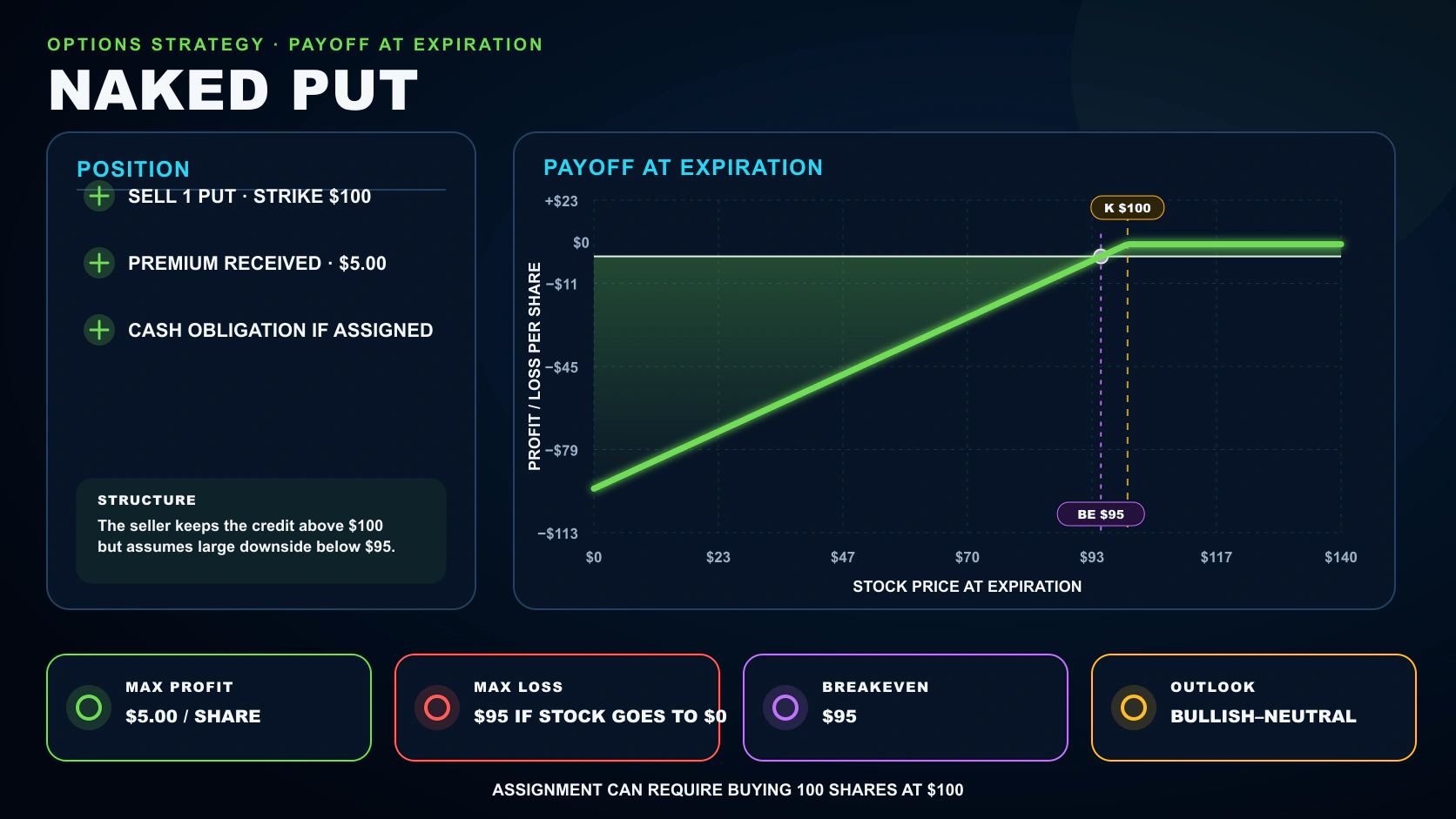
Selling a put obligates the seller to buy 100 shares at the strike price if the buyer exercises the option, which typically happens when the stock is below the strike at or before expiration. The seller collects the premium immediately in exchange for taking on that obligation, with no other position offsetting the risk.
Because puts are American-style and can be exercised at any time, not only at expiration, the seller can be assigned early, though early assignment on puts is less common than on calls and is more likely only when the option is deep in the money with little time value left.
Payoff at Expiration
| Stock price at expiration | Outcome | Net P/L (1 contract) |
|---|---|---|
| $0 | Assigned; buys 100 sh at $50 ($5,000), shares worth $0 | -$4,800 (max loss) |
| $40 | Assigned; buys 100 sh at $50, shares worth $4,000 | -$800 |
| $48 (breakeven) | Assigned; buys 100 sh at $50, shares worth $4,800 | $0 |
| $50 (strike) | At the money; may or may not be assigned | ≈$0 to +$200 |
| $55 | Put expires worthless | +$200 (max profit) |
Max Profit, Max Loss, and Breakeven
- Max profit: the premium received, realized if the stock is at or above the strike at expiration and the put expires worthless.
- Max loss: large. If the stock falls to zero, the loss is (strike − premium) × 100 per contract, since the seller must still buy the shares at the strike while they are worthless.
- Breakeven: strike price − premium received per share.
When Traders Use a Naked Put
A naked put suits a trader who is bullish to neutral on a stock and is genuinely willing to own 100 shares at the strike price if assigned — effectively buying the stock at a discount to today’s price, net of the premium collected. It’s also used purely for the premium income by traders who believe the stock is unlikely to fall below the strike, though that use case still carries the full downside risk if the view is wrong.
Key Risks
- Large, asymmetric loss potential: the maximum profit is limited to the premium collected, while the maximum loss can be many multiples of that premium if the stock falls sharply or goes to zero.
- Assignment can happen early and without warning: a deep in-the-money put can be assigned before expiration, requiring the full purchase price in cash or margin on short notice.
- Overnight and weekend gap risk: bad news, an earnings miss, or a trading halt can gap a stock down well below the strike before there is any chance to close or adjust the position.
- Margin requirements for uncollateralized naked puts: selling puts without setting aside the full cash amount uses margin, and a sharp adverse move can trigger a margin call or forced liquidation of other positions in the account, on top of the loss on the put itself.
Worked Example
XYZ trades at $52. A trader sells the $50 put expiring in 45 days for $2.00 per share, collecting $200 for the contract. Breakeven is $48 ($50 strike − $2.00 premium).
If XYZ finishes at or above $50, the put expires worthless and the trader keeps the full $200 — the maximum profit. If XYZ falls to $40 and the trader is assigned, 100 shares must be bought at $50 ($5,000), while the shares are worth only $4,000; after the $200 premium already collected, the net loss is $800. If XYZ were to fall all the way to $0, the trader would still owe $5,000 for worthless shares, for a maximum loss of $4,800 — a loss more than 20 times the $200 premium originally collected.
FAQs
What’s the difference between a naked put and a cash-secured put?
The payoff is identical, but a cash-secured put has the full purchase price already set aside in cash, so there’s no margin call risk if assigned. A true naked (uncovered) put uses margin instead, which adds leverage and account-level risk on top of the stock-price risk.
Can the loss on a naked put really approach the full value of the shares?
Yes. If the stock goes to zero, the seller still must buy 100 shares at the strike price, so the loss can approach (strike × 100), offset only by the premium collected — a large loss relative to the premium received.
What happens if I get assigned?
100 shares are purchased at the strike price per contract, funded from cash or margin in the account. From that point, the position behaves like any other long stock position and can be held, sold, or used as the basis for a covered call.
Is a naked put the same trade as a covered call?
They have a similar risk-reward shape — both are net short volatility and profit most when the stock stays flat to moderately higher — which is why a cash-secured put is sometimes described as a synthetic covered call. The mechanics differ: a covered call requires owning shares first, while a naked put does not until assignment occurs.
Is there a way to sell puts with less risk than a naked put?
A bull put spread buys a further out-of-the-money put as protection, capping the maximum loss at the width between the strikes instead of leaving it open to the full value of the shares.
Conclusion
A naked put collects a premium that is small relative to the obligation it creates — the maximum profit is fixed and modest, while the maximum loss can be many times larger. It is best used by traders who are genuinely comfortable owning the stock at the strike price, not purely as a source of income, since the downside can be severe in a sharp decline. For a defined-risk alternative, see the bull put spread, and for background on sizing positions relative to account risk, see basic options risk management.