Long Strangle
Updated Aug 29, 2026
- Outlook
- Direction-neutral — expects a large move either way
- Max Profit
- Unlimited upside, large on the downside
- Max Loss
- Total premium paid for both legs
- Breakeven
- Call strike plus total premium (up), put strike minus total premium (down)
- Complexity
- Intermediate
On this page
A long strangle buys an out-of-the-money call and an out-of-the-money put on the same stock with the same expiration date but different strike prices. Like the long straddle, it profits from a large move in either direction and does not care which way the stock breaks — but because both legs start out-of-the-money, it costs less to open than a straddle. That lower cost comes with a tradeoff: the stock has to move further before the position turns a profit.
How a Long Strangle Is Built
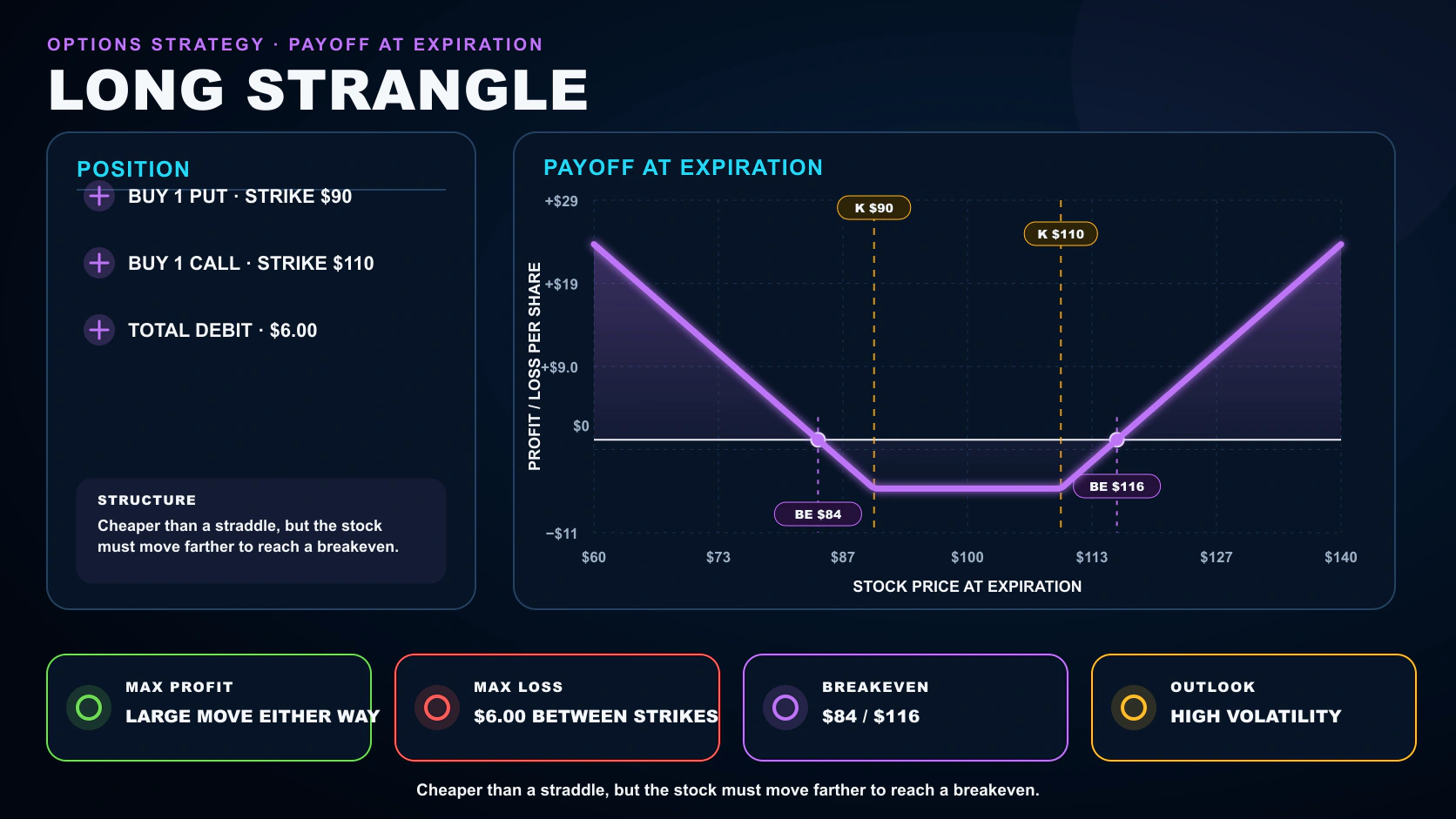
To open a long strangle you buy one out-of-the-money call above the current stock price and one out-of-the-money put below it, both with the same expiration date. The two strikes are not required to be equally spaced from the stock price, though they often are.
Example: stock XYZ is trading at $100. You buy the 110 call for $2.00 and the 90 put for $1.75. Total cost is $3.75 per share, or $375 for one contract of each leg (100 shares per contract), before commissions. That $375 is both the entry cost and the maximum possible loss — noticeably less than the roughly $750 an at-the-money straddle might cost on the same stock, because both legs start with zero intrinsic value.
Payoff at Expiration
- Maximum loss: the total premium paid — $375 in the example — occurs anywhere the stock finishes between the two strikes ($90 to $110) at expiration, since both options expire worthless throughout that entire zone. This is a wider "dead zone" than a straddle has, which is the direct cost of the cheaper premium.
- Maximum profit: theoretically unlimited on the upside above the call strike, and large but bounded on the downside below the put strike (a stock can only fall to $0).
- Two breakevens: one above the call strike, one below the put strike.
Breakeven formulas, in words:
Upside breakeven = call strike + total premium paid
Downside breakeven = put strike − total premium paid
In the example: upside breakeven is $110 + $3.75 = $113.75; downside breakeven is $90 − $3.75 = $86.25. The stock needs to close above $113.75 or below $86.25 for the trade to show a profit at expiration — a wider round trip than the roughly $92.50/$107.50 breakevens a same-strike straddle would need on this stock, since strangle strikes start further from the money.
Payoff Table
| Stock Price at Expiration | Call Value | Put Value | Profit/Loss (per contract pair) |
|---|---|---|---|
| $80 | $0.00 | $10.00 ($1,000) | +$625.00 |
| $86.25 (downside breakeven) | $0.00 | $3.75 ($375) | $0.00 |
| $90–$110 (between strikes) | $0.00 | $0.00 | −$375.00 (max loss) |
| $113.75 (upside breakeven) | $3.75 ($375) | $0.00 | $0.00 |
| $125 | $15.00 ($1,500) | $0.00 | +$1,125.00 |
When Traders Use This Strategy
A long strangle suits the same setups as a long straddle — earnings, litigation outcomes, regulatory decisions, or any binary event where the direction is unknown but a large move is expected — for traders who want to spend less premium and are willing to accept a wider range where the position simply loses everything. It is also sometimes used when a trader wants leverage to a very large move specifically, since the reduced cost means each dollar of premium controls a position that only pays off on a bigger swing.
Main Risks
- Wider dead zone than a straddle: because both legs start out-of-the-money, a move that would have profited a straddle can still be a total loss on a strangle if it doesn’t clear the further-out strikes.
- Time decay: both long options bleed extrinsic value every day the stock stays inside the two strikes, and that decay accelerates into expiration.
- Implied volatility crush: as with a straddle, a strangle bought ahead of a known event can lose value even on a real move if implied volatility collapses once the event has passed and the move fails to clear breakeven by enough to offset it.
- Two commissions, two spreads: both legs carry their own bid-ask spread and commission on entry and exit, which matters more on a strategy that is already cheaper and thinner-margined per leg than a straddle.
Long Strangle vs. Short Strangle
The short strangle sells the same two strikes instead of buying them, collecting premium on the bet that the stock stays between them — with the same unlimited/very-large risk profile on the seller’s side that applies to any short options position.
Long Strangle vs. Long Straddle
A long straddle uses one at-the-money strike for both legs, costs more, and has a narrower dead zone around the strike. The strangle trades a cheaper entry price for a wider range in which it loses money.
FAQs
What is the difference between a straddle and a strangle?
A straddle uses the same strike for the call and put, usually at-the-money. A strangle uses two different strikes, both out-of-the-money, which makes it cheaper to open but requires a bigger move to profit.
What is the maximum loss on a long strangle?
The total premium paid for both legs, lost anywhere the stock finishes between the two strikes at expiration.
What is the maximum profit on a long strangle?
Theoretically unlimited above the call strike, since the long call has no ceiling. Below the put strike, profit is large but bounded because a stock can only fall to $0.
Why would a trader choose a strangle over a straddle?
Lower upfront cost. The tradeoff is a wider range of stock prices — between the two strikes — where the position loses its full premium at expiration.
Does a long strangle suffer from implied volatility crush?
Yes, the same way a long straddle does. If the options were priced for a bigger move than actually happens, a drop in implied volatility after the event can hurt the position even if the stock does move, unless the move is large enough to clear breakeven with room to spare.
Can you use different distances for the call and put strikes?
Yes. Strikes do not have to be equidistant from the current stock price; traders often skew the strikes based on which direction they think is more likely, while still keeping the trade direction-neutral in structure.
Conclusion
The long strangle is a lower-cost cousin of the long straddle, well suited to traders who want exposure to a big directional surprise without committing as much premium — provided they accept that the stock has to travel further before the position becomes profitable, and that time decay and volatility crush work against it in the meantime just as they do against a straddle.