Bull Put Spread
Updated Aug 29, 2026
- Outlook
- Moderately bullish
- Max Profit
- Net credit received
- Max Loss
- Spread width − net credit received
- Breakeven
- Higher strike − net credit received
- Complexity
- Intermediate
On this page
A bull put spread sells a put at a higher strike and buys a put at a lower strike, same expiration, collecting a net credit up front. It’s a defined-risk way to take a moderately bullish or neutral-to-bullish view and get paid to do it, at the cost of a capped, and usually modest, maximum profit.
How a Bull Put Spread Is Built
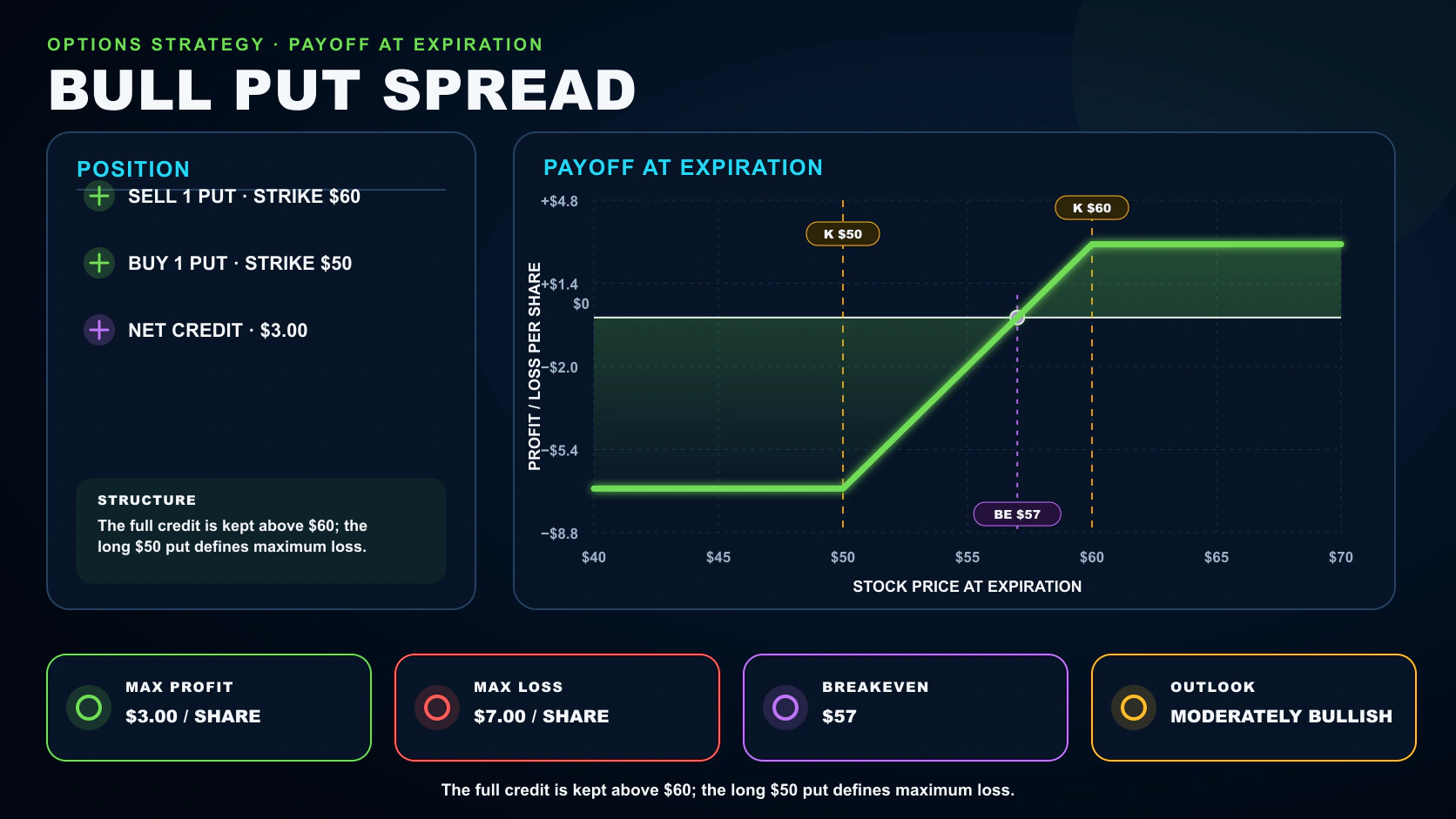
The trade has two legs opened at the same time, same expiration: sell one put at a higher strike, and buy one put at a lower strike as protection. The premium collected from the short put is larger than the premium paid for the long put, so the position is opened for a net credit that is deposited into the account immediately.
The long put is what limits the risk: if the stock falls hard, the long put’s gains offset further losses on the short put below its strike, which is what turns an otherwise open-ended obligation into a defined-risk spread.
Payoff at Expiration
| Stock price at expiration | Outcome | Net P/L (1 spread) |
|---|---|---|
| $90 | Both puts deep in the money; loss floors out | -$320 (max loss) |
| $100 (long strike) | Short put loss no longer grows unmatched | -$320 (max loss) |
| $103.20 (breakeven) | Short put loss exactly offsets the credit | $0 |
| $105 (short strike) | Both puts expire worthless | +$180 (max profit) |
| $110 | Both puts expire worthless | +$180 (max profit) |
Max Profit, Max Loss, and Breakeven
- Max profit: the net credit received, realized if the stock is at or above the higher (short) strike at expiration and both puts expire worthless.
- Max loss: the width between the two strikes minus the net credit received, realized if the stock is at or below the lower (long) strike at expiration.
- Breakeven: higher strike − net credit received per share.
When Traders Use a Bull Put Spread
A bull put spread suits a trader who is moderately bullish or simply expects a stock to hold above a certain level, and prefers a defined-risk, credit-collecting trade over the larger, undefined risk of selling a naked put. Because the broker’s margin requirement for a defined-risk spread is generally close to the maximum loss, it also uses capital more efficiently than an uncovered short put on the same stock.
Key Risks
- Assignment risk on the short put: the short put can be exercised any time it’s in the money, not only at expiration, obligating early purchase of 100 shares at the higher strike before the position is closed.
- Pin risk: if the stock finishes exactly at or very near the short strike, it can be unclear whether the option will be exercised, leaving uncertain post-expiration exposure until assignment is confirmed.
- Max loss can still be sizable: a wide spread between strikes means a larger dollar loss if the stock drops through both strikes, even though the loss is capped.
- Requires margin or collateral: brokers require funds or margin roughly equal to the maximum loss to open the position, which ties up capital for the life of the trade.
Worked Example
XYZ trades at $108.28. A trader sells the $105 put for $3.00 per share and buys the $100 put for $1.20 per share, both expiring the same date. The net credit is $1.80 per share, or $180 for one spread. The spread width is $5.00, so the maximum loss is (5.00 − 1.80) × 100 = $320. Breakeven is $103.20 ($105 − $1.80).
If XYZ finishes at or above $105, both puts expire worthless and the trader keeps the full $180 credit — the maximum profit. If XYZ finishes at $100 or lower, the loss floors out at $320 no matter how much further the stock drops, since the long $100 put’s gains offset the short $105 put’s losses dollar-for-dollar below $100. Between $100 and $105, the outcome scales linearly between the maximum loss and maximum profit.
FAQs
How is a bull put spread different from selling a naked put?
Both profit when the stock holds above the short strike, but a naked put has a much larger maximum loss — up to the full strike value if the stock goes to zero — while the bull put spread’s long put caps the loss at a known amount.
Why would I use a credit spread instead of a naked put if the profit is smaller?
The tradeoff is defined risk and lower margin requirements. A bull put spread cannot produce a catastrophic loss the way an uncovered short put can if the stock craters, which is worth the smaller maximum profit for many traders.
What is pin risk and why does it matter here?
Pin risk occurs when the stock closes right at the short strike at expiration, making it unclear whether the short put will be assigned. Traders often close spreads before expiration when the stock is hovering near the short strike to avoid this uncertainty.
How much margin does a bull put spread require?
Brokers typically require collateral close to the maximum loss (spread width minus credit received), since that is the most the position can lose — far less than the margin or cash required to secure a naked put on the same stock.
Is a bull put spread the opposite of a bear call spread?
They are both credit spreads with defined risk, but a bull put spread is bullish and uses puts, while a bear call spread is bearish and uses calls. They are not exact mirror images of each other, but they share the same credit-spread mechanics.
Conclusion
A bull put spread collects a modest, defined credit for taking on a defined, known-in-advance risk if a stock holds above a chosen level. It trades the larger, uncapped profit potential of a naked put for a much smaller and more predictable maximum loss. For the debit-spread mirror of this trade, see the bull call spread, and for background on margin and position sizing, see basic options risk management.