Long Straddle
Updated Aug 29, 2026
- Outlook
- Direction-neutral — expects a large move either way
- Max Profit
- Unlimited upside, large on the downside
- Max Loss
- Total premium paid for both legs
- Breakeven
- Strike plus total premium (up), strike minus total premium (down)
- Complexity
- Intermediate
On this page
A long straddle buys a call and a put at the same strike price and the same expiration date, almost always at-the-money. The trade does not care which way the stock moves — it needs the stock to move a lot, in either direction, before expiration. It is the classic way to position for a big event, such as earnings or an FDA decision, when a trader is confident volatility is coming but has no edge on direction.
How a Long Straddle Is Built
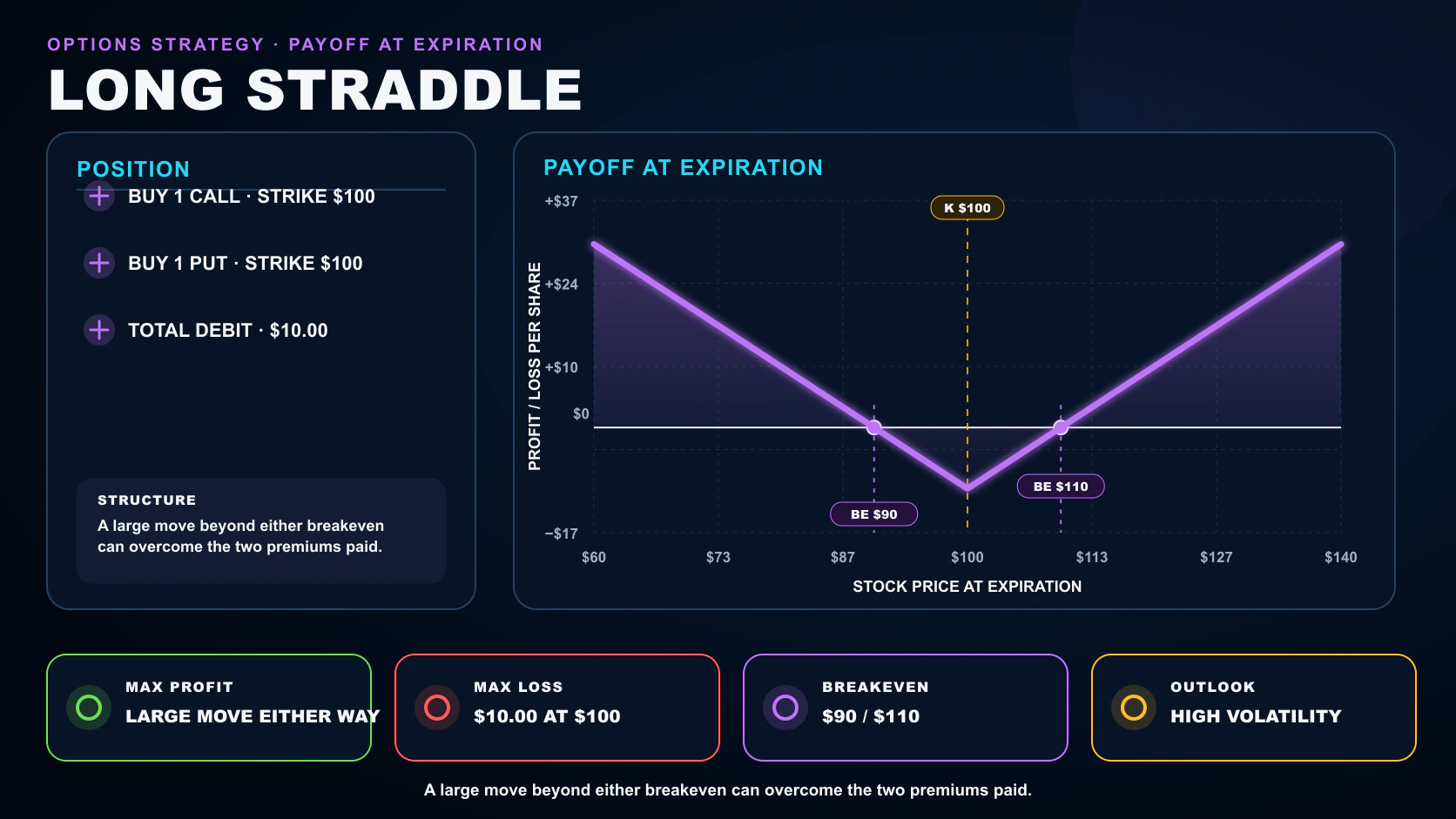
To open a long straddle you buy one call and one put on the same underlying stock, with the same strike price and the same expiration date. Because the position is long both an at-the-money call and an at-the-money put, it is always opened for a net debit — you pay two premiums up front and that combined cost is the entire amount at risk.
Example: stock XYZ is trading at $100. You buy the 100 call for $4.00 and the 100 put for $3.50. Total cost is $7.50 per share, or $750 for one contract of each leg (100 shares per contract, so $750 all-in before commissions). That $750 is both your entry cost and your maximum possible loss.
Payoff at Expiration
At expiration, only one of the two legs can have value (the stock cannot be above and below $100 at once), so the payoff depends entirely on how far the stock has moved away from the strike:
- Maximum loss: the total premium paid for both legs — $750 in the example above — occurs if the stock finishes exactly at $100, the strike price. Both options expire worthless.
- Maximum profit: theoretically unlimited on the upside, since a stock can rise indefinitely and the long call has no cap. On the downside, profit is large but capped by the fact that a stock cannot fall below $0 — the put can be worth at most the strike price.
- Two breakevens: the position needs the stock to move beyond one of two prices to turn a profit.
Breakeven formulas, in words:
Upside breakeven = strike price + total premium paid
Downside breakeven = strike price − total premium paid
In the example: upside breakeven is $100 + $7.50 = $107.50; downside breakeven is $100 − $7.50 = $92.50. The stock has to close outside that $92.50–$107.50 range at expiration for the trade to show a profit — inside that range, the position loses money, with the full $750 lost only if the stock lands exactly on $100.
Payoff Table
| Stock Price at Expiration | Call Value | Put Value | Profit/Loss (per contract pair) |
|---|---|---|---|
| $85 | $0.00 | $15.00 | +$750.00 |
| $92.50 (downside breakeven) | $0.00 | $7.50 | $0.00 |
| $100 (strike, worst case) | $0.00 | $0.00 | −$750.00 (max loss) |
| $107.50 (upside breakeven) | $7.50 | $0.00 | $0.00 |
| $115 | $15.00 | $0.00 | +$750.00 |
When Traders Use This Strategy
A long straddle fits situations where a trader expects a sharp move but does not know which direction it will break — ahead of earnings, a major court ruling, an FDA approval decision, or a binary macro event. Because the strategy profits from movement in either direction, it is sometimes described as being "long volatility" rather than long or short the stock.
Main Risks
- Time decay (theta): both options lose value every day the stock fails to move, and that decay accelerates as expiration approaches. A long straddle held through a quiet stretch bleeds value continuously.
- Implied volatility crush: the classic failure mode is buying a straddle into an earnings report, watching the stock move, and still losing money because implied volatility collapses the moment the news is out. The stock has to clear the breakeven by enough to overcome that volatility drop, not just tick past it.
- Two commissions, two spreads: both legs carry their own bid-ask spread and commission, on entry and exit — a real cost on a trade that already needs a large move to work.
- Needs a genuinely large move: a stock that drifts modestly will still produce a loss, since the combined premium of the two legs sets a real hurdle on both sides.
Long Straddle vs. Short Straddle
The short straddle is the mirror image: selling the same call and put to collect premium, betting the stock stays near the strike. Where the long straddle has capped, known risk and open-ended reward, the short straddle has capped reward and open-ended risk — the two are opposite bets on the same pair of contracts.
Long Straddle vs. Long Strangle
A long strangle buys an out-of-the-money call and an out-of-the-money put at different strikes instead of one at-the-money strike. It costs less to put on than a straddle but needs an even bigger move to reach breakeven, since the stock has to clear two separated strikes rather than one.
FAQs
What is the maximum loss on a long straddle?
The total premium paid for both the call and the put, no more. That loss occurs only if the stock finishes exactly at the strike price at expiration.
What is the maximum profit on a long straddle?
Theoretically unlimited on the upside because the long call has no ceiling. On the downside, profit is large but bounded, since the stock can only fall to $0.
Why can a long straddle lose money even if the stock moves?
If implied volatility was priced for a bigger move than what actually happened — common right after earnings — the drop in implied volatility (an IV crush) can shrink both options' value even as the stock moves, especially if the move doesn’t clear the breakeven by a wide margin.
Is a long straddle a bullish or bearish strategy?
Neither — it is direction-neutral. It profits from a large move in either direction and is a bet on volatility, not on which way the stock goes.
How does time decay affect a long straddle?
Both long options lose extrinsic value every day the stock does not move, and that decay speeds up in the final weeks before expiration. A long straddle is a race between a big enough move and the daily erosion of premium.
Conclusion
The long straddle is a direct, high-conviction bet that a stock is about to move sharply without a view on direction — defined, known risk in exchange for a real hurdle to clear on both sides. It is best reserved for situations with a genuine catalyst, since the combination of time decay and potential volatility crush makes it an expensive way to simply wait around for something to happen.