Long Put
Updated Aug 29, 2026 · Reviewed by Terence Scott, founder
- Outlook
- Bearish
- Max Profit
- Strike price minus premium paid, per share (capped, since a stock cannot trade below zero)
- Max Loss
- Premium paid, in full
- Breakeven
- Strike price minus premium paid
- Complexity
- Beginner
On this page
A long put is the most direct way to profit from an expected decline in a stock: buy a put option, and if the shares fall below the strike price before expiration, the put gains value. It is also used defensively, as insurance on shares you already own. Either way, the appeal is the same — a small, clearly defined maximum loss against a large (though not literally unlimited) profit potential if the stock falls hard.
How a Long Put Works
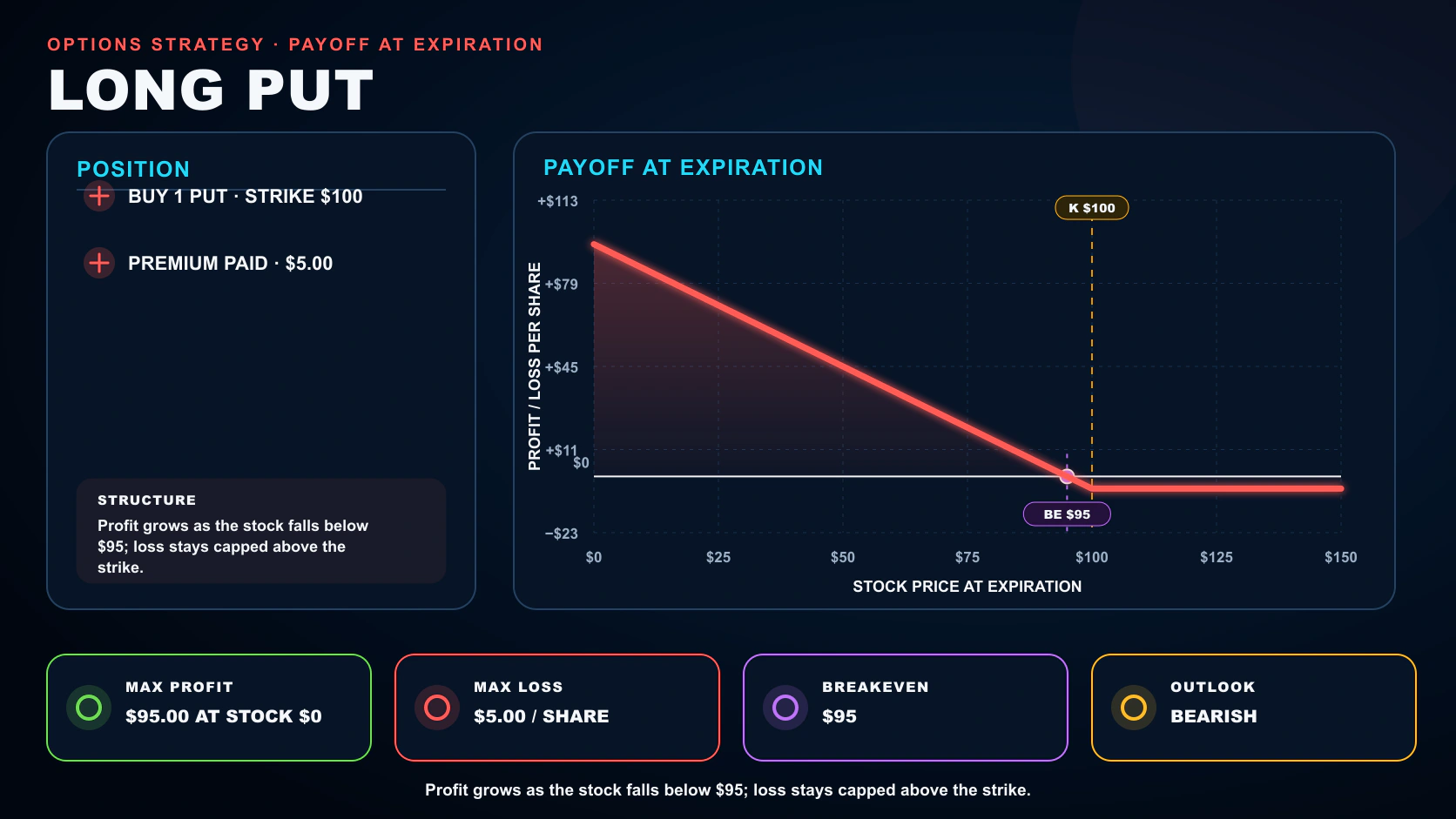
Buying a put gives you the right, but not the obligation, to sell 100 shares of the underlying stock at the strike price on or before expiration. You pay a premium for that right. If the stock is below the strike at expiration, the put has intrinsic value; if it is at or above the strike, the put expires worthless and you lose the premium.
Traders reach for a long put instead of short selling the stock outright for one reason: a short stock position can lose money without limit if the stock rallies, while a long put's downside is capped at the premium paid. There is no margin call risk, no obligation to borrow shares, and no exposure to a short squeeze.
Max Profit, Max Loss, and Breakeven
The math behind a long put is straightforward:
- Max loss = the premium paid, in full. This occurs at any stock price at or above the strike at expiration, when the put expires worthless.
- Max profit = strike price minus premium paid, per share. It is technically capped rather than unlimited, because a stock can only fall to zero — but on an $80 strike bought for $2.50, that ceiling is $77.50 per share, or $7,750 per contract, which for practical purposes behaves like an open-ended payout.
- Breakeven = strike price minus premium paid. Below this price at expiration the position shows a profit; above it, a loss (up to the full premium).
Time decay (theta) works against a long put every day it is held. Even if the stock is drifting in the right direction, the put can still lose value if it drifts too slowly, since extrinsic value erodes as expiration approaches.
Worked Example
Suppose XYZ is trading at $84 and you buy one put with an $80 strike, expiring in six weeks, for $2.50 per share ($250 for the one-contract, 100-share position).
| Stock at Expiration | Put Value (per share) | Profit/Loss (100 shares) |
| $90 (rallies) | $0.00 | -$250 (max loss) |
| $80 (at strike) | $0.00 | -$250 (max loss) |
| $77.50 (breakeven) | $2.50 | $0 |
| $68 (declines) | $12.00 | +$950 |
At $68, the put's intrinsic value is the $80 strike minus the $68 stock price, or $12 per share. Subtracting the $2.50 premium leaves a $9.50-per-share profit, or $950 on the one-contract position, well above the $250 that was ever at risk.
When Traders Use a Long Put
A long put shows up in two very different roles. As a speculative position, it lets a trader express a bearish view on a stock, an ETF, or an index with defined risk and more leverage than shorting shares outright. As a hedge — commonly called a protective put — an investor holding shares buys puts against the position to set a floor under losses ahead of an earnings report or other binary event, without having to sell the stock.
Traders who want bearish exposure at a lower net cost, and who are willing to give up some upside in exchange, often compare a long put against a bear put spread, which partially finances the premium by selling a lower-strike put.
Risks to Understand
The most important risk is time. Because a long put is a wasting asset, being right about direction but wrong about timing can still produce a loss — if the stock doesn't fall far enough, fast enough, decay can erase the position's value before the move happens. Implied volatility also matters: puts bought when volatility (and therefore premium) is elevated need a larger move just to break even, since a subsequent drop in implied volatility works against the position even if the stock cooperates.
Because you are long the option, there is no assignment risk on this leg — assignment is something a put seller faces, not the buyer. If you intend to actually deliver stock you don't already own by exercising the put, keep in mind that doing so creates a new short stock position, so most traders simply sell the put itself to capture its value rather than exercising it.
Compared with selling puts (a bullish, income-oriented strategy with assignment risk of its own), a long put has a completely different risk profile: the buyer's downside is fixed, and there is nothing to be assigned.
FAQs
Is a long put the same as short selling?
Both profit from a decline, but a long put has a defined, limited loss (the premium), while a short stock position carries loss potential that grows the higher the stock rises. A long put also requires no borrowed shares and no margin call exposure to an unexpected rally.
What happens if the stock doesn't move before expiration?
The put will most likely expire worthless, or with only time value remaining, and the buyer loses some or all of the premium, since a put with no intrinsic value has little reason to hold worth at expiration.
Can I lose more than the premium I paid?
No. Once the put is purchased outright, not as part of a spread involving a short option, the maximum loss is the premium paid, in full, and nothing more.
Should I exercise the put or sell it?
In almost all cases, selling the put to close the position captures its value more efficiently than exercising it, especially while time value remains, because exercising forfeits that remaining time value and, if you don't own the shares, creates a new short stock position.
How does implied volatility affect a long put?
Higher implied volatility raises the premium you pay up front, requiring a bigger move to profit; a drop in implied volatility after you buy can reduce the put's value even if the stock ticks lower, an effect known as vega risk.
A long put remains one of the cleanest ways to express a bearish view or hedge an existing position: the risk is capped and known in advance, and the mechanics are simple enough for a trader working through their first options trade. The tradeoff is time — the stock needs to move in your favor before decay erodes the premium you paid.