Call Back Spread
Updated Aug 29, 2026
- Outlook
- Bullish, expecting a large move
- Max Profit
- Unlimited above the upper breakeven
- Max Loss
- Fixed dollar loss at the long call strike
- Breakeven
- Two points bracket a loss zone at the long strike
- Complexity
- Advanced
On this page
A call back spread, also called a call ratio backspread, sells one call at a lower strike and buys two calls at a higher strike, same expiration, usually for a small net credit. It’s built for a large upward move: the position is fine if the stock stays flat or falls, profits without limit on a hard rally, and has its single worst outcome if the stock lands right at the long strike at expiration.
How a Call Back Spread Is Built
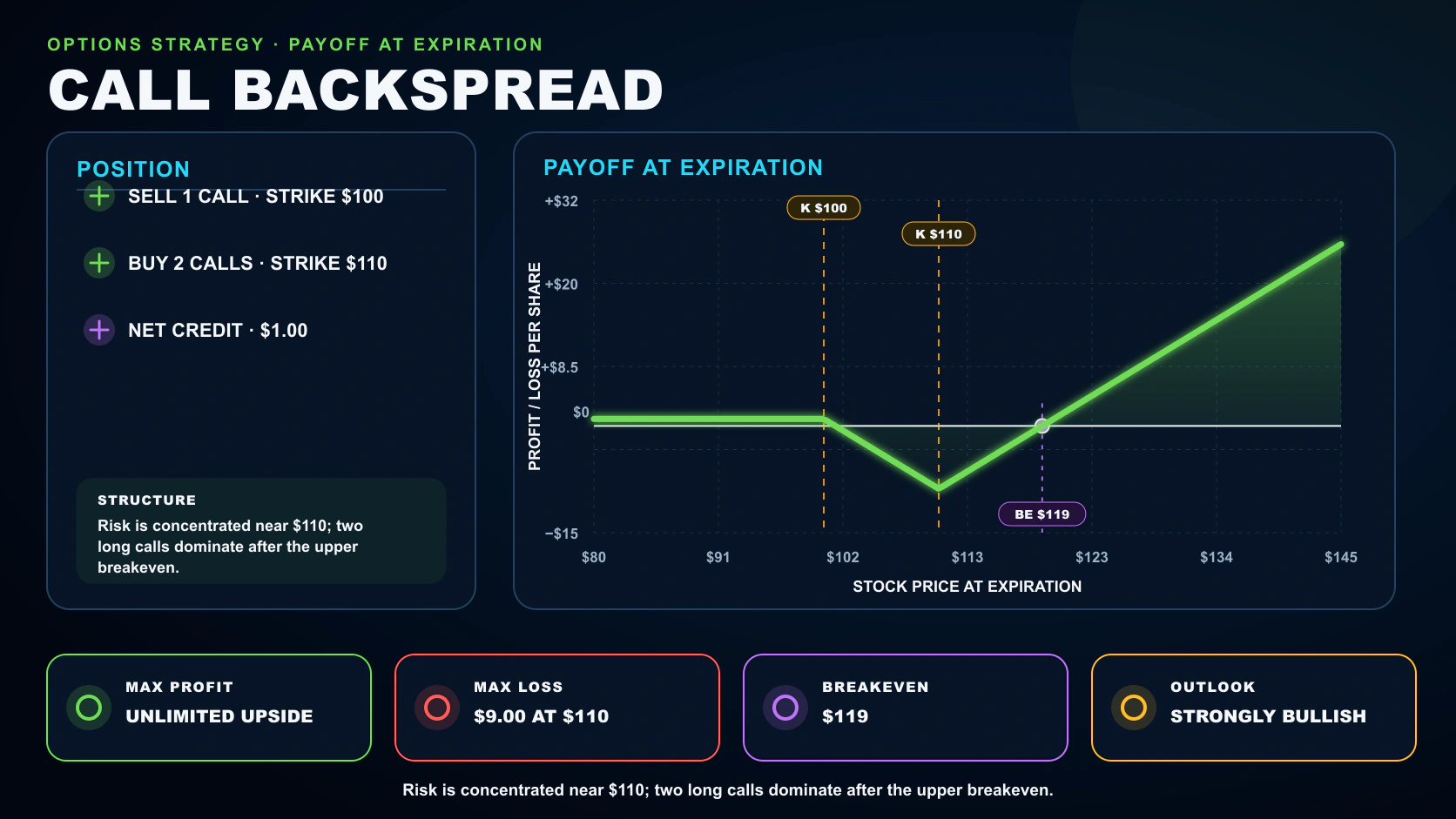
The ratio is what defines this trade: sell 1 call at a lower strike and buy 2 calls at a higher strike, same expiration. Because two long calls are bought against only one short call, the position is net long calls above the higher strike, which is what produces the unlimited upside. The premium from the single short call, plus its typically higher price relative to the further out-of-the-money long calls, often lets the whole structure be opened for a small net credit or a small net debit.
It’s a volatility trade as much as a price trade, benefiting from a large move in the stock or in implied volatility, and it’s used almost exclusively by traders comfortable managing multi-leg positions and assignment risk.
Payoff at Expiration
| Stock price at expiration | Net P/L (1x2 spread) |
|---|---|
| $70 | +$400 (flat — all options worthless, credit kept) |
| $80 (short strike) | +$400 |
| $84 (lower breakeven) | $0 |
| $90 | -$600 |
| $95 (long strike) | -$1,100 (max loss) |
| $100 | -$600 |
| $106 (upper breakeven) | $0 |
| $115 | +$900 |
| $130 | +$2,400 |
Max Profit, Max Loss, and Breakeven
- Max profit: theoretically unlimited above the upper breakeven, since the position holds one extra long call once the stock is above the long strike.
- Max loss: a fixed dollar amount that occurs if the stock finishes exactly at the long call strike at expiration — the single short call has maximum unmatched loss there while the long calls are still worth nothing.
- Breakeven: there are two. A lower one below the long strike, where the position’s profit (from the credit, if the stock stays flat or falls) crosses zero on the way down toward the max-loss point; and an upper one above the long strike, where the gains from the extra long call overtake the accumulated losses on the short call.
When Traders Use a Call Back Spread
This strategy fits a trader who expects a large move — around a binary catalyst such as an FDA decision or a major earnings report — and wants a structure that doesn’t lose money if the move fails to materialize, but still has open-ended upside if it’s big. It’s a poor fit for a trader who expects a modest, gradual rise, since the loss zone sits between the strikes with its worst point at the long strike.
Key Risks
- Assignment risk on the short call: it can be exercised early any time it is in the money, which is more likely just before an ex-dividend date, potentially leaving the trader short 100 shares unexpectedly while still holding the long calls.
- The worst case sits inside the expected move: a stock that rises, but not far enough — landing near the long strike — produces the maximum loss, a common outcome for a stock that moves in the anticipated direction but underdelivers.
- Three contracts, more cost and complexity: commissions, bid-ask spreads, and margin apply across all three legs, and unwinding the position before expiration requires managing them together.
- Volatility risk cuts both ways: a drop in implied volatility after the event (an IV crush) can hurt the long calls’ value even with a somewhat favorable move, particularly if it’s smaller than the market had priced in.
Worked Example
XYZ trades at $87. A trader sells one $80 call for $9.00 per share ($900 credit) and buys two $95 calls for $2.50 per share each ($500 total cost), all expiring the same date. Net credit: $900 − $500 = $400.
At or below $80, all three options expire worthless and the trader keeps the $400 credit. As the stock rises toward $95, the short call’s losses grow while the long calls stay worthless; the position crosses breakeven near $84, then keeps losing until $95 (the long strike), where the loss peaks: $400 − (95 − 80) × 100 = -$1,100. Above $95, the two long calls gain twice as fast as the short call loses, closing the gap and crossing back to breakeven near $106. At $115, the position is worth $400 − (115 − 80) × 100 + 2 × (115 − 95) × 100 = +$900, and gains keep growing without limit as the stock climbs further.
FAQs
Why would this position lose money if the stock goes up?
Between the two strikes, the short call’s loss grows faster than the long calls gain value, since the long calls are still out of the money. The loss reverses only once the stock rises far enough above the long strike for the extra long call to dominate.
What’s the single worst outcome for this trade?
A stock finishing exactly at the long call strike at expiration — the short call has its largest unmatched loss there while the long calls are still worth nothing.
Is a call back spread the same as a bull call spread?
No. A bull call spread buys and sells one call each in a 1:1 ratio for a net debit, with both profit and loss capped. A call back spread uses an uneven ratio, commonly 1:2, for unlimited upside from a large move with a defined loss in between.
What happens if my short call is assigned early?
The trader is suddenly short 100 shares at the short strike while still holding two long calls — a position that typically needs quick resolution, since the resulting short stock carries its own margin and risk profile.
Is the bearish version of this trade called a put back spread?
Yes. The put back spread sells one put at a higher strike and buys two puts at a lower strike, applying the same logic to a large expected downward move.
Conclusion
A call back spread is an advanced, ratio-based structure built for a genuinely large move, not a modest bullish drift — it can often be entered for close to no cost and holds up fine if the stock goes nowhere or falls, but carries a real, defined loss zone centered on the long strike if the move disappoints. It requires comfort with multi-leg management and short-leg assignment risk. For a simpler, single-ratio bullish debit trade, see the bull call spread, and for a refresher on delta and gamma, see the Greeks for beginners.