Bear Call Spread
Updated Aug 29, 2026
- Outlook
- Bearish to neutral
- Max Profit
- Net credit received
- Max Loss
- Spread width minus net credit received
- Breakeven
- Lower (short) strike plus net credit
- Complexity
- Intermediate
On this page
A bear call spread is a defined-risk way to bet that a stock will stay below a certain level through expiration, without the open-ended risk of selling a call outright. It combines a short call at a lower strike with a long call at a higher strike, both expiring on the same date, opened for a net credit collected up front. The tradeoff for that safety net is a capped profit — the most you can make is the credit you received when you opened the trade.
How a Bear Call Spread Is Built
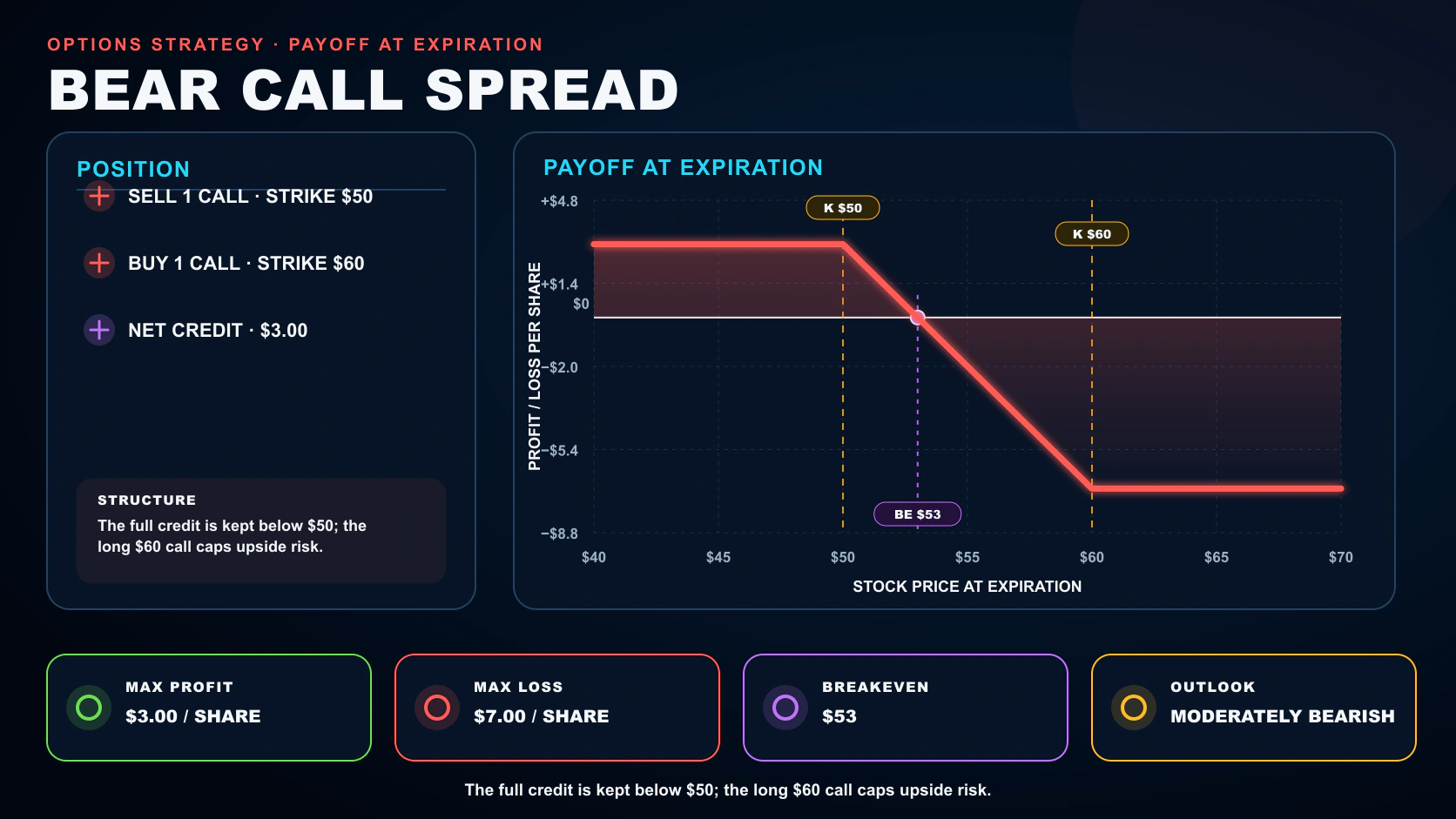
To open the position, sell one call at a strike near or above the current stock price and simultaneously buy one call at a higher strike, same expiration. The premium collected on the short call is larger than the premium paid for the long call, since it sits closer to the money, so the trade generates a net credit deposited into your account immediately.
The long call exists purely as insurance: if the stock rallies hard, its gains offset the mounting losses on the short call once the stock trades above the higher strike, which is what caps the maximum loss. This is the key difference from a naked call, which starts from the same short call but carries no upside protection and therefore unlimited risk.
Max Profit, Max Loss, and Breakeven
- Max profit = the net credit received, realized if the stock closes at or below the short (lower) strike at expiration, so both calls expire worthless.
- Max loss = the width between the two strikes minus the net credit received, realized if the stock closes at or above the long (higher) strike at expiration.
- Breakeven = the lower strike price plus the net credit received.
Worked Example
ABC is trading at $52. You sell one $50 call for $3.20 per share and buy one $55 call for $1.10 per share, a $5-wide spread. The net credit is $3.20 minus $1.10, or $2.10 per share ($210 for the one-contract, 100-share position). Maximum loss is the $5.00 width minus the $2.10 credit, or $2.90 per share ($290 per contract). Breakeven is the $50 short strike plus the $2.10 credit, or $52.10.
| Stock at Expiration | Short $50 Call | Long $55 Call | P/L (per contract) |
| $48 | $0 | $0 | +$210 (max profit) |
| $50 | $0 | $0 | +$210 (max profit) |
| $52.10 (breakeven) | $2.10 | $0 | $0 |
| $55 and above | rises $1-for-$1 | offsets $1-for-$1 | -$290 (max loss) |
Above $55, the long call's gains offset the short call's losses dollar for dollar, which is why the loss never grows past $290 no matter how high the stock trades.
When Traders Use This Strategy
A bear call spread suits a moderately bearish or neutral view: you expect the stock to fall or simply stagnate below the short strike, but aren't confident enough (or the premium isn't rich enough) to justify the open-ended risk profile of a naked call. It's a common alternative to a bear put spread — the call spread collects a credit and benefits from time decay working in its favor, while the put spread pays a debit and needs the stock to actually fall to profit.
Because it is a credit spread, theta helps the position as long as the stock stays below the short strike, and the defined risk means margin requirements are modest compared with an uncovered short call.
Risks and Assignment
The short call carries assignment risk any time it is in the money, since equity options are American-style. Assignment becomes more likely as expiration nears or just before an ex-dividend date, when a call holder may exercise early to capture the dividend if the option's remaining time value is smaller than the payout. If you are assigned, you become short 100 shares per contract, but the long call still caps how much that short position can cost to close.
Because the position is a spread, brokers only require margin equal to the width minus the credit received (in this example, $290 per contract) rather than the far larger, uncapped margin a naked short call would demand.
FAQs
Is a bear call spread better than shorting a call outright?
For most retail traders, yes — the long call caps the loss and dramatically lowers the margin required. The tradeoff is a smaller net credit than selling the call alone.
What if the stock is between the two strikes at expiration?
The short call has intrinsic value that eats into the credit, while the long call is worthless; profit or loss depends on exactly where the stock sits relative to the breakeven price.
Do I need to do anything if both calls expire worthless?
No. If the stock is below the short strike at expiration, both legs simply expire and you keep the full credit, though many traders close the position early to remove pin risk near the strike.
How does implied volatility affect this trade?
A drop in implied volatility after opening the position generally helps a credit spread, since both legs lose extrinsic value, though the short leg, closer to the money, is usually more sensitive.
What's the difference between this and a bull put spread?
A bull put spread is the bullish mirror image, built with puts instead of calls and profiting when the stock stays above the short strike rather than below it.
A bear call spread trades away some upside for a known, bounded risk — a reasonable compromise for traders who want to collect premium on a bearish view without the open-ended exposure of a naked short call.