Collar
Updated Aug 29, 2026
- Outlook
- Neutral to mildly bullish, protecting an existing position
- Max Profit
- Call strike minus stock cost basis, adjusted for net premium
- Max Loss
- Stock cost basis minus put strike, adjusted for net premium
- Breakeven
- Stock cost basis plus net premium paid (or minus net credit received)
- Complexity
- Beginner
On this page
A collar is a hedge, not a speculative bet. You already own 100 shares of a stock, and you want to protect the position from a sharp decline without paying much — or anything — out of pocket. The trade-off is that you also give up the stock's upside above a certain price. Because it caps both the downside and the upside, a collar is best understood as portfolio insurance rather than a way to generate profit.
How a Collar Is Built
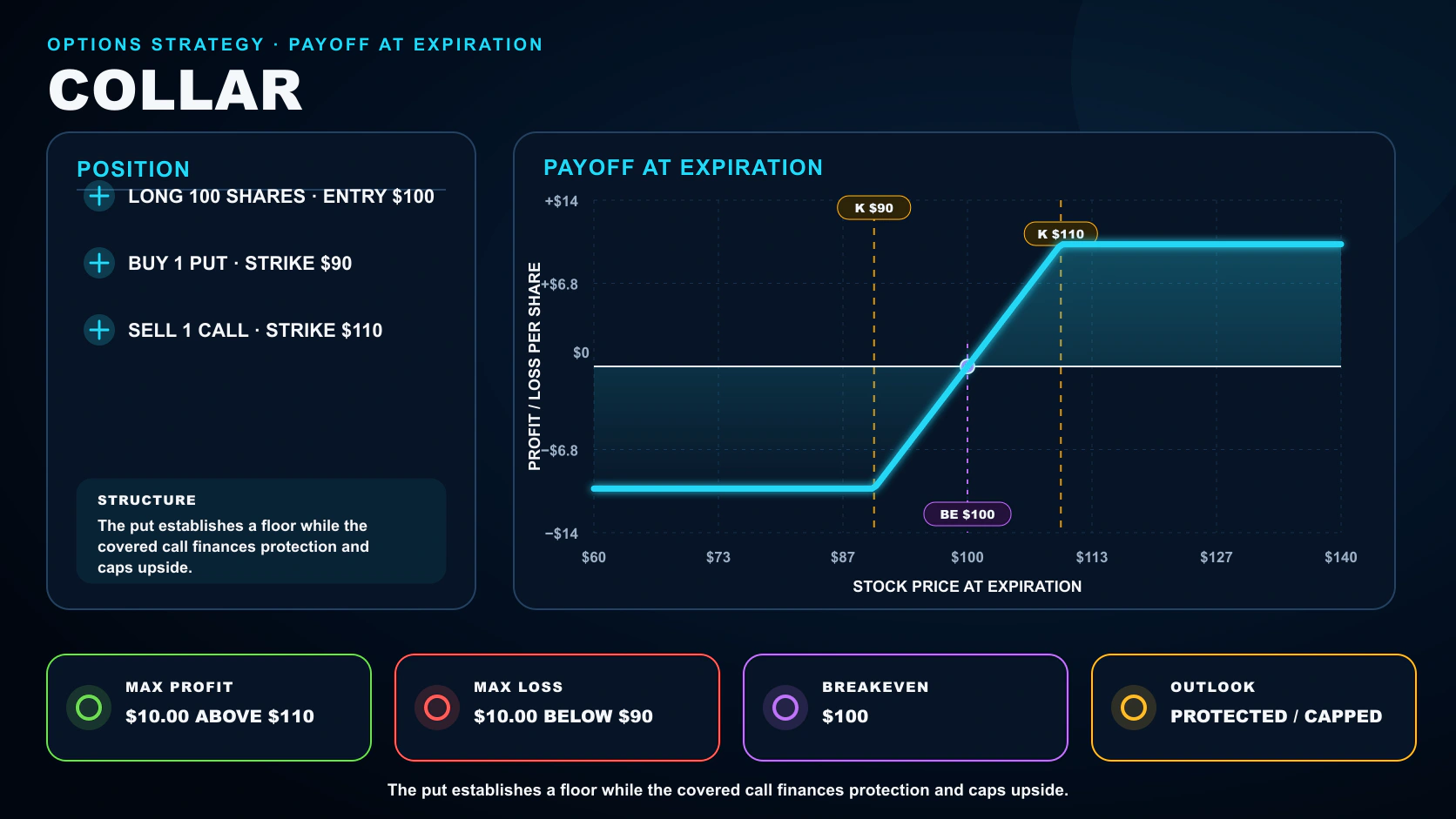
A collar has three parts, all on the same 100 shares:
- Own 100 shares of the underlying stock (the position you already hold).
- Buy 1 protective put with a strike below the current stock price. This sets a floor under your losses.
- Sell 1 covered call with a strike above the current stock price. The premium collected offsets — or fully pays for — the put.
Both options share the same expiration date. When the call premium roughly equals the put premium, the position is called a "costless collar" or "zero-cost collar" because the net cash outlay for the options is close to zero. In practice the two premiums rarely match exactly, so most collars are opened for a small net debit or a small net credit.
This is functionally the same risk profile as a bull call spread built around a long stock position: gains and losses are both bounded. It is also the combination of a protective put and a covered call stacked on top of each other, so it helps to understand each of those individually first.
Payoff at Expiration
Three zones matter at expiration:
- Above the call strike: the stock's gains are capped there because the short call caps the upside — shares are typically called away at the call strike, or you buy the call back at a loss.
- Between the two strikes: both options expire worthless and you simply hold the stock, participating fully in its move within that range.
- Below the put strike: the long put's gains offset further stock losses one-for-one, so the position's value stops falling at the put strike.
Max Profit, Max Loss, Breakeven
Using the stock's original cost basis and the net premium paid (or received) for the two options:
| Max Profit | (Call strike − cost basis) − net premium paid, or + net credit received. Capped once the stock is at or above the call strike. |
| Max Loss | (Cost basis − put strike) + net premium paid, or − net credit received. Floored once the stock is at or below the put strike. |
| Breakeven | Cost basis + net premium paid (or − net credit received) |
Worked Example
You bought 100 shares of ABC at $50.00 (your cost basis). ABC now trades at $52.00 and you want to lock in protection into the next earnings report without selling the stock. You buy 1 ABC 45-strike put for $1.10 and sell 1 ABC 60-strike call for $1.20, both expiring in eight weeks.
| ABC trading @ $52.00, cost basis $50.00 | |
| Own 100 ABC @ $50.00 cost basis | $5,000.00 |
| Buy 1 ABC 45 Put @ $1.10 | ($110.00) |
| Sell 1 ABC 60 Call @ $1.20 | $120.00 |
| Net premium (credit) | $10.00 |
Because the call brought in $0.10 more per share than the put cost, this is a small net-credit collar. On a per-contract basis:
- Max profit: ($60 − $50) × 100 + $10 = $1,010, realized if ABC is at or above $60 at expiration.
- Max loss: ($50 − $45) × 100 − $10 = $490, realized if ABC is at or below $45 at expiration.
- Breakeven: $50.00 − $0.10 = $49.90 per share, essentially your cost basis.
Between $45 and $60 at expiration, both options expire worthless and you keep the shares plus the small net credit.
When Traders Use It
Collars show up most often on concentrated single-stock positions — a large holding from an IPO, restricted stock units, an inheritance, or a position that has grown to dominate a portfolio. Selling the stock outright can trigger a large capital gain, so traders collar it instead to cap the risk while keeping the shares. It is also common ahead of a known binary event, such as earnings, when a trader wants to stay invested but not unhedged into the report.
Some traders run collars on a rolling monthly basis, closing the short call and long put each cycle and opening new ones at updated strikes — effectively renting out upside a month at a time for continuous downside protection. Because this involves selling calls repeatedly against a long-term holding and can affect the character of gains, it's worth checking with an accountant before running one systematically.
Main Risks
- Opportunity cost: if the stock rallies hard past the call strike, you miss the additional upside — the call will very likely be exercised or you will need to buy it back at a loss to keep the shares.
- Early assignment on the short call: American-style equity calls can be assigned before expiration, especially just before an ex-dividend date if the call is in the money and its remaining time value is less than the dividend. Assignment means your shares are called away early.
- Not costless in cash terms: even a "zero-cost" collar has bid-ask spread costs on both legs, and commissions apply to both the put and the call.
- Static protection: once opened, the collar's strikes are fixed; a large move followed by a reversal can leave the hedge poorly positioned unless it is actively managed or rolled.
FAQs
Does a collar cost anything to put on?
It depends on the strikes chosen. A true zero-cost collar selects a call premium that matches the put premium exactly, but in practice one leg is usually slightly more expensive, producing a small net debit or net credit.
Can I lose money on a collar?
Yes, relative to your cost basis, if the stock is below the put strike at expiration — the loss is capped rather than eliminated. You can also underperform buy-and-hold if the stock rallies far above the call strike, since that upside is given away.
What happens if my call gets assigned early?
Your 100 shares are sold at the call strike and you keep the premium already collected. The long put remains open; many traders let it expire or sell it separately once the shares are gone.
How is a collar different from a covered call alone?
A covered call gives up upside above the call strike but has no floor on the downside beyond the premium collected. Adding the protective put is what turns it into a collar.
Do I need margin approval to run a collar?
The covered call requires owning the shares, which most brokers treat as fully covered and low-risk, and the long put is a simple debit purchase, so a collar generally needs only basic options approval.
Conclusion
A collar trades away some upside for a firm floor under a stock position, which makes it a hedging tool first and a profit strategy second. It is most useful for investors who have a large, often low-cost-basis position they want to protect through a specific window of time — earnings, a lockup expiration, a volatile macro stretch — without liquidating the shares outright. Before opening one, map out the exact dollar floor and ceiling in your own cost-basis terms, and factor in commissions on both legs plus any tax or dividend timing considerations tied to early assignment.