Put Back Spread
Updated Aug 29, 2026
- Outlook
- Sharply bearish, expecting a large fast move down
- Max Profit
- Large as the stock falls toward zero; limited to the net credit if flat or higher
- Max Loss
- A defined dollar amount, reached at the long strike price
- Breakeven
- Two points — short strike minus credit, and (2 x long strike) minus short strike plus credit
- Complexity
- Advanced
On this page
A put back spread, also called a put ratio backspread, is built for one specific scenario: a stock you expect to fall hard and fast, more than the option chain seems to be pricing in. It sells one put at a higher strike and buys two puts at a lower strike, all in the same expiration, typically for a small net credit. The payoff is unusual — a modest profit if the stock does nothing, a real loss if it drifts down only a little, and an increasingly large profit if it falls a lot. This is an advanced strategy that depends on getting both the direction and the magnitude of the move right.
How a Put Back Spread Is Built
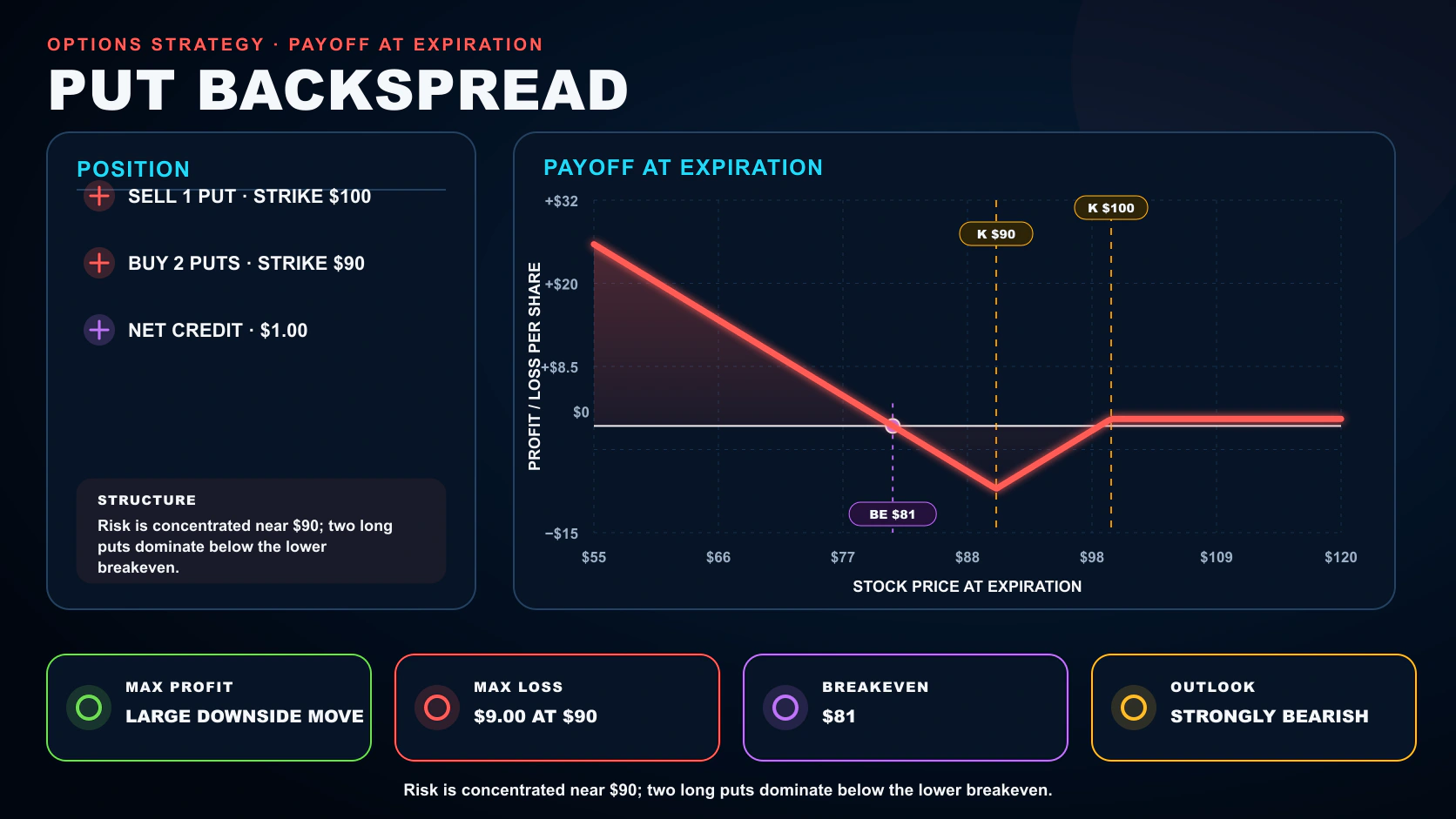
Sell one put at a strike near the current stock price and buy two puts at a lower strike, same expiration. Selling the higher-strike put brings in more premium per contract than each of the lower-strike puts costs, so the position as a whole is typically opened for a small net credit, occasionally a small debit, depending on how the strikes are chosen.
Because there are twice as many long puts as short puts, once the stock falls meaningfully below the lower (long) strike, the long puts' combined gains eventually overtake the short put's loss and the position's value starts climbing again. This is the bearish, put-based version of a call back spread, which uses the same one-short, two-long structure with calls to bet on a big move higher.
Max Profit, Max Loss, and Breakeven
The payoff is not a simple line — it has a plateau, a trough, and then rising profit further out:
- At or above the short strike: all options expire worthless and you keep the net credit received.
- At the long strike (the worst case): the short put carries its full intrinsic loss while the long puts are still worthless, producing the maximum loss, a specific, calculable dollar amount, not an unlimited one.
- Below the long strike: the two long puts gain value twice as fast as the short put loses it, so losses shrink and eventually turn back into profit, growing larger the further the stock falls, capped only because a stock cannot trade below zero.
Two Breakeven Points
Because of the plateau-trough-rise shape, a put back spread has two breakeven prices instead of one:
- Upper breakeven = short strike minus net credit received, per share.
- Lower breakeven = (2 x long strike) minus short strike, plus net credit received, per share.
Worked Example
GHI is trading at $75. You sell one $75 put for $4.50 per share ($450 credit) and buy two $65 puts for $1.30 per share each ($260 total debit). The net credit is $450 minus $260, or $190 for the full position.
| Stock at Expiration | Short $75 Put | Long $65 Puts (x2) | P/L (whole position) |
| $80 or $75 (flat/up) | $0 | $0 | +$190 |
| $73.10 (upper breakeven) | -$190 | $0 | $0 |
| $65 (long strike, worst case) | -$1,000 | $0 | -$810 (max loss) |
| $56.90 (lower breakeven) | -$1,810 | +$1,620 | $0 |
| $50 | -$2,500 | +$3,000 | +$690 |
Notice the shape: profit near the top, a loss that peaks at the long strike, then a recovery back to breakeven near $56.90, followed by growing profit on any further decline. That trough at the long strike is the defining risk of a back spread — the worst outcome is not a huge crash, it's the stock landing almost exactly on the long strike at expiration.
When Traders Use This Strategy
A put back spread is a volatility-and-direction bet: it wants a large downside move, ideally paired with rising implied volatility, which inflates the two long puts more than the single short put. Traders reach for it ahead of binary events with real crash risk — an earnings report, a drug trial readout, a litigation ruling — where a smaller, defined-risk trade like a bear put spread wouldn't fully capture the anticipated move. Compared with a plain long put, the back spread can be opened for a similar or smaller net cost while offering a larger payoff far out of the money, at the expense of the loss zone between the two strikes.
Risks and Assignment
The short put can be assigned any time it is in the money, since equity options are American-style; assignment obligates you to buy 100 shares at the higher strike, but the two long puts remain in place and continue to hedge that exposure. The larger risk is simply the shape of the payoff itself: if the stock ends up anywhere near the long strike at expiration, the position loses money even though the initial trade may have been opened for a credit. This strategy also carries meaningful vega, or volatility, risk in both directions — a volatility crush after an anticipated event, even if the stock does fall, can mute the gains on the long puts.
FAQs
Why would this ever lose money if it was opened for a credit?
The credit only guarantees a profit if the stock stays at or above the short strike. Between the short and long strikes, the short put's growing intrinsic value isn't yet offset by the long puts, producing a real loss that peaks exactly at the long strike.
Is the maximum loss really limited?
Yes. Unlike a naked short put or call, every leg here is either fully hedged or defined at expiration, so the loss at the long strike is a specific, calculable number, not open-ended.
What outlook does this strategy need to be profitable?
Either a stock that stays flat or rises, keeping the small credit, or one that falls sharply past the lower breakeven. A modest decline into the loss zone between the two strikes is the one outcome that hurts.
How does implied volatility affect the position?
Rising implied volatility generally helps, since it inflates the two long puts more than the single short put; a sharp drop in volatility, even alongside a falling stock, can work against the position.
How does this compare with a call back spread?
A call back spread is the bullish mirror image, selling one lower-strike call and buying two higher-strike calls to profit from a large move higher instead of lower.
A put back spread is a specialized tool for a specific belief: not just that a stock will fall, but that it will fall by more than the options market is pricing in. Traders who are less certain about magnitude are usually better served by a simpler, single-breakeven strategy like a long put or a bear put spread.