Short Strangle
Updated Aug 29, 2026
- Outlook
- Neutral — expects the stock to stay in a range
- Max Profit
- Total premium received
- Max Loss
- Unlimited upside, very large on the downside
- Breakeven
- Call strike plus total premium (up), put strike minus total premium (down)
- Complexity
- Advanced
On this page
A short strangle sells an out-of-the-money call and an out-of-the-money put on the same stock, same expiration, at two different strikes. It collects a premium credit up front and profits if the stock stays between the two strikes through expiration — but like the short straddle it carries risk that is unlimited on the upside and very large on the downside. The wider range between the strikes gives the position more room to be right than a straddle, but the tail risk on either side is the same open-ended exposure any short option position carries.
Unlimited Risk, Stated Up Front
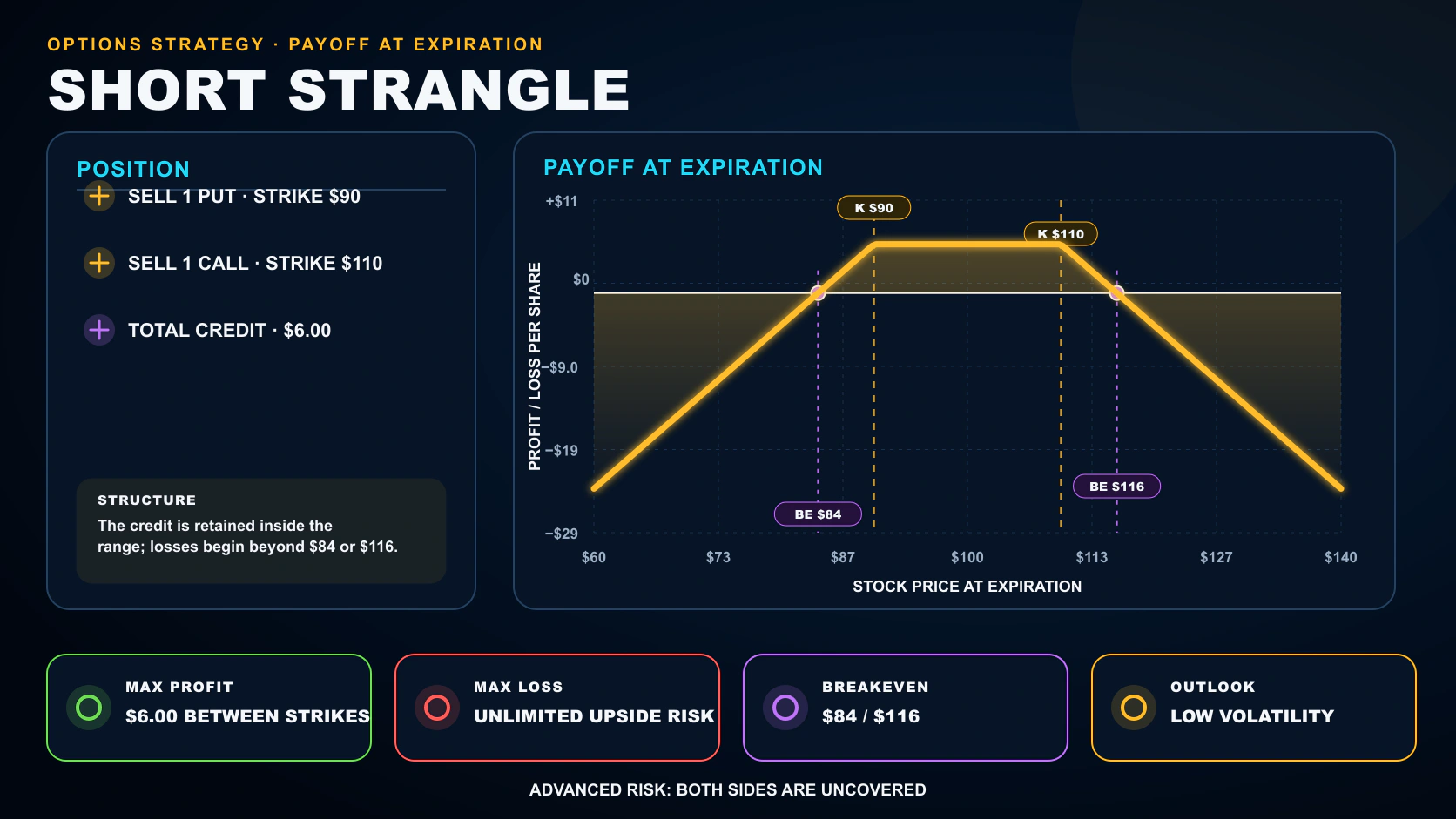
A short strangle’s maximum profit is fixed and known the moment you open the trade: it is the premium collected, full stop. The loss side is not symmetric. If the stock rallies past the short call strike, the loss grows without limit as the stock keeps climbing. If the stock falls past the short put strike, the loss is very large, bounded only by the stock reaching $0. This is a margin-intensive, actively-managed position, not a passive income trade — brokers require meaningful margin against the undefined risk, and either short leg can be assigned early if it moves in-the-money before expiration.
How a Short Strangle Is Built
To open a short strangle you sell one out-of-the-money call above the current stock price and one out-of-the-money put below it, collecting both premiums as an immediate credit.
Example: stock XYZ is trading at $100. You sell the 110 call for $2.00 and the 90 put for $1.75, collecting $3.75 per share, or $375 for one contract of each leg (100 shares per contract), before commissions. That $375 credit is the maximum you can make on the trade, realized in full if the stock finishes anywhere between $90 and $110 at expiration.
Payoff at Expiration
- Maximum profit: the $375 premium received, earned anywhere the stock closes between the two strikes ($90 to $110), since both short options then expire worthless.
- Maximum loss: unlimited above the call strike; very large (bounded only by $0) below the put strike.
- Two breakevens: one above the call strike, one below the put strike, marking where losses begin.
Breakeven formulas, in words:
Upside breakeven = call strike + total premium received
Downside breakeven = put strike − total premium received
In the example: upside breakeven is $110 + $3.75 = $113.75; downside breakeven is $90 − $3.75 = $86.25. Between $86.25 and $113.75 the trade is profitable, with the full $375 gain anywhere between $90 and $110. Beyond either breakeven, losses grow directly with the stock’s move, with no ceiling above $113.75.
Payoff Table
| Stock Price at Expiration | Call Intrinsic Value | Put Intrinsic Value | Profit/Loss (per contract pair) |
|---|---|---|---|
| $80 | $0.00 | $10.00 ($1,000) | −$625.00 |
| $86.25 (downside breakeven) | $0.00 | $3.75 ($375) | $0.00 |
| $90–$110 (between strikes) | $0.00 | $0.00 | +$375.00 (max profit) |
| $113.75 (upside breakeven) | $3.75 ($375) | $0.00 | $0.00 |
| $125 | $15.00 ($1,500) | $0.00 | −$1,125.00 |
Net profit/loss equals the $375 premium collected minus the combined intrinsic value the seller must pay out on whichever short leg finishes in-the-money.
When Traders Use This Strategy
Traders reach for a short strangle when they expect a stock to stay within a defined range and believe implied volatility is overstating how much the stock is likely to actually move. The wider strikes give the stock more room to wander before either side is threatened — a less aggressive version of a short straddle, but still a short-volatility trade with open-ended risk.
Main Risks
- Unlimited loss above the call strike: a sustained rally, a takeover announcement, or a short squeeze can produce losses many times the premium collected, with no ceiling.
- Very large loss below the put strike: a sharp decline, including an overnight gap on bad news, can produce a large loss before there’s any chance to close or adjust the position.
- Assignment risk on both legs: either short option can be assigned early if it moves in-the-money, particularly the call around ex-dividend dates.
- Margin calls: undefined risk means substantial margin requirements that can increase sharply if the trade moves against you.
- Two commissions, two spreads: both legs carry their own bid-ask spread and commission cost on entry and exit, a real drag against a capped, modest maximum gain.
Short Strangle vs. Short Straddle
A short straddle sells one at-the-money strike for both legs. It collects more premium up front but has a narrower profitable range, since the stock only has to move a smaller distance before hitting a breakeven. The short strangle trades some premium income for a wider cushion.
Short Strangle vs. Iron Condor
Traders who want the same "stock stays in a range" thesis without unlimited risk often build an iron condor instead, buying a further-out call and put to cap the loss on both sides. That protection reduces the premium collected in exchange for defined, known maximum risk.
FAQs
What is the maximum profit on a short strangle?
The total premium received when the trade is opened, earned in full if the stock closes anywhere between the two short strikes at expiration.
What is the maximum loss on a short strangle?
Unlimited above the call strike, since a stock’s price has no ceiling. Below the put strike the loss is very large but technically bounded, since a stock cannot trade below $0.
Is a short strangle less risky than a short straddle?
It has a wider profitable range because the strikes start further from the stock price, but the underlying risk profile is the same: unlimited upside risk and very large downside risk. It reduces the frequency of large losses, not their potential size.
Can I be assigned early on a short strangle?
Yes. Either the short call or the short put can be assigned any time it moves in-the-money before expiration, independent of the other leg.
Is a short strangle a good way to generate income?
It generates premium, but calling it "income" downplays the tail risk. A single large move against either leg can erase far more than months of collected premium, so it needs to be managed as a risk position, not a yield strategy.
Conclusion
A short strangle offers a wider margin for error than a short straddle while still collecting real premium, but the core tradeoff does not go away: capped, modest profit potential against unlimited upside risk and very large downside risk. It requires margin, active monitoring, and a specific plan for a large adverse move before it belongs in a portfolio.