Bear Put Spread
Updated Aug 29, 2026
- Outlook
- Bearish
- Max Profit
- Spread width minus net debit paid
- Max Loss
- Net debit paid, in full
- Breakeven
- Higher (long) strike minus net debit
- Complexity
- Intermediate
On this page
A bear put spread is a lower-cost way to position for a decline in a stock than buying a put outright. It pairs a long put at a higher strike with a short put at a lower strike, both expiring on the same date, financing part of the premium by giving up profit potential below the lower strike. The result is a defined-risk, defined-reward trade: you know the most you can make and the most you can lose before you ever place the order.
How a Bear Put Spread Is Built
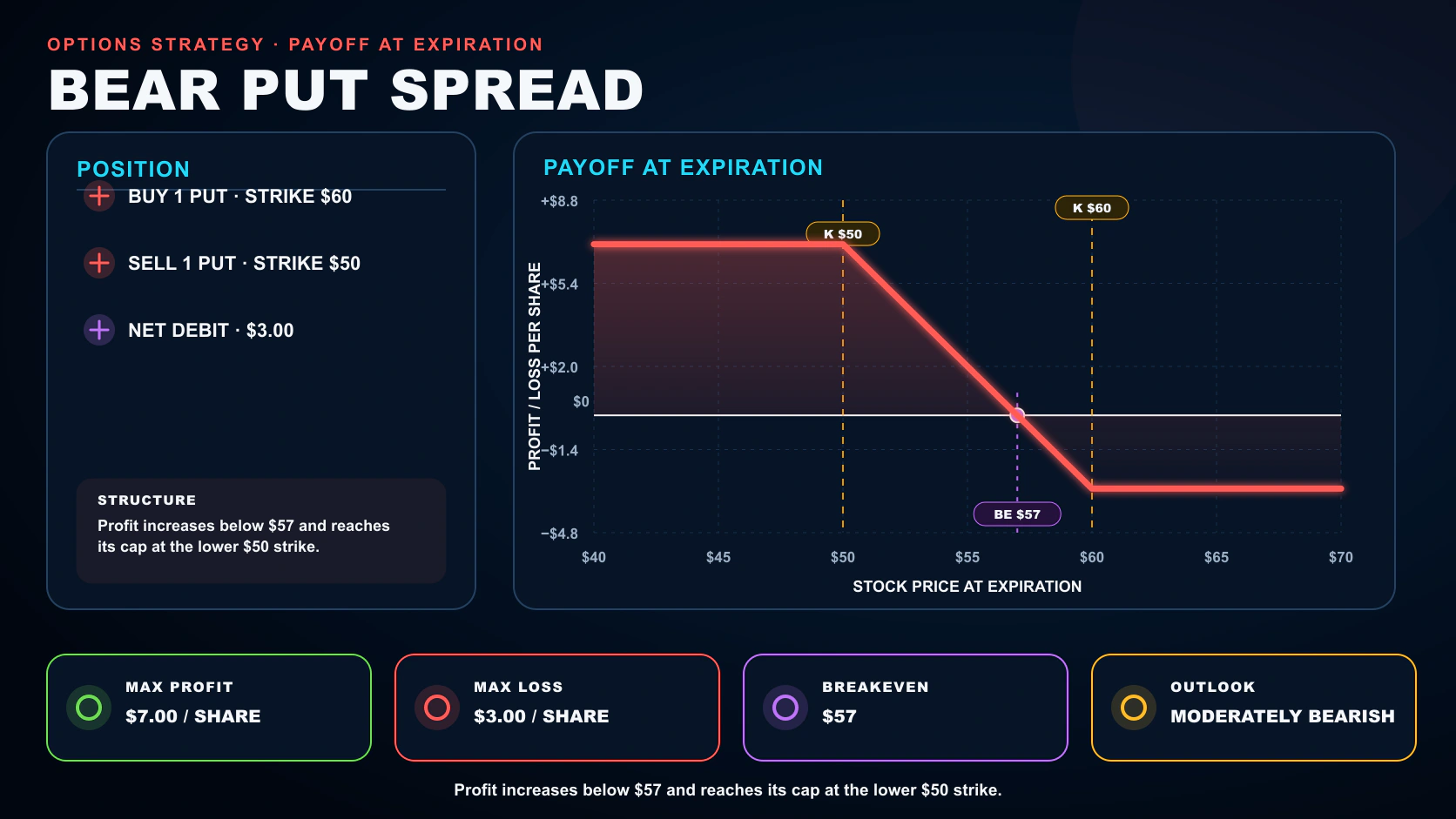
Buy one put at a strike close to or above the current stock price, and sell one put at a lower strike, same expiration. Because the put you buy is more expensive than the put you sell, the trade costs a net debit, paid up front. That debit is the entire amount at risk.
The short put lowers the cost of the position but also caps the payoff: once the stock falls to the lower strike, further declines no longer add profit, because the short put's losses offset the long put's gains dollar for dollar below that point.
Max Profit, Max Loss, and Breakeven
- Max profit = the width between the two strikes minus the net debit paid, realized if the stock closes at or below the lower (short) strike at expiration.
- Max loss = the net debit paid, in full, realized if the stock closes at or above the higher (long) strike at expiration, when both puts expire worthless.
- Breakeven = the higher strike price minus the net debit paid.
Worked Example
DEF is trading at $118. You buy one $120 put for $7.00 per share and sell one $110 put for $2.50 per share, a $10-wide spread. The net debit is $7.00 minus $2.50, or $4.50 per share ($450 for the one-contract position). Maximum profit is the $10.00 width minus the $4.50 debit, or $5.50 per share ($550 per contract). Breakeven is the $120 strike minus the $4.50 debit, or $115.50.
| Stock at Expiration | Long $120 Put | Short $110 Put | P/L (per contract) |
| $125 (rallies) | $0 | $0 | -$450 (max loss) |
| $120 | $0 | $0 | -$450 (max loss) |
| $115.50 (breakeven) | $4.50 | $0 | $0 |
| $110 | $10.00 | $0 | +$550 (max profit) |
| $105 (declines further) | $15.00 | $5.00 | +$550 (max profit) |
Below $110, the short put's losses grow at the same rate as the long put's gains, which is why profit stays fixed at $550 no matter how far the stock keeps falling.
When Traders Use This Strategy
A bear put spread fits a trader who is bearish on a stock but wants to lower the cost, and the breakeven distance, compared with a long put bought outright, in exchange for capping the profit if the stock falls sharply. It is the bearish mirror image of a bull call spread, and traders often weigh it against a bear call spread, which achieves a similar bearish, defined-risk profile as a net credit instead of a net debit.
Because the position is a net debit, time decay works against it overall, though less severely than for a single long put, since the short put also decays in the position's favor.
Risks and Assignment
The short put can be assigned at any time it is in the money, since equity options are American-style, obligating you to buy 100 shares per contract at the lower strike. Because you are also long a put at a higher strike, early assignment is rarely damaging — you can exercise or sell the long put to offset the newly assigned shares — but it does mean unplanned share ownership and a cash or margin requirement until the position is unwound. Assignment risk on the short put rises when it is deep in the money with little time value left, though puts are exercised early for dividend-capture reasons far less often than calls.
The other risk is simply being wrong about magnitude and timing: if the stock drifts sideways or falls too slowly, the position can still lose part or all of its debit to time decay even if the direction eventually proves correct.
FAQs
Why sell a put instead of just buying one?
Selling the lower-strike put reduces the net cost of the trade and therefore the breakeven point, at the cost of giving up profit on any move below the short strike.
What is the maximum I can lose?
The net debit paid to open the trade, in full, and nothing more, since both legs are exchange-listed options with no margin call exposure beyond the initial cost.
Does this strategy benefit from rising implied volatility?
Modestly. The long put, closer to the money in most setups, tends to be more sensitive to volatility than the short put, but the net effect is much smaller than for an outright long put.
What happens if I'm assigned on the short put early?
You buy 100 shares per contract at the lower strike. Because you hold a higher-strike long put, you can exercise it or sell both positions to close out the resulting exposure without added directional risk.
How is this different from a bear call spread?
A bear call spread uses calls instead of puts and is opened for a net credit rather than a net debit, though both express a similarly bearish, defined-risk view.
A bear put spread trades a lower breakeven and a known maximum loss for a capped upside — a practical middle ground between an outright long put and simply shorting the stock.