Lesson 7
Greeks Beginner
Updated Aug 29, 2026
- Delta range
- 0 to 1 (calls), -1 to 0 (puts)
- Gamma
- rate of change of delta
- Theta
- time decay per day, usually negative
- Vega
- sensitivity to a 1-point IV change
- Rho
- interest-rate sensitivity, usually minor
On this page
The "Greeks" are a set of numbers, generated by an options pricing model, that describe how an option's price is expected to react to changes in the stock price, time, volatility, and interest rates. The video above walks through the same five Greeks covered here. You don't need to memorize formulas, but you do need a working sense of what each Greek is telling you, because together they explain most of the day-to-day price movement in an option that has nothing to do with whether your trading thesis is right.
Every Greek you see on a broker's options chain is an output of a pricing model (Black-Scholes and its descendants), not a fact about the future. The model takes the stock price, strike, time to expiration, interest rate, and an estimate of implied volatility, and produces a theoretical price along with these sensitivities. Change the inputs and the Greeks change with them, treat them as a snapshot of risk right now, not a guarantee of what happens next.
Delta: How Much the Option Moves
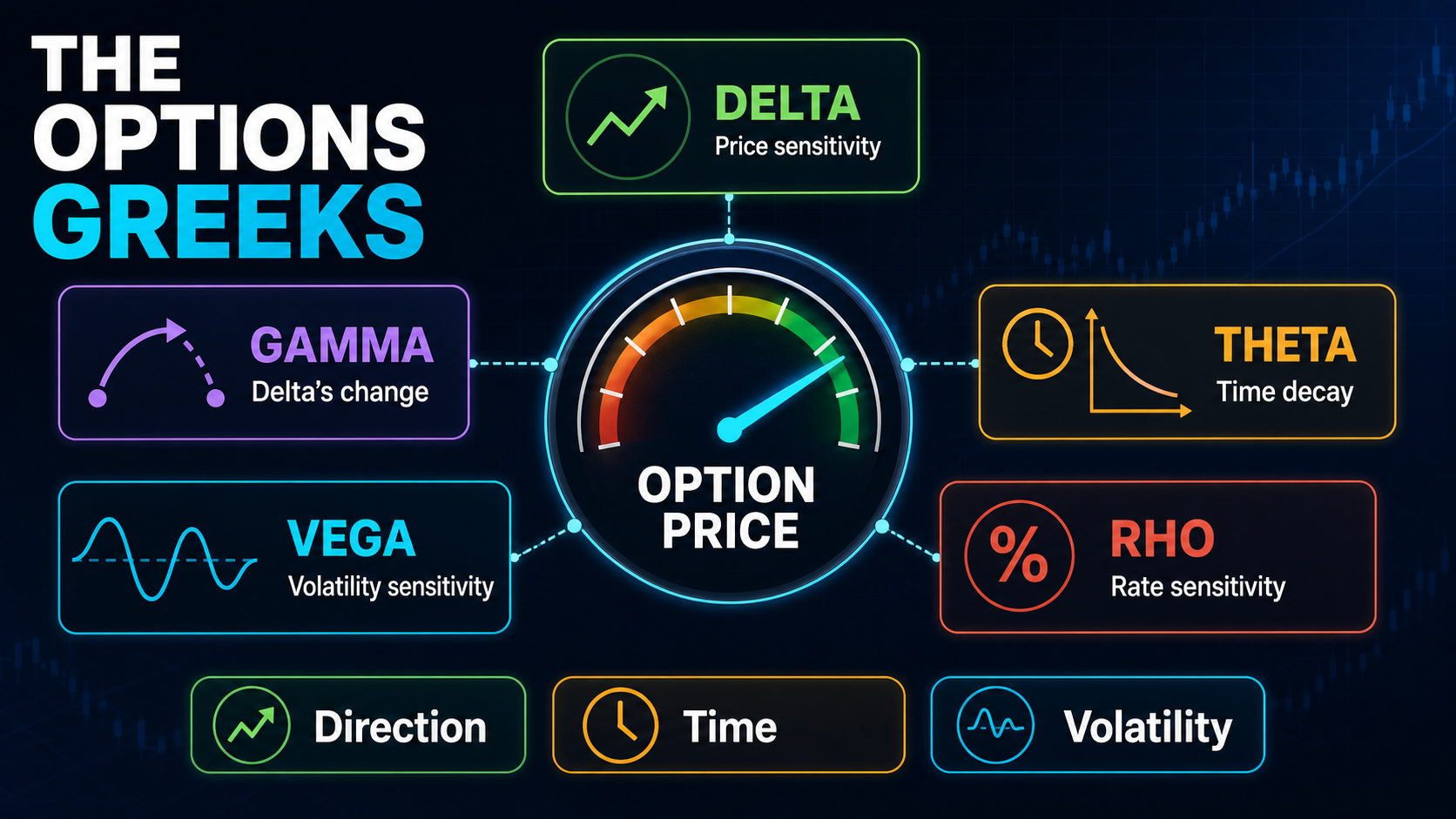
Delta measures how much an option's price is expected to change for a $1 move in the underlying stock. Call options have a delta between 0 and 1; put options have a delta between -1 and 0 (the negative sign just reflects that puts gain value when the stock falls). A call with a delta of 0.50 should gain about $0.50 if the stock rises $1, and lose about $0.50 if it falls $1; a put with a delta of -0.40 works the same way in reverse.
Delta also doubles as a rough, informal proxy for the probability an option finishes in the money, a 0.30 delta call is often read as "roughly a 30% chance," though it's an approximation from the model, not a guarantee. Deep in-the-money options have delta approaching 1 (or -1 for puts), since they behave almost like owning the stock outright; at-the-money options sit near 0.50; far out-of-the-money options sit closer to 0.
Gamma: How Fast Delta Changes
Gamma measures the rate of change of delta itself, for every $1 move in the underlying. If a call has a delta of 0.50 and a gamma of 0.05, then a $1 rise in the stock should push delta to about 0.55, and a $1 drop should push it toward about 0.45.
Gamma is typically highest for at-the-money options and shrinks as an option moves deep in or out of the money. It also increases as expiration nears for at-the-money strikes, part of why short-dated options can swing so much more violently than longer-dated ones on the same stock.
Theta: Time Decay
Theta measures how much value an option is expected to lose each day, all else being equal, purely from the passage of time. For a long option position (one you bought), theta is normally negative, meaning the position loses a little value every day it holds, even if the stock doesn't move.
If an option is priced at $2.00 with a theta of -0.05, you'd expect it to be worth roughly $1.95 the next day if nothing else changed. Decay isn't linear: it accelerates as expiration nears, especially for at-the-money options, which is why holding a long option into its final week or two can be costly even if you're directionally right.
Vega: Sensitivity to Volatility
Vega measures how much an option's price is expected to change for a 1-point (one percentage point) move in implied volatility, the market's estimate of how much the stock is likely to swing going forward. Long options (calls and puts you own) generally gain value when implied volatility rises and lose value when it falls, independent of what the stock price itself does.
Vega tends to be larger for longer-dated options, since there's more time for volatility to matter. This is one reason options can lose value right after earnings even when the stock moves in your favor: implied volatility often collapses once the uncertain event has passed, a dynamic sometimes called "volatility crush."
Rho: Sensitivity to Interest Rates
Rho measures an option's sensitivity to changes in interest rates. It's the Greek that matters least for most retail traders holding short- to medium-term options, since interest rate moves have a comparatively small effect over a few weeks or months. Rho becomes more relevant for options with expirations a year or more out (LEAPS), where the cost of carrying the position matters more.
The Greeks at a Glance
| Greek | Measures | Long call | Long put |
| Delta | $ change per $1 move in stock | 0 to 1 | -1 to 0 |
| Gamma | Change in delta per $1 move | Positive | Positive |
| Theta | $ change per day (time decay) | Usually negative | Usually negative |
| Vega | $ change per 1-point IV move | Positive | Positive |
| Rho | $ change per rate move | Positive | Negative |
A Quick Worked Example
Say a stock trades at $100 and you're looking at a call option with these approximate Greeks: delta 0.45, gamma 0.04, theta -0.06, and vega 0.10, priced at $3.20. Overnight, the stock rises to $102 and implied volatility ticks up by 1 point, with one trading day passing.
- Delta effect: roughly +$0.45 x 2 = +$0.90 (plus a small extra boost from gamma as delta increases along the way)
- Vega effect: roughly +$0.10 for the 1-point rise in implied volatility
- Theta effect: roughly -$0.06 for one day of time decay
Netting those out, the option's new price would be roughly $3.20 + $0.90 + $0.10 - $0.06 ≈ $4.24, before the bid-ask spread you'd actually trade at. This is a simplified, linear approximation; real models account for how the Greeks interact, but it shows why an option's price can move for reasons beyond "the stock went up."
Why This Matters for Beginners
You don't need to calculate Greeks by hand, every major broker displays them on the options chain. What matters is using them to sanity-check a trade before you place it: a high-delta option tracks the stock closely; a high-theta option bleeds value quickly if the stock stalls; a high-vega option is partly a bet on volatility, not just direction. Alongside bid and ask pricing and volume and open interest, the Greeks are the next layer for understanding why an option is priced the way it is.
FAQs
Do I need to calculate the Greeks myself?
No. Your broker's options chain and order ticket display delta, gamma, theta, vega, and usually rho for every listed option. Your job is to interpret them, not compute them.
Which Greek matters most for a beginner?
Delta and theta first. Delta tells you how directional your position is; theta tells you how much it costs you just to hold it over time.
Can the Greeks predict what will happen to my option?
No. They're outputs of a pricing model based on current inputs, not guarantees, so treat them as a risk snapshot, not a forecast.
Why did my option lose value even though the stock moved in my favor?
Usually because theta decay or a drop in implied volatility outweighed the gain from delta, common right after an earnings report when implied volatility often falls sharply.
Is a high delta always better?
Not necessarily. A high-delta option behaves more like stock and costs more upfront; a low-delta option is cheaper but needs a bigger move to pay off. It depends on your strategy.
Conclusion
The Greeks won't tell you which way a stock is going to move, but they will tell you how an option is likely to react once it does, and how much it costs you to simply wait. Get comfortable reading delta, theta, and vega before you place your first trade, and revisit them any time an option's price behaves in a way you didn't expect.