Lesson 6
Order Actions
Updated Aug 29, 2026
- Buy to Open
- Opens a long position
- Sell to Open
- Opens a short position
- Sell to Close
- Exits a long position
- Buy to Close
- Exits a short position
- Assignment Risk
- Short positions only
On this page
Every options order you place is really answering two separate questions: are you opening a new position or closing one you already have, and are you buying or selling? Combine those two questions and you get the four standard order actions — buy to open, sell to close, sell to open, and buy to close. This lesson maps out what each one does and, critically, the risk that comes with the two "opening" actions.
The video above runs through an order ticket on screen; the written version below focuses on the mental model and the risk side most beginners skip past.
The Two Questions Behind Every Order
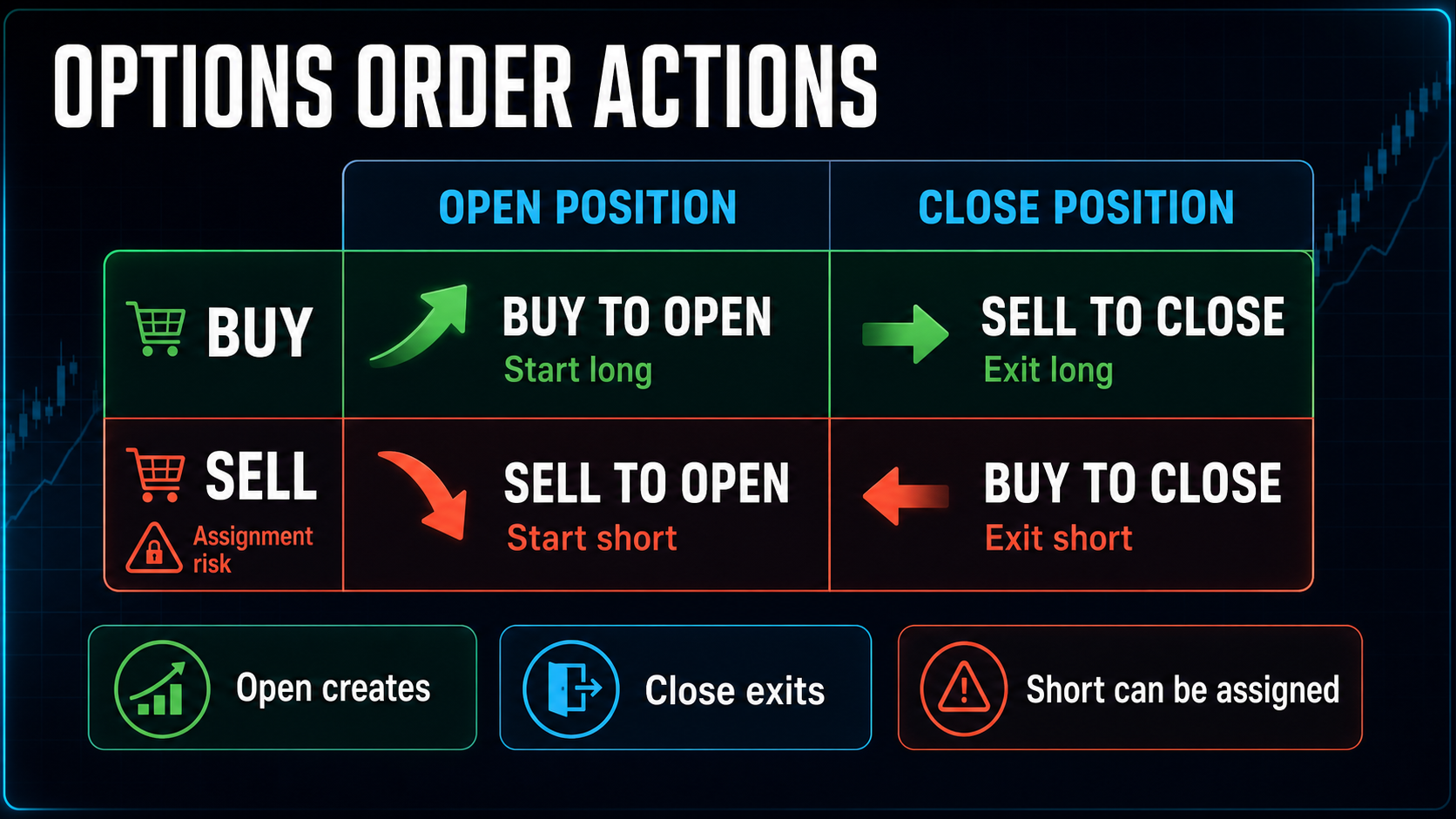
| Buying | Selling | |
|---|---|---|
| Opening | Buy to Open (BTO) | Sell to Open (STO) |
| Closing | Buy to Close (BTC) | Sell to Close (STC) |
"Opening" creates a new position where you had none. "Closing" ends a position you already hold. Getting this pair of questions right before you look at the order ticket makes the four labels much easier to keep straight.
Buy to Open (BTO)
Buy to open is how most beginners place their first trade: you buy a call or put to open a new long position. This is the options equivalent of a plain "buy" order for stock. Your maximum loss on a bought-to-open position is the premium you paid, full stop — nothing more can be taken from you even if the trade goes completely against you.
Sell to Close (STC)
Sell to close exits a long position you opened with buy to open. You're selling the same contract back into the market, and the difference between what you paid and what you receive is your profit or loss. Most option buyers sell to close rather than exercise, since selling captures any remaining extrinsic value that exercising would throw away.
Sell to Open (STO)
Sell to open is how you write (sell) an option to create a new short position, collecting the premium up front instead of paying it. This is the options equivalent of short selling stock, and it comes with a fundamentally different risk profile than buying: instead of a capped loss, a short position carries an obligation — to sell shares (for a short call) or buy shares (for a short put) at the strike price if you get assigned.
How much that obligation can cost you depends heavily on whether the position is covered or naked. A short call backed by 100 shares you already own (a covered call) has a much more contained risk than a short call with no shares behind it (a naked call), which carries theoretically unlimited risk since a stock's price has no ceiling. A short put's risk is capped only because the stock can't fall below $0 — that cap can still mean a large loss. See the covered call and naked call strategy guides for the contrast in detail, and never sell an option to open without understanding exactly what you're on the hook for.
Buy to Close (BTC)
Buy to close exits a short position you opened with sell to open — you buy back the same contract to cancel your obligation. This is the options equivalent of "buying to cover" a short stock position. The difference between the premium you originally collected and what you pay to buy it back is your profit or loss.
Assignment: The Risk Behind Selling to Open
Assignment is what happens when the holder on the other side of your short position exercises their contract, forcing you to fulfill your obligation. A few things to know about it:
- Assignment risk applies only to short positions — anything opened with sell to open. A long position you bought to open can never be assigned; the worst case is that it simply expires worthless.
- On standard American-style equity options, assignment can technically happen at any time the contract is in the money, not just at expiration, although early assignment away from expiration is uncommon outside of dividend situations.
- You don't choose when you're assigned — it's initiated by the option holder (or their broker's automated exercise) on the other side of the trade, not by you.
Buying to close before expiration removes assignment risk entirely, since you no longer have an open short position for anyone to exercise against.
Worked Example
You buy to open 1 XYZ call for $2.00 ($200 total), and two weeks later sell to close it for $3.50 ($350 total) — a $150 profit, and your position is now flat.
Separately, you sell to open 1 XYZ put for $1.80, collecting $180 up front, believing the stock will stay above the strike. If the stock cooperates and the put's value falls to $0.40, you can buy to close for $40, keeping the $140 difference as profit and closing out your obligation before expiration.
FAQs
Which order type should a beginner start with?
Buy to open, closed later with sell to close. It has the simplest risk profile — a known, limited maximum loss — before moving on to strategies that involve selling to open.
Is sell to open the same thing as short selling stock?
Conceptually similar (you're opening a position by selling first), but the mechanics and risk differ by strategy. A covered call, for example, is a sell-to-open position with contained risk because you own the underlying shares, unlike a naked short stock position.
What happens if I don't buy to close before expiration on a short position?
If it's in the money at expiration, you'll typically be assigned automatically. If it's out of the money, it expires worthless, your obligation disappears, and you keep the full premium you collected.
Can I get assigned on a day when the market is closed?
Assignment notices are processed by the Options Clearing Corporation and typically show up in your account the next business day, but the exercise decision itself is generally made by the option holder before markets close.
Do all four order actions cost the same in commissions?
That depends entirely on your broker's fee schedule, not on the order action itself. Check your broker's options commission and per-contract fees before trading actively.
Conclusion
Buy to open and sell to close are the pair that opens and exits a long position; sell to open and buy to close are the pair that opens and exits a short position. The labels are mechanical, but the risk behind them is not symmetric — understand assignment risk before you ever sell an option to open a new position.