Lesson 9
Volume and Open Interest
Updated Aug 29, 2026
- Volume
- contracts traded during the current session
- Open interest
- contracts still open, not yet closed
- Volume resets
- to zero at the start of each session
- Open interest updates
- once, overnight
- Combined signal
- high volume + high OI usually means tighter spreads
On this page
Volume and open interest sit right next to each other on every options chain, and beginners frequently mix them up. The video above introduces both terms; this lesson explains what each one actually measures, how they're calculated differently, and how to use them together to judge whether a contract will be easy or hard to trade.
Volume: Activity Today
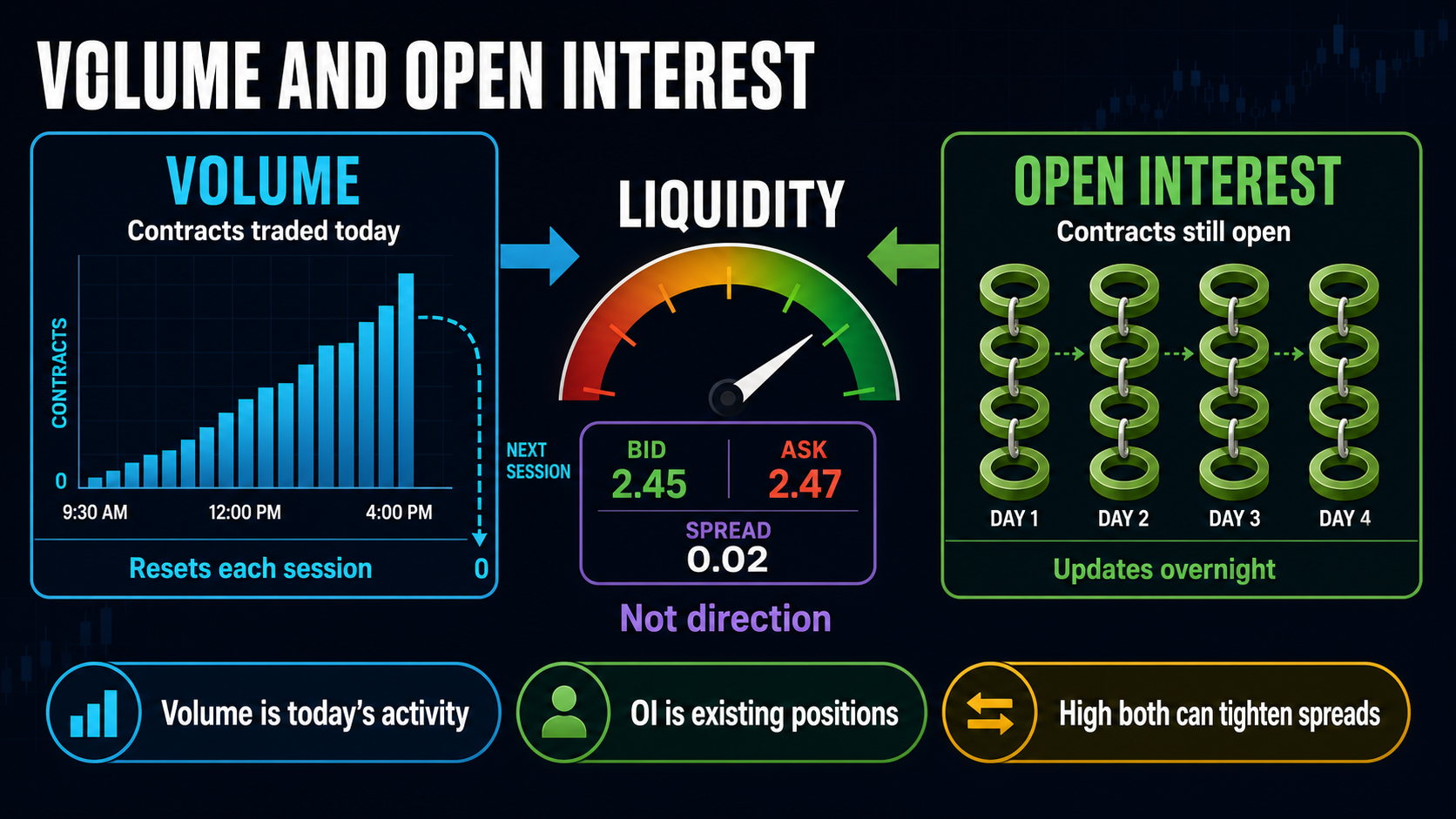
Volume is the number of contracts of a specific option (a specific strike, expiration, and call or put) that have changed hands during the current trading session. It's a same-day counter that resets to zero at the start of every trading day.
Every trade counts once for the buyer's side and once for the seller's side, but it's reported as a single number, not doubled. If 10 contracts trade between one buyer and one seller, that's 10 volume, not 20. Volume tells you how active a specific contract is right now, today, which is useful context but doesn't tell you anything about how many contracts exist beyond today.
Open Interest: Contracts Still Outstanding
Open interest is a different measurement entirely: it's the total number of contracts of that option that are currently open, meaning bought or sold to open a new position and not yet closed, expired, or exercised. Unlike volume, open interest doesn't reset daily, it carries forward and is only recalculated once, overnight, after the exchanges reconcile the day's opening and closing trades.
Open interest increases when a trade adds a new contract to the market, for example when one trader buys to open and another sells to open. It decreases when an existing position is closed, for example when a trader who's long the contract sells to close, and the counterparty is buying to close their short. A single day's volume can be a mix of trades that open new positions and trades that close existing ones, which is why volume and the change in open interest from one day to the next aren't the same number.
A Simple Way to Tell Them Apart
Volume answers "how many contracts traded today?" Open interest answers "how many contracts are currently outstanding?" If you bought 10 contracts today and are still holding them tomorrow, you contributed 10 to today's volume, and (assuming those were new contracts rather than ones bought from someone closing a position) you added 10 to open interest, where it will stay until you or someone else closes the position.
Why Both Numbers Matter for Getting a Fair Fill
Contracts with meaningful daily volume and healthy open interest are generally easier to trade at a fair price, because more participants are actively quoting and trading them, which tends to produce a tighter bid-ask spread. A contract with 5 volume and 20 open interest is thinly traded; you may struggle to get filled near the mid-price. A contract with 5,000 volume and 40,000 open interest is likely to have a tight spread and fill quickly, close to the price you expect.
A reasonable rule of thumb: before sizing a trade, compare the number of contracts you want to trade against both the day's volume and the open interest. If you're planning to buy 50 contracts, look for a strike where volume and open interest are comfortably larger than 50, not barely equal to it, so your own order doesn't move the market against you.
What Neither Number Tells You
It's tempting to read high volume or open interest as a signal that "smart money" is betting on a direction, but neither number tells you whether the trades were bullish or bearish, opening or closing, or from a buyer or a seller. A surge in put volume could mean traders are betting on a decline, or it could mean traders who are long the stock are buying protective puts, or market makers are hedging an unrelated position. Volume and open interest describe how much a contract is trading, not what anyone believes about where the stock is headed.
A Worked Example
Suppose the 100-strike call on a stock shows 1,200 volume and 8,500 open interest at 11am. That tells you 1,200 contracts have already traded today (some opening, some closing), and 8,500 contracts remain open from all trading days up to yesterday's close, plus whatever net change happens today once it's reconciled overnight. If you're looking to buy 20 contracts, both numbers comfortably exceed your size, a good early sign that you should be able to get a reasonable fill with a limit order near the mid-price.
FAQs
Does open interest update in real time during the day?
No. Open interest is reported once per day, calculated overnight from the prior session's activity. The open interest number you see during the trading day reflects the start of that session, not trades happening in real time.
Can volume be higher than open interest?
Yes, easily. If a lot of same-day trading activity is opening and closing positions repeatedly (common around news events or on very popular strikes), volume for the day can exceed the total open interest.
Is low open interest always a bad sign?
Not necessarily bad, but it usually means less liquidity, which typically means wider spreads and a higher chance of a poor fill. It's more of a caution flag than a red flag, especially for newly listed expirations that simply haven't built up open interest yet.
Do volume and open interest predict where the stock is going?
No. They measure trading activity and outstanding positions, not direction or sentiment. Don't treat a spike in either one as a signal to buy or sell.
What happens to open interest when an option expires?
Any contracts still open at expiration are removed from open interest once they're exercised, assigned, or expire worthless, since they no longer exist as live positions.
Conclusion
Volume tells you how busy a contract has been today; open interest tells you how many contracts are currently alive. Neither one tells you which way a stock is headed, but together they're one of the fastest ways to judge whether a strike will be easy to trade in and out of, which matters just as much as picking the right direction.