Lesson 5
Moneyness
Updated Aug 29, 2026
- ITM Call
- Strike below stock price
- ITM Put
- Strike above stock price
- ATM
- Strike near stock price
- Deep ITM
- Trades like the stock
- Deep OTM
- Often expires worthless
On this page
"In the money," "at the money," and "out of the money" describe the relationship between a contract's strike price and the stock's current price — a state traders call moneyness. It changes every time the stock price moves, and it drives both the cost of a contract and how it behaves. This lesson covers the exact definitions for calls and puts, since they run in opposite directions, plus what moneyness means for pricing and risk.
The video above walks through it visually; the table and examples below are meant as a reference you can come back to.
The Three States
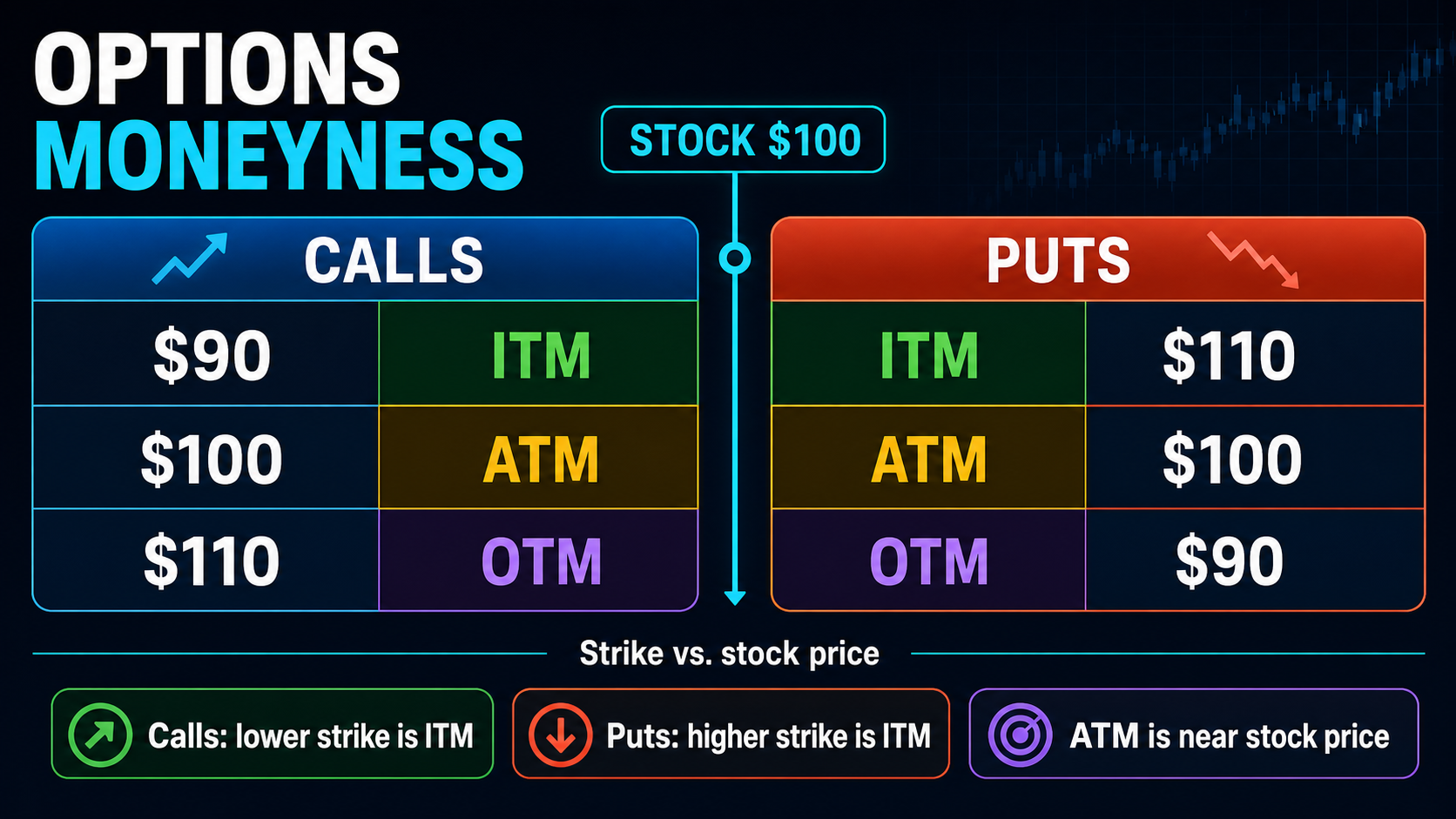
- In the money (ITM): the contract has intrinsic value right now — it would be worth exercising immediately, ignoring time value.
- At the money (ATM): the strike is at or very close to the current stock price. Intrinsic value is at or near zero.
- Out of the money (OTM): the contract has zero intrinsic value — it would be worth nothing if exercised immediately.
Calls and puts are mirror images of each other here, which is the part beginners most often mix up between the two contract types.
Calls vs. Puts: The Full Grid
| State | Call | Put |
|---|---|---|
| In the money (ITM) | Strike is below the stock price | Strike is above the stock price |
| At the money (ATM) | Strike is at/near the stock price | Strike is at/near the stock price |
| Out of the money (OTM) | Strike is above the stock price | Strike is below the stock price |
Worked Example
Suppose XYZ is trading at $147.30. Here's how a handful of strikes classify:
- $140 call — ITM (strike below stock price), with $7.30 of intrinsic value
- $145 call — ITM (strike below stock price), with $2.30 of intrinsic value
- $150 call — OTM (strike above stock price), zero intrinsic value
- $140 put — OTM (strike below stock price), zero intrinsic value
- $145 put — OTM (strike below stock price), zero intrinsic value
- $150 put — ITM (strike above stock price), with $2.70 of intrinsic value
Notice the $145 strike is OTM for the put and ITM for the call at the exact same stock price — moneyness always depends on which side of the contract you're looking at.
How Moneyness Drives Price
Moving from OTM toward ITM at a given expiration, premiums rise for two reasons: intrinsic value increases dollar for dollar with how far in the money the strike is, and the probability of finishing in the money at expiration also rises, which increases extrinsic value too. That's why the deepest ITM strikes on a chain are the most expensive per contract, and the furthest OTM strikes are the cheapest.
Moneyness and Risk
Moneyness is really a dial between two different trades:
- Deep ITM contracts cost the most per contract but move close to dollar-for-dollar with the stock (a high delta) and have a high probability of retaining value at expiration. Risk and reward are both comparatively contained.
- Deep OTM contracts cost the least per contract, offer the most leverage if the stock makes a big move, and have a comparatively low probability of ever being worth anything — many of them expire completely worthless. Cheap does not mean low risk; on a percentage basis, far OTM contracts lose their full value more often than any other part of the chain.
See the strike prices lesson for how intrinsic and extrinsic value combine into the premium, and the options chain lesson for where moneyness shows up visually on a live chain.
FAQs
Is "at the money" an exact price or a range?
It's informal — there's no fixed rule for how close is "close enough." Traders generally mean the nearest strike or two to the current stock price.
Does an OTM option have any value at all?
Yes, as long as there's time left before expiration — that value is entirely extrinsic (time) value, reflecting the chance the stock could move into the money before the contract expires. It shrinks to zero by expiration if the stock never gets there.
Can moneyness change before expiration?
Constantly. Moneyness is based on the current stock price, so it moves every time the stock does. A call that's OTM in the morning can be ITM by the afternoon.
Which moneyness should a beginner trade?
There's no single right answer, but many beginners are better served starting closer to the money, where pricing behaves more predictably and the odds of a total loss are lower than with far OTM lottery-ticket strikes.
Is ITM the same thing as profitable?
No. Being ITM only measures intrinsic value against the strike, not against what you paid. A contract can be ITM and still be a loss if you paid more in premium than its current intrinsic value.
Conclusion
Moneyness is simply the relationship between strike and stock price at this moment, and it runs in opposite directions for calls and puts. Once the ITM/ATM/OTM grid is second nature, reading intrinsic value, judging relative pricing on a chain, and understanding the risk trade-off between contracts all get much easier.