Lesson 10
Selecting a Broker
Updated Aug 29, 2026
- Approval levels
- typically tiered 1-4, broker-dependent
- Options fees
- usually $0 base + a per-contract fee
- Assignment/exercise
- many brokers charge a separate fee
- Margin
- required for spreads, naked calls, and naked puts
- TD Ameritrade
- absorbed into Charles Schwab (2023-2024)
On this page
If you're new to options, one of the first practical questions is which broker to open an account with, or whether your existing brokerage account is even set up to trade options. The video above walks through what to look for; this lesson breaks down each factor so you know exactly what you're comparing. There isn't one "best" broker for every trader, the right choice depends on how you plan to trade, so this lesson focuses on what to evaluate, not which specific firm to pick.
A Quick Note on Dated Platform References
If you've seen older options tutorials, including earlier versions of this course, reference TD Ameritrade and its thinkorswim platform, that brand no longer exists as a separate retail broker. TD Ameritrade was acquired by Charles Schwab, and client accounts were migrated onto Schwab's systems over 2023 and 2024; thinkorswim itself has continued on under Schwab. This lesson stays platform-neutral, since features, fees, and tools change over time and vary by broker, always check a broker's current disclosures directly rather than relying on any tutorial's screenshots.
Options Approval Levels
Before you can place an options trade, your brokerage account needs to be approved for options trading, and most brokers use a tiered approval system. You typically apply by answering questions about your trading experience, income, net worth, and investment objectives, and the broker assigns you a level based on your answers. Exact tier definitions vary by firm, but a common structure looks roughly like this:
- Lowest tier: Covered calls and cash-secured puts, strategies where the risk is limited because you either own the underlying shares or have set aside the cash to buy them.
- Middle tier: Buying calls and puts outright, and often basic spreads (buying one option while selling another to define your risk).
- Higher tiers: More advanced multi-leg spreads and strategies with undefined or larger risk.
- Highest tier: Uncovered ("naked") calls and puts, which carry the largest risk and require both approval and margin.
Higher approval levels almost always require a margin account, and brokers can decline to approve you for a level regardless of what you request, the decision is theirs. If you're just starting out, expect a lower tier first, and to request higher approval later as you build a track record.
What Trading Actually Costs
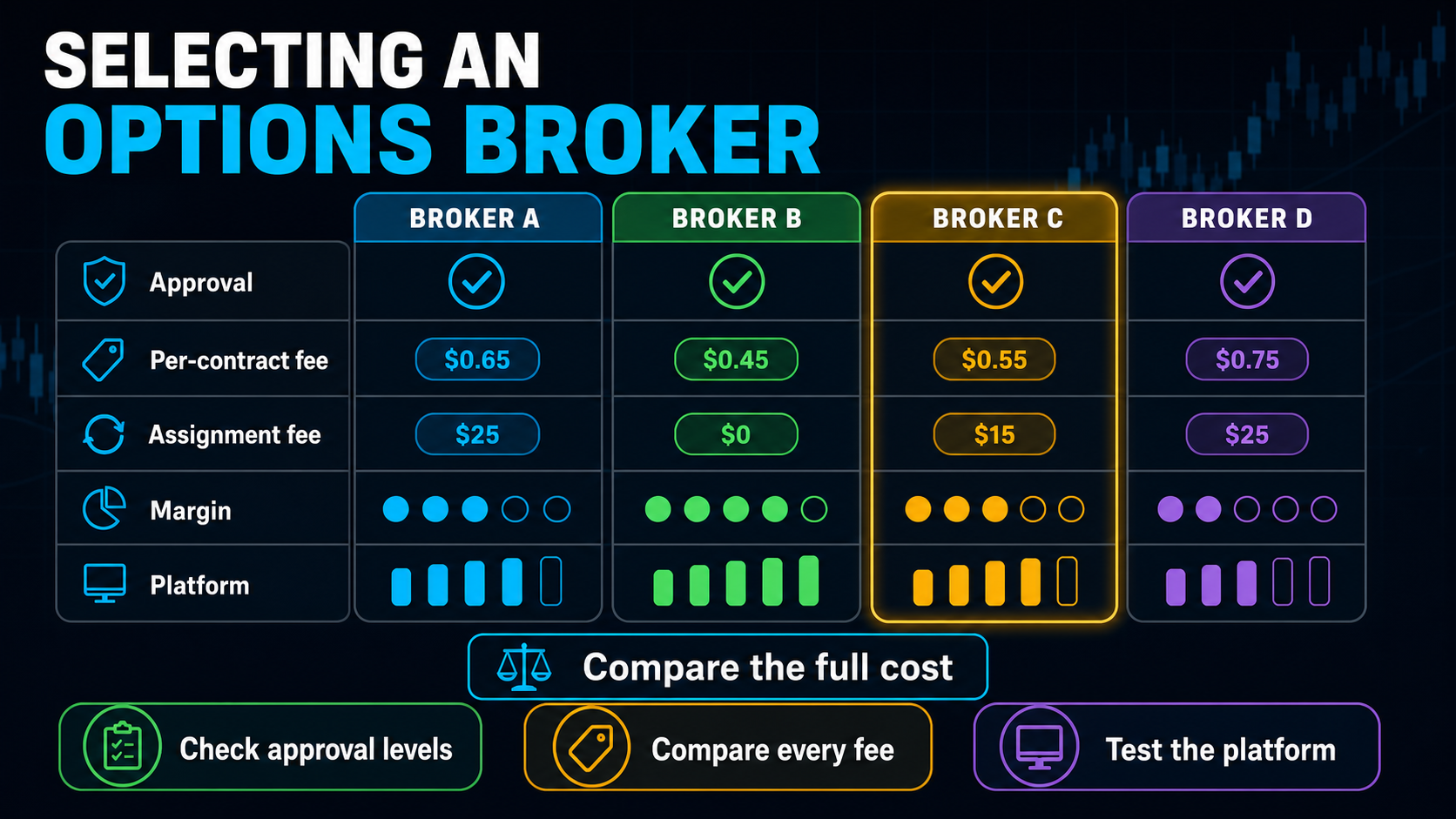
Options costs generally come in a few separate pieces, and it's worth checking each one on a broker's current fee schedule rather than assuming:
- Base commission per trade: Many U.S. brokers now charge $0 base commission for online options orders, a shift from the flat per-trade or per-leg fees that were standard years ago. Confirm this is still the case for the specific broker and order type you're using.
- Per-contract fee: On top of any base commission, most brokers charge a small fee for each contract traded (for example, buying 10 contracts costs 10 times the per-contract fee). This is usually the main cost of an options trade today.
- Assignment and exercise fees: If you're assigned on a short option, or you exercise a long option, some brokers charge a separate flat fee for processing that transaction. This can matter more than the trading commission if you frequently let options expire in the money or get assigned.
- Multi-leg order costs: Spreads, straddles, and other multi-leg strategies involve more than one option in a single order. Check whether the broker charges per contract across all legs combined or has any additional per-leg charge.
Because fee schedules change and differ by broker, treat any specific numbers you read online, including in older tutorials, as a starting point for comparison, not the current truth. Pull up the actual fee schedule on the broker's website before opening an account.
Platform and Tools
Beyond cost, the trading platform itself matters a lot for options traders specifically, more so than for simple stock investors. Things worth comparing:
- Quality of the options chain display (Greeks, implied volatility, and bid/ask visible without extra clicks)
- Whether the platform supports multi-leg orders as a single ticket, so a spread fills as one transaction instead of two separate legs
- Charting tools and the ability to model a trade's potential profit and loss before placing it
- Mobile app quality, if you expect to manage positions away from a desktop
- Availability of a paper trading (simulated) account to practice without risking real money
Margin Requirements
Margin is a factor for options traders even if you never intend to borrow money to buy stock. Spreads, naked calls, naked puts, and other advanced strategies typically require a margin account, and the broker will calculate a margin requirement based on the position's potential risk. For undefined-risk strategies like naked calls, margin requirements can be substantial and can change if the position moves against you, potentially triggering a margin call. Understand a broker's margin methodology for the strategies you actually plan to use before you need it.
Putting It Together
There's no universal "best" broker for options, the right fit depends on how often you trade, how many contracts per trade, whether you use multi-leg strategies, and how much you value platform tools versus low fees. A trader placing occasional single-contract trades will weigh things differently than someone running frequent multi-leg spreads. Compare approval-level requirements, the full fee picture (not just the headline commission), platform quality, and margin terms across two or three brokers before opening an account, and don't assume any specific numbers from this or any other tutorial are still current.
FAQs
What happened to TD Ameritrade?
TD Ameritrade was acquired by Charles Schwab, and accounts were migrated to Schwab's platform over 2023 and 2024. It no longer operates as a separate retail brokerage.
Do all brokers use the same options approval levels?
No. The general concept of tiered approval is nearly universal, but the exact number of tiers and what's allowed at each one varies by broker. Always check the specific broker's definitions.
Can I get approved for the highest options level right away?
Usually not as a brand-new trader. Brokers weigh your stated experience, income, and net worth, and most beginners start at a lower tier and request higher approval later.
Is a broker with $0 commissions automatically the cheapest choice?
Not necessarily. Per-contract fees, assignment fees, and margin costs can matter more than the headline commission, especially if you trade frequently or use multi-leg strategies.
Do I need a margin account to trade options?
For basic strategies like buying calls and puts or covered calls, often not. For spreads and uncovered positions, yes, a margin account is typically required.
Conclusion
Choosing a broker for options trading comes down to matching approval levels, real all-in costs, platform quality, and margin terms to how you actually plan to trade, not chasing whichever platform a tutorial happens to feature. Once your account is approved and funded, the next lesson walks through placing your first options trade from start to finish.