Lesson 3
Strike Prices
Updated Aug 29, 2026
- Also Called
- Exercise price
- Applies To
- Calls and puts
- Set By
- The exchange
- Key Idea
- Strike vs. stock price determines moneyness
On this page
The strike price, also called the exercise price, is the fixed price written into every options contract — the price a call holder can buy the stock for, or a put holder can sell it for. It's one of the two numbers, along with the expiration date, that defines exactly which contract you're looking at on a chain. This lesson covers what the strike controls, why contracts at different strikes are priced so differently, and how to think about choosing one.
The video above shows this on a live chain; the written version below covers the pricing mechanics in more depth.
What the Strike Price Controls
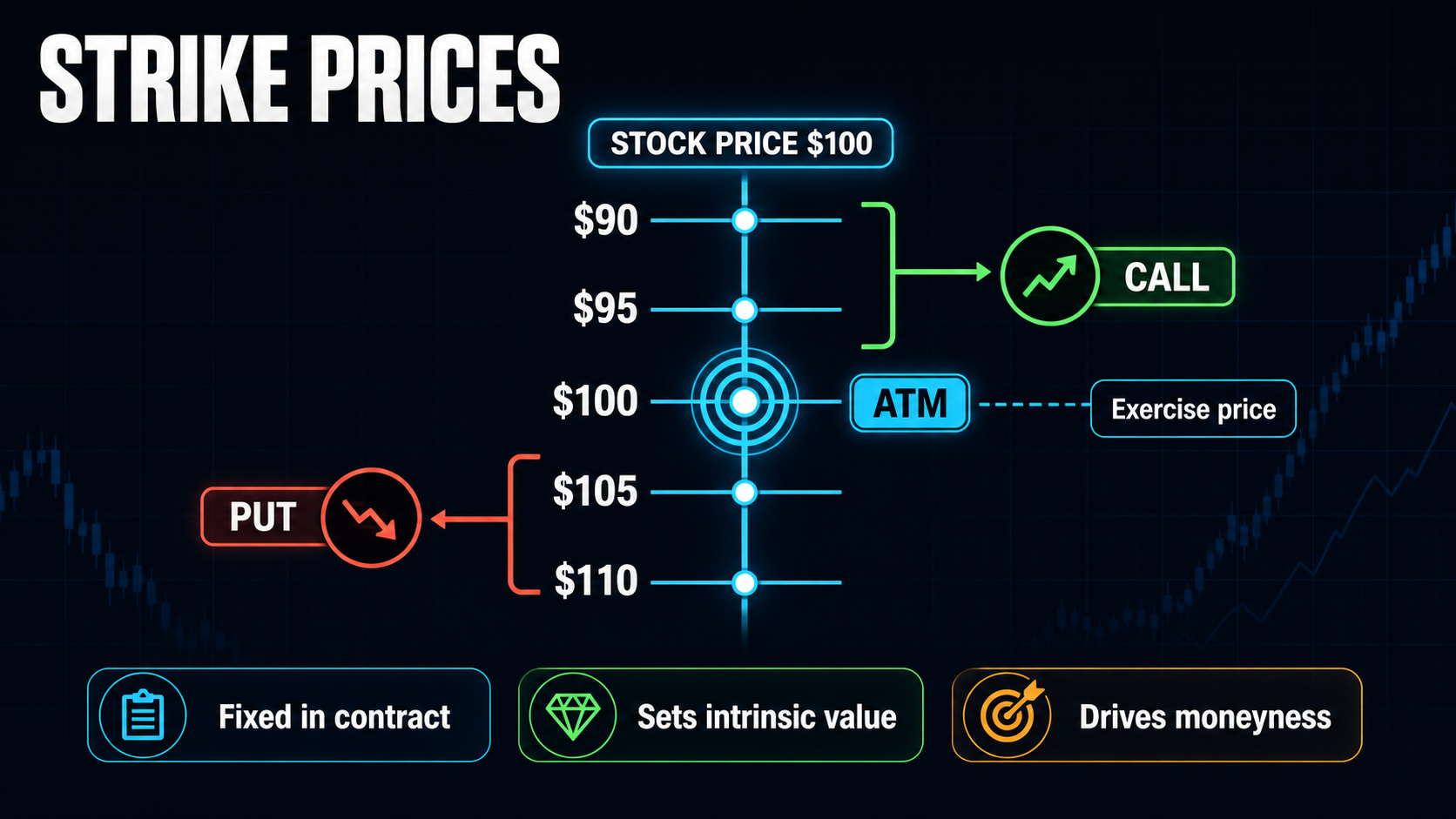
For a call, the strike is the price at which the holder can buy 100 shares of the underlying stock. For a put, it's the price at which the holder can sell 100 shares. See the calls and puts lesson for a refresher on that distinction. The strike price never changes over the life of the contract — only the stock's price and the option's premium move.
Intrinsic Value vs. Extrinsic Value
An option's premium is made up of two components:
- Intrinsic value is the amount the option is in the money right now. A call at a $90 strike when the stock trades at $100 has $10 of intrinsic value; that same call at a $105 strike has zero intrinsic value, since it isn't in the money. Intrinsic value can never be negative.
- Extrinsic value, also called time value, is everything in the premium beyond intrinsic value — compensation for the time remaining and the uncertainty of where the stock could go before expiration. Extrinsic value shrinks toward zero as expiration approaches, a process called time decay.
Premium equals intrinsic value plus extrinsic value, always. If a $90 call is quoted at $11.50 with the stock at $100, that's $10 of intrinsic value and $1.50 of extrinsic value.
Why Strikes Are Priced the Way They Are
Holding the stock price and expiration constant, moving the strike changes how likely the option is to be in the money at expiration — and price follows that probability.
- Call premiums fall as the strike price rises. A $90 call is more likely to finish in the money than a $110 call on the same $100 stock, so it costs more.
- Put premiums rise as the strike price rises. A $110 put is more likely to finish in the money than a $90 put on that same $100 stock, so it costs more.
Choosing a Strike for Your Strategy
There's no universally "right" strike — it's a direct trade-off:
- Strikes closer to or in the money cost more per contract, move more closely with the stock, and have a higher probability of retaining some value at expiration.
- Strikes further out of the money cost less per contract, offer more leverage on a percentage basis, and have a lower probability of being worth anything at expiration — many of them expire completely worthless.
Cheaper is not automatically better. A strike far enough out of the money can have a very low chance of ever paying off, no matter how cheap it looks on the chain.
Can You Act on an Option Before Expiration?
Standard U.S. equity options are American-style, meaning the holder can exercise them — or simply sell the contract to close the position — at any point before expiration, not only when it's in the money at the end. Most retail traders never exercise; they sell to close instead, since selling captures both intrinsic and remaining extrinsic value, while exercising throws the extrinsic value away.
Broad index options, like SPX, are typically European-style instead: they can only be exercised at expiration and settle in cash rather than shares. If you eventually trade index options, check the contract specification, since the rules differ from single-stock options.
Worked Example
XYZ is trading at $100 with 30 days to expiration. On the chain you see:
- $90 call: intrinsic value $10, quoted at $11.40 (about $1.40 of extrinsic value)
- $100 call: intrinsic value $0 (at the money), quoted at $3.20 (all extrinsic value)
- $110 call: intrinsic value $0 (out of the money), quoted at $0.65 (all extrinsic value, and cheap because it's unlikely to finish in the money)
Each of those is a separate 100-share contract, so the $100 call at $3.20 costs $320 to buy, not $3.20.
FAQs
Is strike price the same as exercise price?
Yes, the two terms are used interchangeably.
Can I sell my contract if it's not in the money?
Yes. You can sell to close an option position at any point before expiration whether it's in the money or not, as long as there's a market for it. If it's still out of the money at expiration, it expires worthless.
Why do two contracts with the same strike but different expirations cost different amounts?
Because extrinsic value depends on time remaining. More time means more opportunity for the stock to move, so a longer-dated contract at the same strike almost always costs more. See the expirations lesson.
Does a deep in-the-money option behave just like owning the stock?
Close, but not identically. It moves close to dollar-for-dollar with the stock (a high delta), but it's still a contract with an expiration date and, unlike stock, can expire or be assigned.
What's the difference between strike price and moneyness?
Strike price is a fixed number written into the contract. Moneyness is the relationship between that strike and the stock's current price — it changes every time the stock price moves. See the moneyness lesson for the full breakdown.
Conclusion
The strike price is the anchor point for everything else about a contract: it sets what you can buy or sell the stock for, splits the premium into intrinsic and extrinsic value, and determines how sensitive the contract is to the stock's next move. Picking a strike is really picking a point on the risk-and-reward spectrum between "moves like the stock and costs more" and "moves like a lottery ticket and costs less."