Lesson 1
Options Chain
Updated Aug 29, 2026 · Reviewed by Terence Scott, founder
- Calls
- Left side of chain
- Puts
- Right side of chain
- Grouped By
- Expiration, then strike
- Shows
- Bid, ask, volume, open interest
On this page
An options chain is the master list of every call and put contract available on a stock or ETF, organized by expiration date and strike price. Once you can read one fluently, you can price out a trade idea in seconds instead of guessing. This lesson breaks down each column and section so the chain stops looking like a wall of numbers.
The video above walks through a live chain on screen; the written version below goes column by column so you can use it as a reference while you pull up a chain of your own.
How a Chain Is Organized
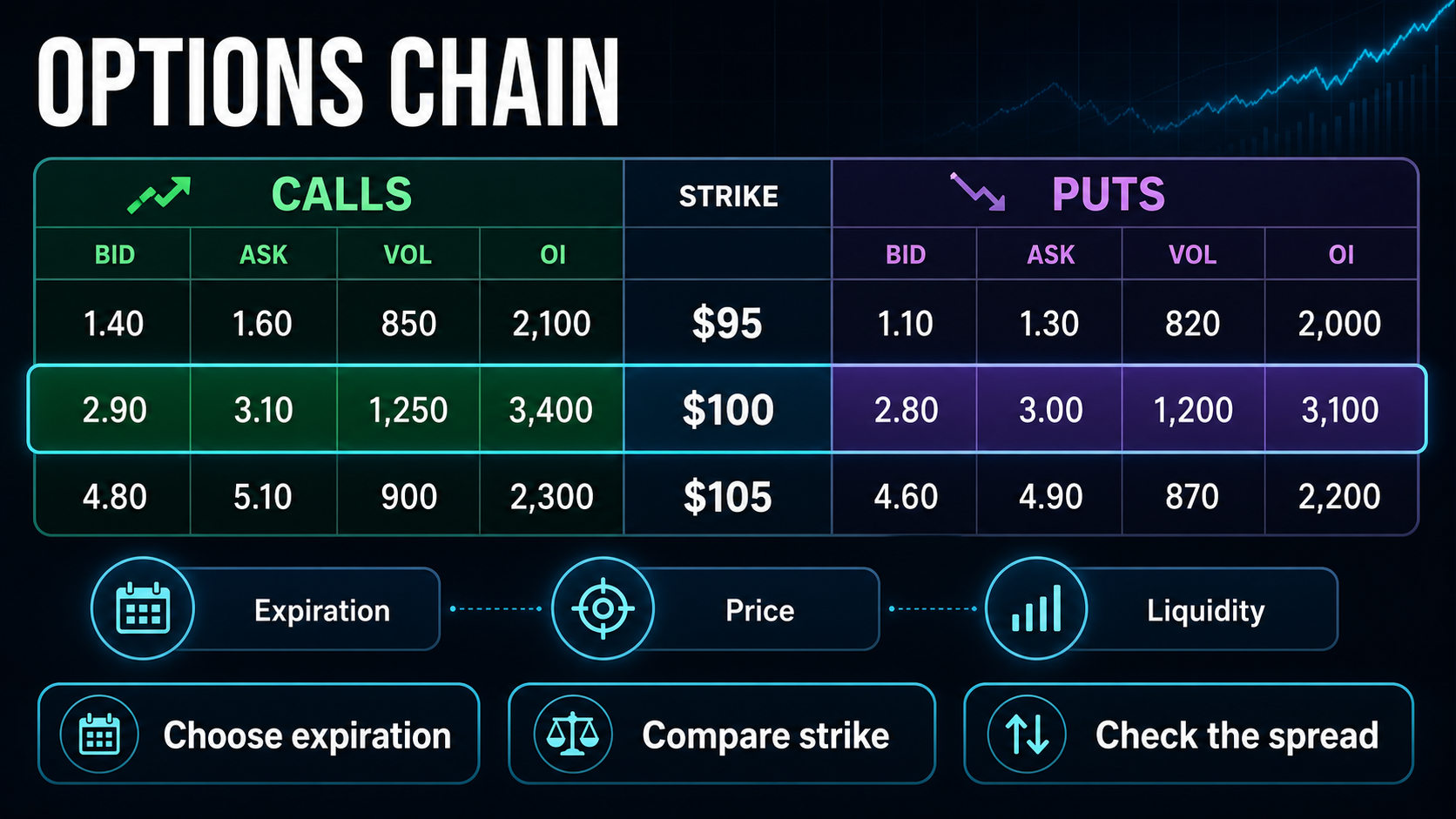
Every broker platform lays out its chain a little differently, but the structure is the same everywhere. Contracts are grouped first by expiration date, then by strike price within that expiration. Most platforms show calls on the left of the strike column and puts on the right, with the current stock price marked in the middle of the strike list so you can see which strikes sit above and below it.
Expiration Dates
Expanding a chain shows a row of dates — usually a run of near-term weekly expirations followed by the standard monthly dates, and sometimes long-dated LEAPS further out. Each date is its own separate chain of strikes; a $150 call expiring next Friday and a $150 call expiring in six months are two completely different contracts with different prices. The expirations lesson covers how each cycle works and how to pick one.
Strike Price
The strike price is the price at which a contract can be exercised — the price a call holder can buy the stock for, or a put holder can sell the stock for. It has nothing to do with what you paid for the contract; a stock does not need to reach the strike for you to sell your position, only for the option to have exercise value at expiration. The strike prices lesson covers this in detail.
Moneyness: Why Some Strikes Are Highlighted
Most platforms shade or highlight the strikes that are currently in the money (ITM) so they stand out from the rest of the chain — the exact color varies by broker, but the idea is universal. The three states are:
- In the money (ITM): for calls, the strike is below the current stock price; for puts, the strike is above it.
- At the money (ATM): the strike is at or very close to the current stock price, for both calls and puts.
- Out of the money (OTM): for calls, the strike is above the current stock price; for puts, the strike is below it.
Being ITM or OTM right now says nothing about where the stock will be at expiration — it only describes the contract's position today. A standard American-style equity option can also be sold to close, or exercised, at any point before expiration; it doesn't have to wait for expiration day to have value. The moneyness lesson goes deeper on how this affects pricing.
Bid and Ask
The bid is the highest price a buyer is currently offering for the contract — roughly what you'd receive selling at the market. The ask is the lowest price a seller is currently offering — roughly what you'd pay buying at the market. The gap between them, the bid-ask spread, tends to be tight on heavily traded strikes and wide on thin ones. See the bid and ask lesson for how to trade around that spread instead of just paying it.
Volume and Open Interest
Volume is the number of contracts at that strike traded so far today — a same-day activity gauge. Open interest is the number of contracts still open at that strike, which builds up over the contract's life. High open interest with low volume usually just means positions built up over time and little is happening right now; a volume spike relative to open interest can flag fresh interest in that strike.
A Worked Example
Suppose XYZ is trading at $148, and you pull up the monthly expiration 45 days out. Scanning the chain:
- The $140 call shows a $9.20 bid / $9.40 ask. The strike is below the stock price, so it's ITM — mostly intrinsic value ($8) plus a bit of time value.
- The $150 call shows a $3.10 bid / $3.25 ask. The strike is above the stock price, so it's OTM — the entire premium is time value, and it decays to zero if the stock never gets there.
- The $150 put shows a $4.80 bid / $4.95 ask. Same strike as the OTM call above, but because it's a put, a $150 strike above a $148 stock price makes it ITM instead.
One contract at any of those prices controls 100 shares, so the $150 call at the $3.25 ask would cost $325 to buy ($3.25 x 100), not $3.25.
FAQs
Do I need to check every expiration and strike before every trade?
No — most traders settle on a short list of expirations and a moneyness range that fits their strategy, then scan just that slice of the chain.
Why do some strikes have no bid at all?
Thin trading. Far OTM or far-dated strikes on less popular tickers can go untraded for stretches, leaving a wide or missing quote until a market maker steps in.
Does a highlighted (ITM) strike mean I should trade it?
No, the highlighting is purely informational. ITM contracts cost more and behave more like the stock; OTM contracts cost less and carry more leverage along with a higher chance of expiring worthless. Neither is inherently "better" — it depends on the trade you're trying to make.
Why does the same strike show a different price for the call versus the put?
Calls and puts on the same strike and expiration are priced independently based on their own intrinsic and time value, though they're mathematically linked through put-call parity. One side is often worth noticeably more, especially when the strike is far from the current stock price.
What if I don't see weekly expirations for a stock I'm watching?
Weekly options are only listed on the most actively traded names. Monthly-only availability is a liquidity decision made by the exchange, not something you can enable yourself.
Conclusion
An options chain is a structured price list: expiration, then strike, then a call and a put quote with a bid, an ask, volume, and open interest attached. Once those columns are second nature, reading a chain takes seconds — the harder part, covered in the rest of this course, is deciding which expiration, strike, and side actually fits the trade you want to make.