TRIX
Updated Aug 26, 2026 · Reviewed by Terence Scott, founder
- Display Type
- Oscillator
- Complexity
- Intermediate
- Best For
- Trend Analysis, Momentum Assessment, Divergence Detection, Noise Reduction
On this page
TRIX (Triple Exponential Average) is a momentum oscillator, developed by Jack Hutson in the 1980s, that measures the one-period percentage rate of change of a triple exponentially smoothed moving average of closing price. Applying three layers of EMA smoothing before calculating the rate of change filters out most short-term noise, producing an oscillator that moves more deliberately, and with fewer false signals, than most single-smoothed momentum indicators. TRIX oscillates around a zero centerline, with positive values indicating bullish momentum and negative values indicating bearish momentum.
What is TRIX?
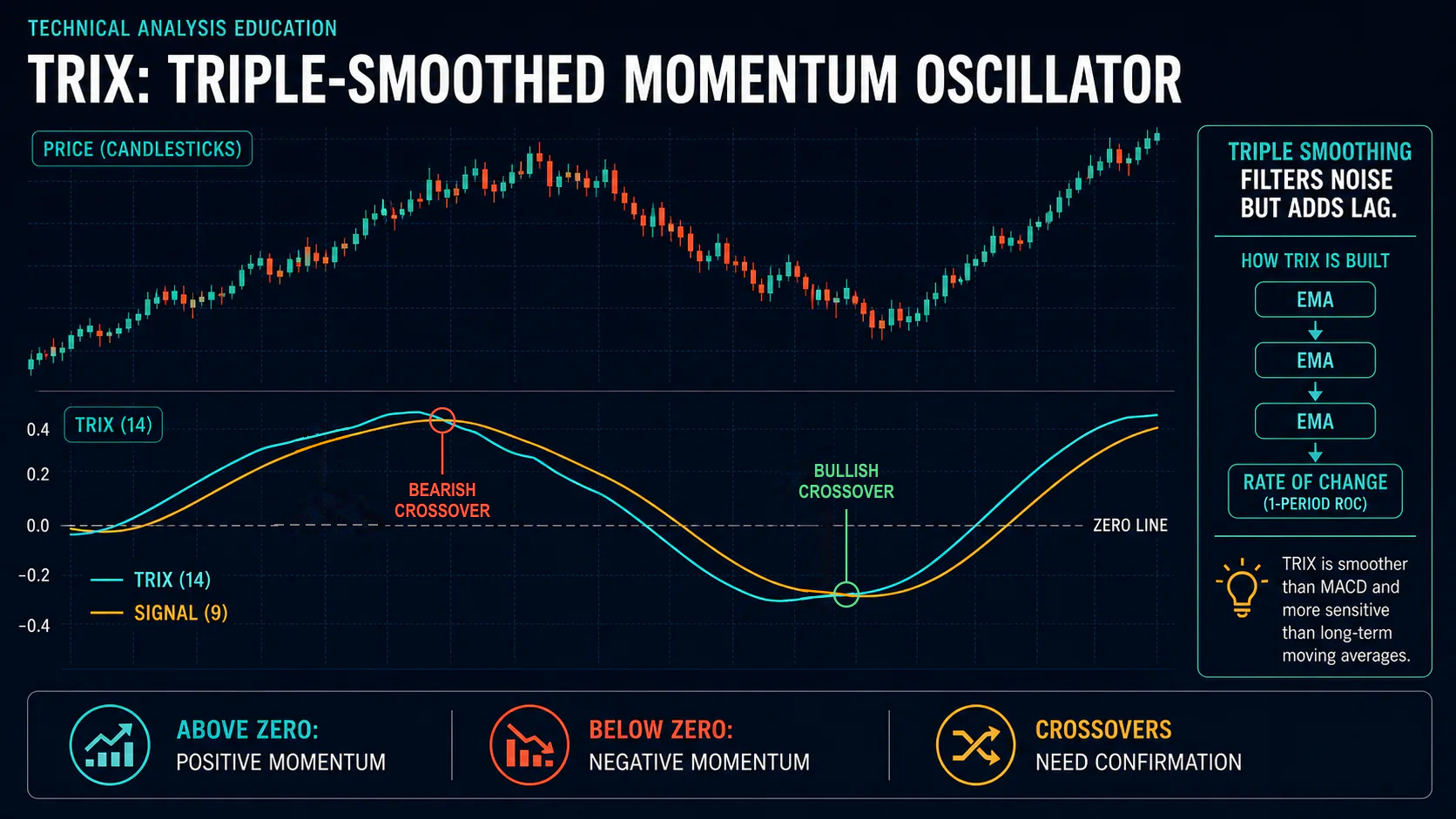
The triple smoothing is what distinguishes TRIX from simpler oscillators: rather than measuring the rate of change of price directly, it measures the rate of change of an EMA of an EMA of an EMA. This heavier processing removes much of the noise that produces whipsaws in faster oscillators, at the cost of more lag before a signal appears. That tradeoff — fewer, later, but more reliable signals — is the defining characteristic of the indicator.
Key Uses
- Trend Bias: Zero-line position shows whether momentum is net bullish or bearish
- Divergence Detection: Momentum/price disagreement can flag a weakening trend
- Signal Line Timing: TRIX crossing its signal line gives entry/exit timing within the broader bias
- Noise Reduction: The triple smoothing filters out much of the chop that affects faster oscillators
How TRIX Works
Calculation
- EMA1 = EMA of closing price over the chosen period
- EMA2 = EMA of EMA1 over the same period
- EMA3 = EMA of EMA2 over the same period
- TRIX = (EMA3 − EMA3[previous]) / EMA3[previous] × 10,000
The result is the percentage bar-to-bar change of the triple-smoothed average, scaled up for readability, oscillating around zero.
Default Parameters
- Period: 15 (applied to all three EMA passes)
- Signal line: 9-period EMA of TRIX
- Centerline: zero
Interpreting TRIX
- TRIX above zero: bullish momentum bias; sustained readings above zero reinforce the trend read
- TRIX below zero: bearish momentum bias; sustained readings below zero reinforce the trend read
- Zero-line crossover: the more significant signal — a shift from negative to positive (or vice versa) marks a potential change in the dominant trend, with the usual lag from the triple smoothing
- Signal-line crossover: a faster, earlier signal than the zero-line cross, more reliable when it agrees with the zero-line bias than when it runs against it
Trading Strategies
Zero-Line Crossover
A cross from negative to positive, confirmed by a sustained move above zero and supportive price action, is treated as a bullish trend-change signal; the mirror applies on the downside. Because of the lag, waiting for the crossover to hold for more than a bar or two, rather than acting on the first tick across zero, reduces the odds of reacting to a false cross.
Signal-Line Crossover
TRIX crossing above its signal line is a bullish timing cue, most reliable when both lines already sit above zero; the mirror applies below zero for bearish signals. This crossover fires earlier than a zero-line cross and can be used for entry timing within a bias already established by the zero-line position.
Divergence
A bullish divergence — price making a lower low while TRIX makes a higher low, particularly while TRIX is still in negative territory — warns that downside momentum is fading; the mirror (higher high in price, lower high in TRIX, above zero) warns that upside momentum is fading. As with other oscillators, look for at least two clear divergent points and confirmation from price action before acting, since a divergence can persist for a long stretch before it resolves.
Combining TRIX with Other Indicators
A longer-term moving average (50/200) establishes the dominant trend, and TRIX signals taken only in that direction tend to be more reliable than counter-trend ones. RSI provides a second, less-smoothed momentum read — a divergence that shows up on both TRIX and RSI simultaneously carries more weight than either alone. MACD, though calculated differently, plays a similar confirming role: alignment between MACD's histogram and TRIX's zero-line position adds conviction, and disagreement between them is a reason for caution. Volume expansion on a zero-line or signal-line cross adds confirmation; a cross on light volume is more likely to fail.
Market Conditions
TRIX performs best in trending markets, where the zero line cleanly separates bullish and bearish phases and the signal line offers usable entries within the trend. In range-bound markets its heavy smoothing becomes a liability — it tends to lag short-term reversals and can miss range extremes that a faster oscillator would catch, so pairing it with a faster indicator or reducing position size is the standard adjustment. In volatile conditions the triple smoothing filters out much of the noise that would whipsaw a faster indicator, at the cost of even more lag during rapid moves.
Common Mistakes
- Expecting fast signals: TRIX's lag is the direct cost of its noise filtering — treat it as a trend and divergence tool, not a precise timing tool.
- Trading against the zero-line bias: a signal-line cross that runs counter to the zero-line position is a weaker, lower-conviction signal.
- Skipping confirmation: pair TRIX signals with price action, volume, or another indicator rather than acting on TRIX alone.
- Applying it on very short timeframes: the smoothing makes TRIX poorly suited to fast scalping timeframes; it fits swing and position trading better.
FAQs
What makes TRIX different from other momentum oscillators?
The triple exponential smoothing removes much more short-term noise than a single-smoothed oscillator like RSI or the standard MACD, producing more reliable but later signals.
Why does TRIX use triple smoothing?
Each smoothing pass removes another layer of short-term noise while the final rate-of-change step preserves the underlying momentum trend, trading responsiveness for reliability.
How should the lag be handled?
Treat it as the cost of TRIX's noise reduction rather than a flaw to fix — use TRIX for trend bias and major turns, and pair it with a faster indicator if more timely entries are needed.
What's the significance of a zero-line crossover?
It marks a shift in the direction of underlying momentum and is among TRIX's more reliable signals, though it always arrives after the smoothing lag, so confirming with price action adds value.
Can TRIX be used for day trading?
It's better suited to swing and position trading given its lag. Day traders who want to use it typically shorten the period or pair it with a faster oscillator for timing.
Should the 9-period signal line be adjusted?
The standard 9-period EMA works well for most uses. A shorter period gives faster but noisier signals; a longer period gives smoother but later ones.
Conclusion
TRIX's triple exponential smoothing produces a cleaner, less whipsaw-prone momentum read than most oscillators, at the direct cost of lag. That tradeoff makes it best suited to swing and position traders who want fewer, higher-quality signals rather than frequent trading opportunities. The zero line gives the primary directional bias, the signal line adds entry timing within that bias, and divergences — confirmed by price action — are typically its most reliable individual signal. As with any lagging indicator, the discipline is accepting the delay rather than fighting it.