Bearish Deliberation
Updated Aug 26, 2026
- Signal
- Bearish Reversal
- Reliability
- Moderate
- Rarity
- Common
- Confirmation
- Required
- Trend Position
- Uptrend Top
On this page
The bearish deliberation pattern, also called a stalled pattern, is a three-candle sequence that appears late in an uptrend: two long bullish candles followed by a third, much smaller bullish candle that opens at or near the second candle's close. Unlike a full reversal pattern, deliberation doesn't claim that sellers have taken control — it's a warning that the advance is running out of energy, which may lead to a pause, a period of consolidation, or eventually a genuine top.
Recognizing the Pattern
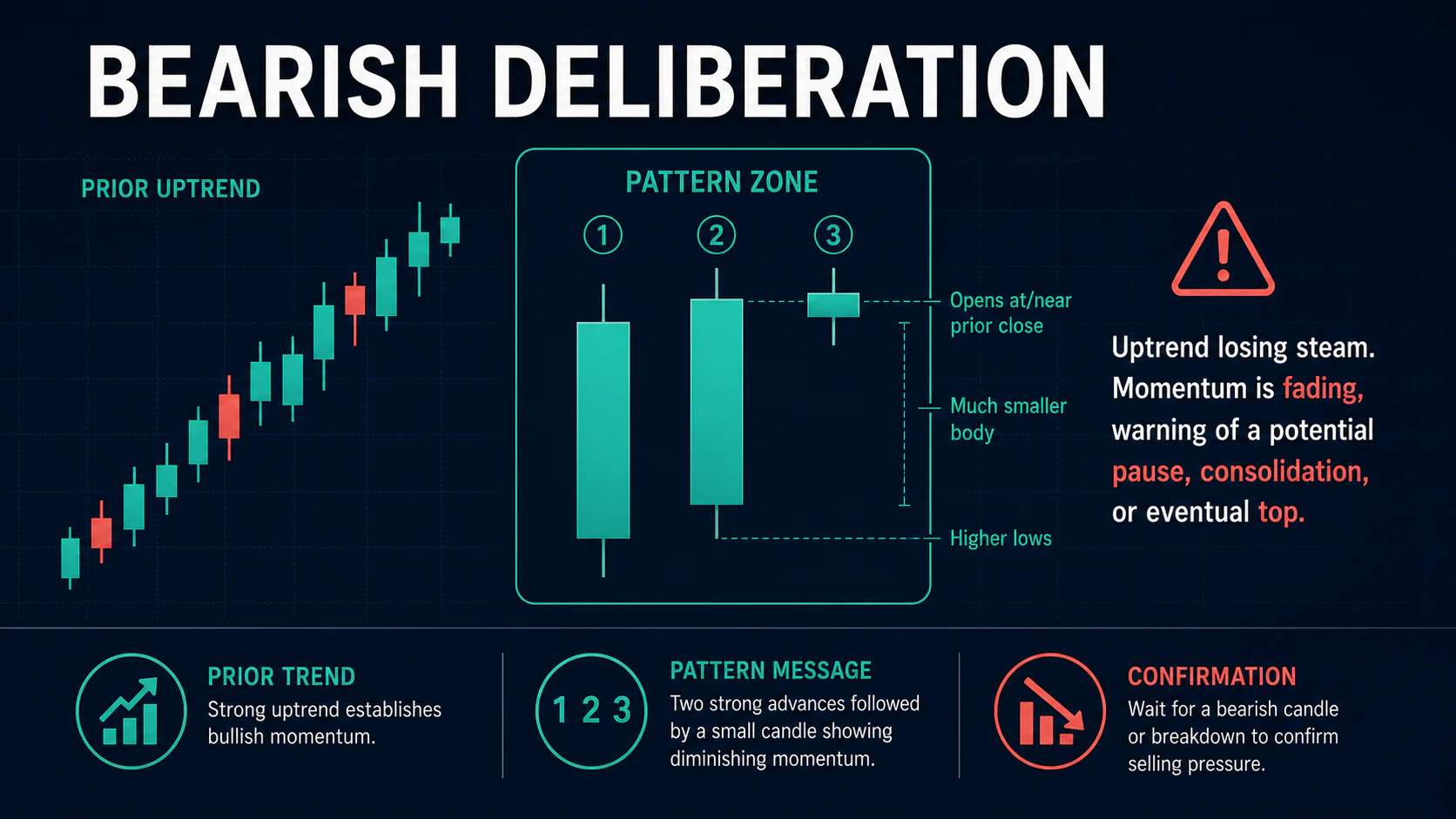
First candle: A long bullish candle continuing the uptrend with meaningful range, showing buyers clearly in charge.
Second candle: Another long bullish candle, similar in size to the first, extending the advance further.
Third candle: A noticeably smaller bullish candle that opens at or near the second candle's close, often showing little net progress and sometimes a small upper shadow. This candle is still white or green — if it turns into a doji or gaps away from the second candle, the pattern is better described as a doji star or evening star instead, both stronger and more decisive reversal signals.
The defining feature of deliberation is that shrinking third candle, not a change in color or a gap — it's the market visibly struggling to make further progress while still nominally advancing.
Market Psychology
The first two candles show sustained buying with real conviction. The third candle tells a different story: price still closes higher, but the range and the net gain both shrink sharply, as if the last buyers willing to pay up are running out. It's a subtler signal than a doji star or evening star, both of which show an outright stall or reversal within the same session. Deliberation instead shows the trend still technically intact but visibly losing momentum — a caution sign for continued buyers rather than a declaration that sellers have won.
Trading the Pattern
Entry
Because the pattern is only a warning, not a completed reversal, wait for a subsequent close below the pattern's low before treating it as a short setup. Entering directly off the third candle assumes a reversal that the pattern itself hasn't yet confirmed.
Stop Loss
Place stops above the high of the three-candle formation — a continued advance past that point means the "deliberation" was simply a pause, not exhaustion.
Profit Targets
Favor nearby support levels for initial targets, and treat the trade conservatively given that the pattern is a weaker signal than a full three-candle reversal like an evening star.
Combining With Indicators
The pattern is worth taking more seriously when it coincides with overbought readings on RSI or stochastics, a bearish MACD divergence, or formation at a well-established resistance level. It's also worth comparing against the related advance block pattern, another three-white-candle warning of fading momentum, to see which better matches the specific candle shrinkage you're observing.
Common Mistakes
- Treating deliberation as a confirmed reversal rather than what it actually is — a warning that momentum is fading.
- Mislabeling a doji or gapping third candle as deliberation, when those features point instead to a doji star or evening star.
- Trading the pattern without waiting for an actual break of the pattern's low.
- Ignoring volume, which often declines through the three candles and can help confirm that participation is genuinely fading.
FAQs
Is deliberation the same as an evening star?
No. An evening star's middle or final candle shows a clear stall or reversal, often with a gap. Deliberation's third candle is still a small bullish candle showing reduced, not reversed, momentum — a milder, earlier warning than an evening star.
Does deliberation guarantee a top?
No. It signals that an advance is losing steam, which can resolve as a pause, sideways consolidation, or eventually a reversal — not necessarily an immediate top.
What if the third candle is a doji instead of a small bullish candle?
Then the pattern is better classified as a doji star, a different and generally more decisive warning pattern.
How is this different from an advance block?
Both describe fading momentum across three white candles. Advance block typically shows progressively shrinking bodies and growing upper shadows across all three candles, while deliberation shows two strong candles followed by one notably smaller one.
Conclusion
Bearish deliberation is a momentum warning, not a reversal signal in its own right — two strong advances followed by a third that barely moves the needle. Respect that distinction: wait for an actual break of the pattern's low before treating it as tradeable, and don't confuse it with the more decisive doji star or evening star patterns that share a similar three-candle structure.