Bearish Belt Hold
Updated Aug 26, 2026
- Signal
- Bearish Reversal
- Reliability
- Moderate
- Rarity
- Common
- Confirmation
- Required
- Trend Position
- Uptrend Top
- Best Timeframes
- Daily+
On this page
A bearish belt hold is a single-candle pattern that opens at or very near the session's high and then closes at or near the session's low, with little to no upper shadow. Appearing after an advance, it shows sellers taking control from the opening bell and holding that control through the close, without buyers ever mounting a real intraday challenge.
Recognizing the Pattern
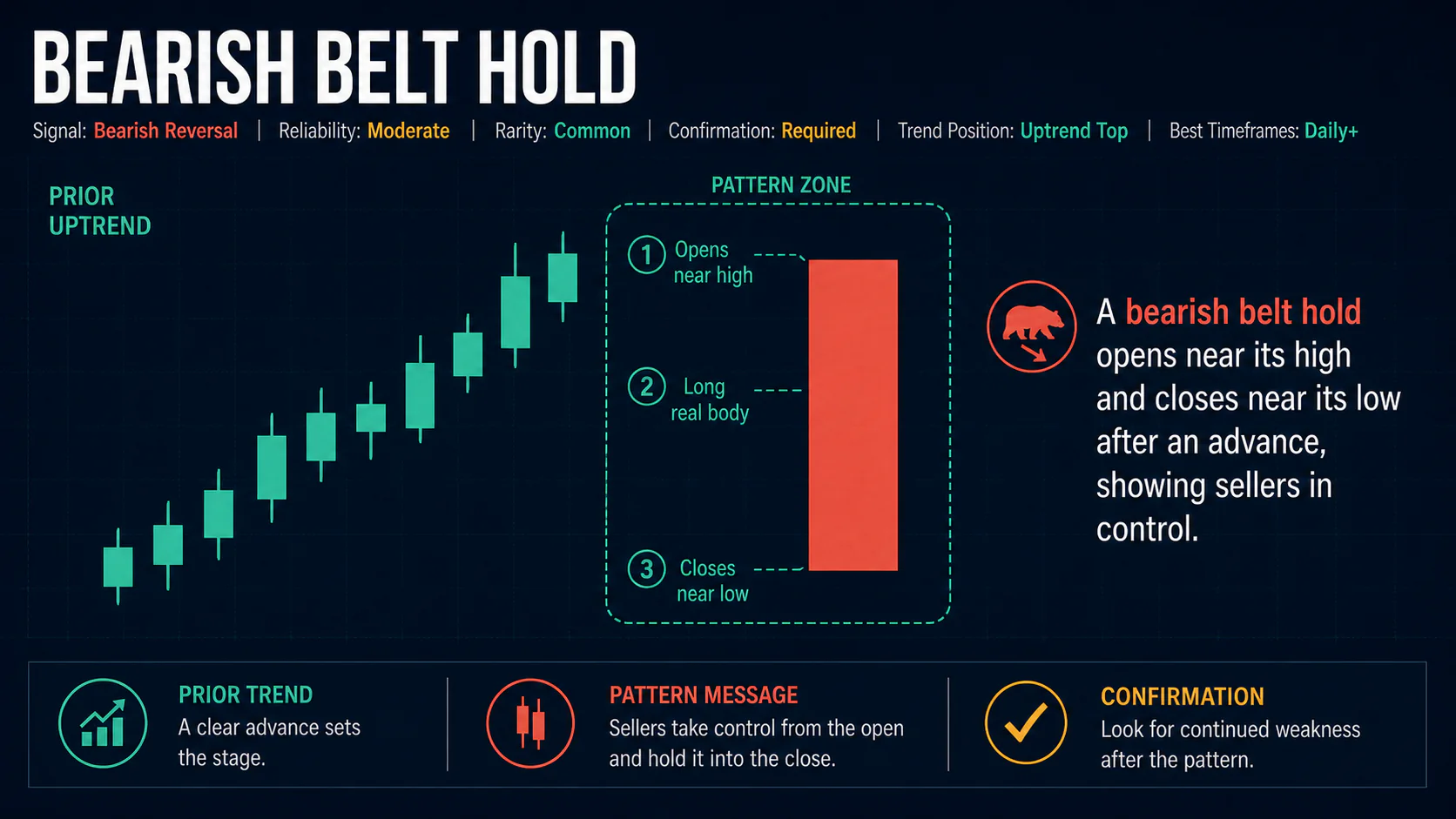
Opens at the high: The session opens with little to no upper shadow, meaning the open itself was effectively the high of the day.
Long real body: The body dominates the candle's range, reflecting a long, largely uninterrupted decline through the session.
Closes at or near the low: Little to no lower shadow either — sellers were still in control as the session ended.
Uptrend context: The pattern needs a genuine prior uptrend to carry reversal significance; the same shape after a decline is instead a bullish belt hold (see the bullish belt hold).
Market Psychology
An opening at the high followed by a straight decline to the low says sellers were ready to act from the first trade of the session and never lost the initiative. There's no meaningful intraday tug-of-war here, unlike a doji or spinning top — the belt hold is a statement of one-sided control for an entire session. After a run-up, that kind of decisive, uncontested selling is a reasonable signal that sentiment has shifted, though a single session of this kind of pressure still benefits from follow-through before being treated as a confirmed reversal.
Trading the Pattern
Entry
Wait for the following session to close below the belt hold's low, or to break a nearby support level, before entering short. Patterns that occur on above-average volume, suggesting broader participation, deserve more weight.
Stop Loss
Place stops above the belt hold's high — any close back above that level suggests buyers have reasserted themselves.
Profit Targets
Target nearby support levels first. Some traders project the belt hold's body length downward from its low as a rough minimum target, though this is a guideline rather than a rule.
Combining With Indicators
The signal is more convincing when it forms at a recognizable resistance level or major moving average, and when RSI or stochastic readings are already overbought. Volume noticeably above the recent average also supports the idea that the selling reflects broad participation rather than a thin, easily reversed session.
Common Mistakes
- Trading belt holds that appear in sideways or already-declining markets, where there's no uptrend to reverse.
- Accepting candles with a meaningful upper shadow, which weakens the "sellers controlled the open" premise the pattern depends on.
- Entering during the belt hold session itself instead of waiting for confirmation.
- Ignoring volume, which is one of the more useful ways to separate a convincing belt hold from a thin, low-conviction one.
FAQs
What makes a belt hold different from a regular bearish candle?
The defining feature is where it opens and closes: a belt hold opens essentially at the day's high and closes essentially at the day's low, with little to no shadow on either end — a stronger, more one-sided statement than an ordinary down candle.
Does a bearish belt hold need to appear after an uptrend?
Yes, for the reversal interpretation to apply. The identical shape can also appear mid-trend as a continuation signal, where its implications are different.
How important is volume for this pattern?
Very. Since the pattern's strength comes from sellers controlling the entire session, higher-than-usual volume adds confidence that the move reflects real participation rather than thin trading.
Do I need to wait for confirmation?
Yes — a single belt hold shows decisive selling for one session, but a follow-through close below its low provides much stronger evidence that the reversal is holding.
Conclusion
The bearish belt hold is one of the more visually direct reversal candles: sellers in control from the opening trade to the close, with no real contest along the way. That clarity makes it easy to spot, but a single session of one-sided selling still benefits from confirmation and volume context before it's treated as a genuine trend change.