Bearish Two Crows
Updated Aug 26, 2026
- Signal
- Bearish Reversal
- Reliability
- Moderate
- Rarity
- Rare
- Confirmation
- Recommended
- Trend Position
- Uptrend Top
- Best Timeframes
- Daily+
On this page
The Bearish Two Crows is a rare three-candle reversal pattern that forms at the top of an uptrend. A strong bullish candle is followed by a black candle that gaps up on the open but closes lower, then a second black candle that opens inside the first black candle's body and closes even lower, cutting back into the original white candle's range. The two dark candles perched above the white candle give the pattern its name — and its ominous reputation — though its rarity means most traders will only encounter a handful of clean examples over time.
Recognizing the Pattern
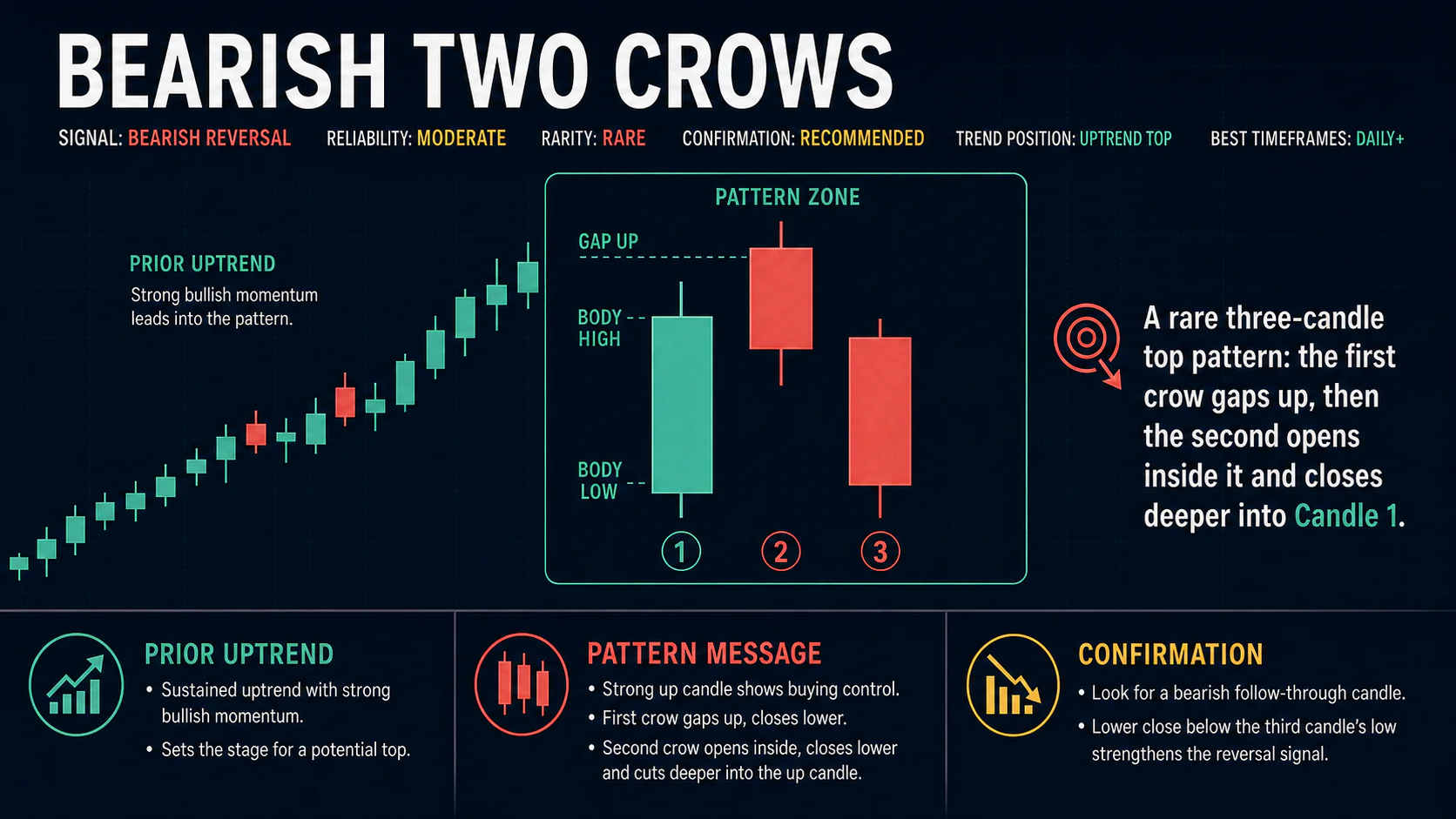
First candle: a strong bullish candle continuing the uptrend, with good size and volume.
Second candle (first crow): gaps up from the first candle's close but closes bearish, with the close still landing within the upper portion of the first candle's body.
Third candle (second crow): opens within the second candle's real body — it does not gap up again — and closes lower than the second candle, penetrating further into the first candle's body.
Only the second candle needs to gap up; the third candle's defining feature is opening inside the prior crow's body and pushing the close deeper into the white candle's range. The pattern needs a genuine uptrend behind it, and the deeper the third candle penetrates into the first candle's body, the more convincing the signal.
Quick Recognition Checklist
- Sustained uptrend precedes the pattern
- First candle is a strong bullish candle with solid volume
- Second candle gaps up from the first candle's close, then closes bearish
- Third candle opens inside the second candle's body without a new gap
- Third candle closes lower than the second, penetrating into the first candle's body
- Deeper penetration into the first candle's body signals a stronger setup
A Related Pattern
The Evening Star shares the same three-session, top-of-trend setup but uses a small-bodied middle candle instead of two consecutive gap-up failures — worth comparing when learning to tell these formations apart, since both describe a similar loss of upside momentum through different candle mechanics.
Notable Variations
A version where the second crow closes in the lower half of the first candle's body is a materially stronger signal than one where it barely dips inside the first candle's range, since deeper penetration reflects more forceful selling. Formation at a well-tested resistance level, rather than in open space, adds a structural reason for the reversal on top of the candle pattern itself.
Market Psychology
The pattern captures a fast unraveling of bullish sentiment across three sessions, from confidence to outright failure.
First Candle: Continued Confidence
- Buyers extend the uptrend with real conviction and solid volume
- The session reflects broad participation rather than a thin, low-volume drift higher
First Crow: The Gap Fails
- The gap-up open shows one more burst of optimism
- The session fails to hold, closing lower and signaling supply meeting demand at higher prices
Second Crow: Confirmation
- The session opens inside the previous body rather than gapping further, showing buyers can no longer even attempt a fresh push higher
- Sellers press the close deeper into the first candle's range
- The buying interest behind the original gap has clearly evaporated
Trading the Pattern
Entry
Most traders enter short once the third candle closes, since that is when the pattern is complete. More conservative traders wait for the following session to confirm additional weakness — for instance, an open below the third candle's close.
Stop-Loss
A stop above the pattern's highest point, usually the second candle's high, is the standard placement, since any close back above that level undoes the pattern's bearish premise.
Profit Targets
Reasonable targets include the nearest support level below the pattern, or a projection of the first candle's size measured downward from the third candle's close. Given the pattern's rarity and moderate reliability, scaling into targets rather than committing to a single fixed objective is a sensible approach.
Confirmation and Indicator Confluence
The pattern is more convincing when RSI is overbought and beginning to roll over, when MACD shows bearish divergence heading into the pattern, or when the formation occurs at a well-defined resistance level. A gap-down open on the session after the pattern completes is one of the stronger confirmation signals available.
Volume characteristics on the two crow candles also matter: heavier volume on the failed gap-up sessions is more consistent with active distribution, while light volume can simply reflect a lack of buyers rather than active selling — the former is the more reliable read on the pattern.
Broader market and sector conditions round out the picture. A Two Crows pattern that forms while related stocks or the overall index are also showing early signs of topping carries more weight than the same three candles appearing in an otherwise strongly trending market, where an isolated stumble is more likely to be temporary.
Common Mistakes
- Treating the third candle as if it needs its own gap up — its defining feature is opening within the second candle's body, not gapping further.
- Trading the pattern without a clear uptrend behind it.
- Entering after only the second candle, before the third candle confirms the failure.
- Ignoring how deep the third candle penetrates into the first candle's body — shallow penetration is a weaker signal than a close near or below the first candle's midpoint.
- Sizing the trade as if this were a high-reliability pattern; it's a moderately reliable, infrequent signal that benefits from confirmation.
- Confusing this pattern with the Upside Gap Two Crows, which requires the gap to remain unfilled rather than closing back into the first candle's body.
FAQs
Why is it called "Two Crows"?
The two black (bearish) candles sit above the first white candle like a pair of crows perched over the chart — a visual metaphor from the pattern's origins in Japanese candlestick charting.
Does the second crow need to gap up too?
No. Only the first crow (second candle) gaps up from the prior close. The second crow (third candle) opens within the first crow's body without a new gap.
How is this different from the Upside Gap Two Crows?
In the Upside Gap Two Crows, both black candles stay above the original gap, which remains unfilled through the pattern. In the plain Two Crows, the second black candle closes back within the first candle's body, filling much of the gap.
Is this a common pattern?
No — it's considered rare, since it requires a fairly specific sequence of a gap-up failure followed immediately by a non-gapping second failure.
What would invalidate the pattern?
A close back above the second candle's high on a subsequent session suggests buyers have regained the upper hand.
Does the pattern need to occur exactly at a resistance level?
No, but formation near a well-established resistance level or prior high adds a structural reason for the reversal, making an already moderately reliable pattern somewhat more trustworthy.
Can this pattern appear in a strong bull market and still be meaningful?
It can appear anywhere an uptrend exists, but its signal carries more weight when other stocks or the broader market are also showing early cracks — an isolated Two Crows during an otherwise powerful, broad-based rally is more likely to resolve as a brief pause than a genuine top.
Conclusion
The Bearish Two Crows captures a specific and infrequent kind of top: an uptrend that gaps higher on hope, only to fail twice in a row. Its rarity means traders won't see it often, but when the full three-candle structure is present — including the second crow opening inside the first crow's body — it offers a moderately reliable signal that buying momentum has broken down. Patience for that complete structure, rather than acting on a partial resemblance, is what keeps the pattern useful.