Bearish On Neck
Updated Aug 26, 2026
- Signal
- Bearish Continuation
- Reliability
- Moderate
- Rarity
- Common
- Confirmation
- Recommended
- Trend Position
- Mid-Trend
- Best Timeframes
- Daily+
On this page
The bearish on neck pattern is a two-candle continuation pattern that forms in a downtrend. A long black candle is followed by a white candle that gaps down at the open, recovers during the session, but can only close at or very near the low of the prior candle. That weak, stalled recovery is read as a sign sellers remain in control and the downtrend is likely to continue.
Recognizing the Pattern
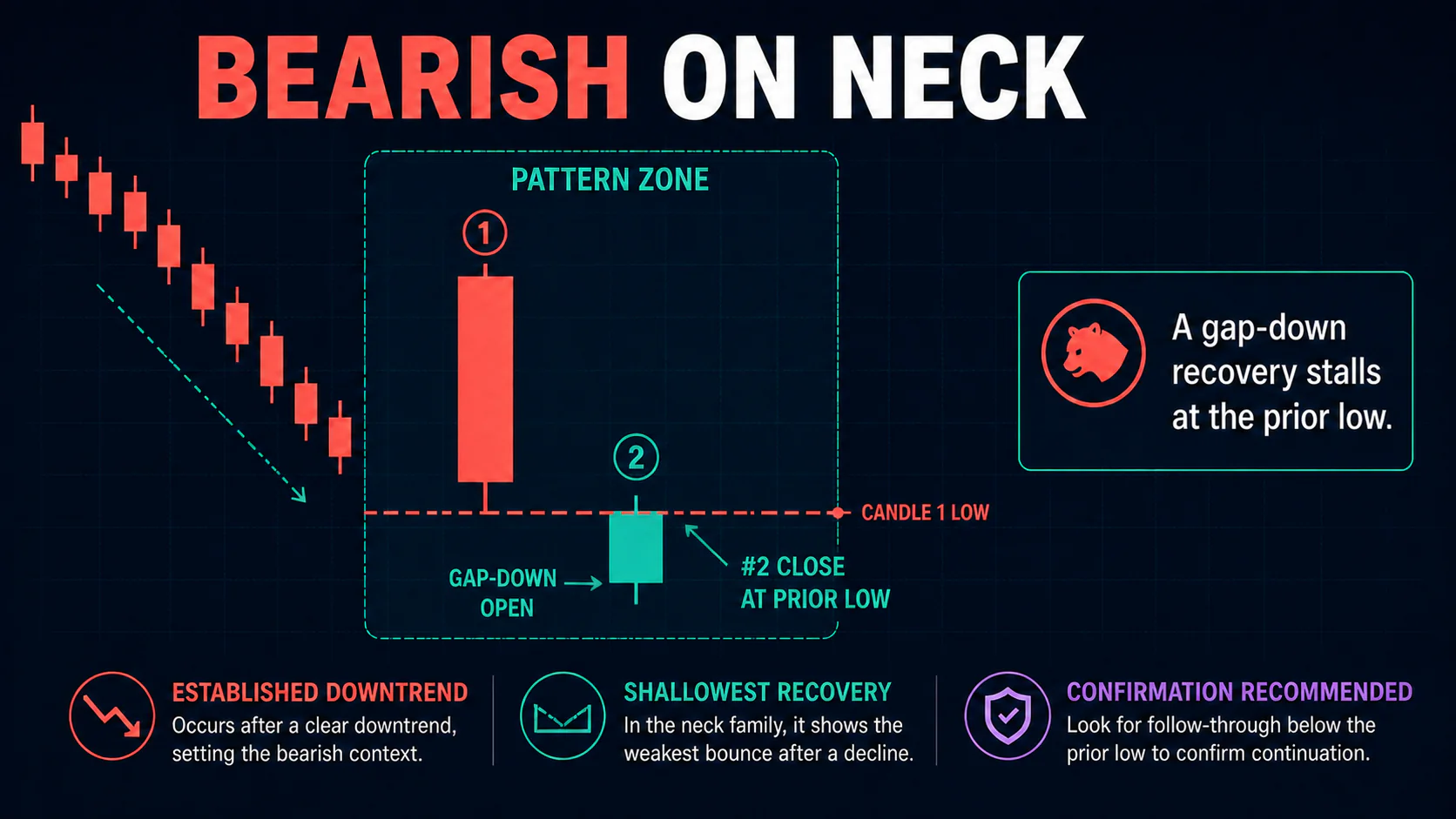
First candle: a strong black candle with a sizeable real body, confirming sellers controlled the session.
Second candle: a white candle that opens below the first candle's low (a gap-down open), rallies during the session, but closes at or only fractionally above the first candle's low - the shallowest possible recovery among this family of patterns.
On neck sits at one end of a family of three closely related patterns that share the same basic setup - a long black candle followed by a gap-down white candle in a downtrend - and differ only in how far the second candle's close penetrates the first candle's body. On neck is the shallowest, closing right around the prior low; in neck closes a little higher, just above the prior close; and thrusting closes deeper still, though always below the first candle's midpoint. A close above that midpoint would instead be read as a bullish piercing line.
As with its relatives, the pattern only has continuation meaning when it appears inside an established downtrend.
Market Psychology
The strong first candle establishes a new low that becomes the test level for the pattern. The gap-down open on the second candle shows selling pressure spilling into the next session, and while buyers manage an intraday recovery, they cannot push the close past the prior low - previous support is acting as new resistance. That failure at such a low bar signals buyers currently lack the conviction to challenge the trend, and sellers are likely to use the bounce as a fresh opportunity to add to short positions.
Variations
The purest form of on neck has the second candle close exactly at the first candle's low; slight variations where the close lands a fraction of a percent above the low are still read the same way, since the essential point is that the recovery stalls right at the prior floor rather than pushing meaningfully into the black candle's body. A version with a longer intraday recovery that still fails at the low is a somewhat more convincing setup than one with almost no recovery at all, since it shows buyers genuinely tried and still failed.
Trading the Pattern
Entry: many traders wait for the session after the pattern to open lower or close in the bottom half of the second candle's range before entering short, since the pattern alone only reflects a very narrow test of resistance.
Stop-loss: place stops above the high of the second candle; a sustained move above that level would undercut the bearish read.
Targets: project the length of the first candle downward from the pattern's low as an initial target, then look toward the next significant support level.
Confirmation
Confirmation is especially important for on neck given how narrow its margin is. Look for the next session to open lower or extend the decline with expanding volume; a session that instead pushes back up through the first candle's close should be treated as a sign the pattern has failed rather than merely paused.
Combining with Indicators
RSI remaining in bearish territory and the pattern forming beneath a key moving average both add supporting context, as does a MACD reading that stays negative through the two-candle formation.
Common Mistakes
The most common error is treating any weak bounce as a valid on neck setup - the close needs to sit close to the prior candle's low, not simply somewhere inside its body, which would make it in neck or thrusting instead. Skipping confirmation is a second common mistake, since the pattern's margin for error is thin and a slightly stronger follow-through session can flip the near-term picture. Trading it outside a clear downtrend, or ignoring volume on the recovery candle, are the other frequent pitfalls.
FAQs
What makes on neck different from in neck and thrusting?
All three start the same way - a long black candle followed by a gap-down white candle - but on neck's close lands right at the prior candle's low, the shallowest recovery of the three.
Is bearish on neck a strong signal on its own?
Not particularly. It is a common pattern with only moderate reliability, and its very narrow margin means it benefits more than most patterns from waiting for confirmation.
Does the second candle need to gap down?
Yes, a gap-down open is part of the definition; without it, the pattern does not qualify as on neck.
What invalidates the pattern?
A close well above the prior candle's low - deep enough into the body to resemble in neck or thrusting - or a subsequent session that reclaims the first candle's close both undercut the bearish read.
Where does the "neck" name come from?
It refers to the second candle's close landing right at, or just above, the low point of the prior black candle, creating the visual impression that gives the pattern its name.
Should on neck be traded differently from thrusting?
Yes - because on neck shows a weaker recovery than thrusting, it generally warrants more conservative position sizing and a stronger preference for waiting on confirmation before entering.
Conclusion
Bearish on neck is a narrow-margin continuation signal: a bounce that could barely clear the prior session's low. Because that margin is thin, it works best as one confirming piece of evidence within a broader downtrend thesis rather than a standalone trade trigger.