Bearish Breakaway
Updated Aug 26, 2026 · Reviewed by Terence Scott, founder
- Signal
- Bearish Reversal
- Reliability
- Moderate
- Rarity
- Rare
- Confirmation
- Recommended
- Trend Position
- Uptrend Top
On this page
The bearish breakaway is a five-candle top reversal pattern. A long white candle is followed by a gap up, then two or more small candles drift sideways or slightly higher, before a long black candle erases the drift and closes back inside the original gap. That final reversal candle is what confirms the uptrend has broken down.
Recognizing the Pattern
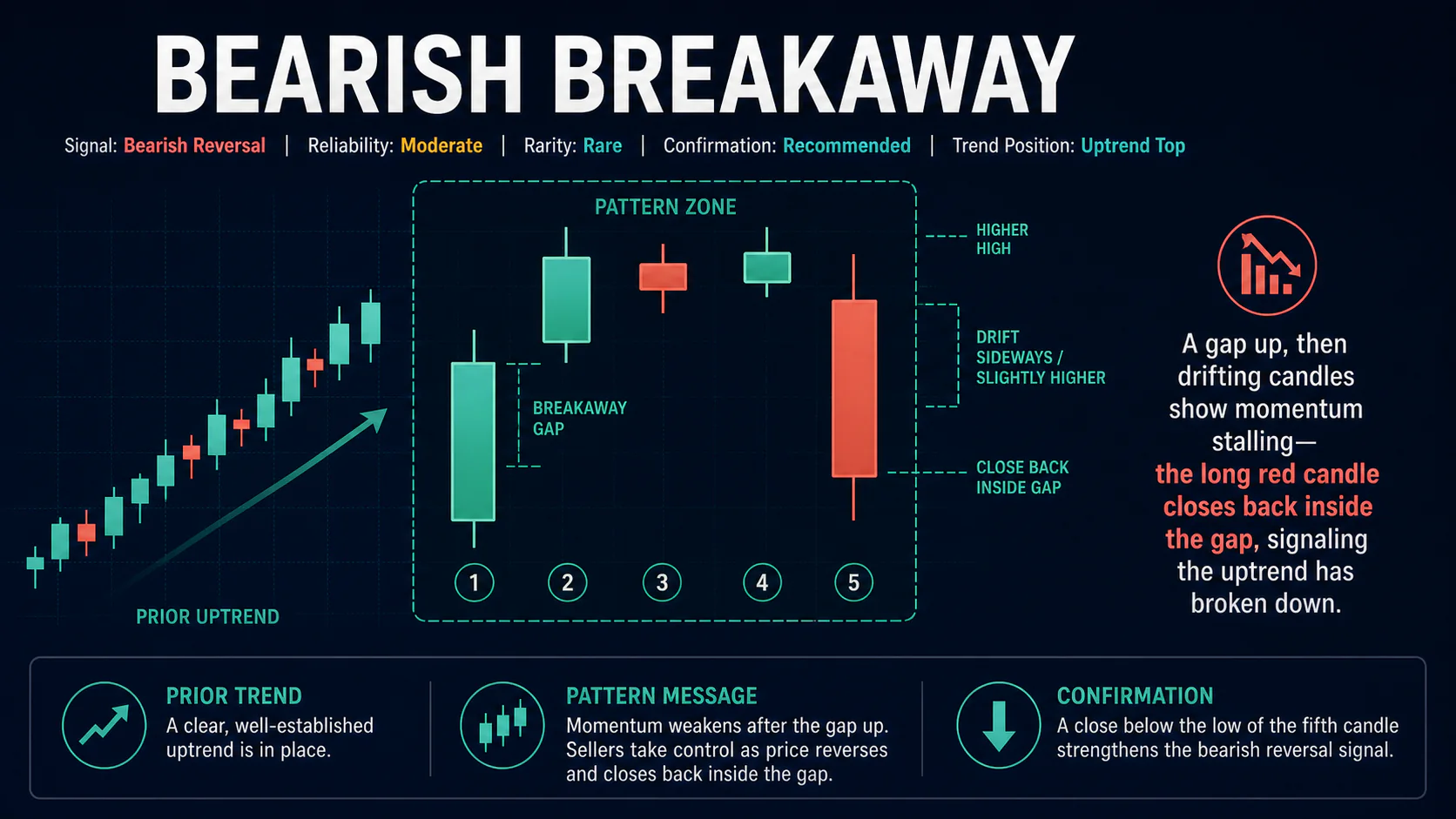
First candle: a long white candle that continues the prevailing uptrend with conviction.
Second candle: gaps up from the first candle, opening above its high. This is the "breakaway gap" that gives the pattern its name.
Third and fourth candles: small-bodied candles of any color that drift, typically continuing slightly higher or moving sideways, without breaking down. These candles show waning momentum rather than an outright reversal - the trend is stalling, not yet failing.
Fifth candle: a long black candle that reverses sharply and closes back inside the gap created between the first and second candles, erasing the drift of candles three and four and part of the second candle's advance. The close does not need to reach below the first candle's low; landing back inside the original gap is what completes the pattern.
The pattern requires a well-established uptrend beforehand; without one, the gap-and-drift sequence has no reversal significance. If price recovers back above the gap area shortly after the fifth candle, the reversal is considered to have failed.
Market Psychology
The long first candle and the gap up that follows reflect strong, confident buying - the kind of move that draws in late momentum buyers. The small drifting candles that come next show that confidence starting to fade: price can no longer make decisive progress, even though it has not yet turned down. That stall is often the first sign buyers are running out of new demand while some holders quietly begin taking profits. The long black fifth candle is the release of that built-up hesitation - a session where sellers finally overwhelm the market, erasing the recent drift and pulling price back into the gap that once looked like strength. Landing back inside that gap signals the earlier breakout has failed and shifts the market's psychology from optimistic to defensive.
Variations
The drift phase can last longer than the minimum two candles, with three or four small sessions instead of two before the reversal candle finally appears; the underlying logic is unchanged as long as the drift never breaks down on its own before the long black candle arrives. A version where the fifth candle closes well below the first candle's low, rather than just inside the gap, is a stronger and more convincing reversal than one that barely dips back into the gap.
Trading the Pattern
Entry: enter short once the fifth candle closes back inside the original gap, ideally with increased volume; some traders wait for a failed retest of the breakdown level for a higher-conviction, tighter-risk entry.
Stop-loss: place stops above the high of the second candle (the top of the original gap) - a recovery back above that level would undo the pattern's premise.
Targets: project the size of the original gap downward from the breakdown point for an initial target, then look to significant support levels below the pattern - prior lows, moving averages, or round numbers.
Confirmation
The strongest confirmation is simply the absence of any quick recovery back above the gap once the fifth candle completes it. Expanding volume on the fifth candle supports genuine selling rather than a thin, low-conviction session, and continued weakness over the sessions that follow adds further conviction to the reversal.
Combining with Indicators
RSI or MACD showing bearish divergence across the five-candle sequence, and the pattern forming near a known resistance level, both add supporting context.
Common Mistakes
Entering before the full five-candle sequence completes is the most common mistake, since the third and fourth candles alone do not confirm anything - the reversal only exists once the fifth candle closes back inside the gap. Mistaking a normal pullback for the drift phase, or treating the third and fourth candles as if they must be declining candles rather than simply stalling ones, are also common misreadings of the structure. As always, trading the pattern without a genuine prior uptrend removes its reversal significance. For the mirror-image bottoming pattern, see bullish breakaway.
FAQs
What does the fifth candle need to close below?
It needs to close back inside the gap formed between the first and second candles - not necessarily below the first candle's low, though a deeper close adds conviction.
What do the third and fourth candles represent?
They represent a stalling uptrend - small, often quietly higher or sideways candles that show buying momentum fading before the actual reversal candle appears.
Is bearish breakaway a common pattern?
No, it is rare. A specific five-candle sequence with a clean initial gap and a decisive final reversal does not appear often.
What invalidates the pattern?
A quick recovery back above the gap after the fifth candle completes suggests the breakdown failed and the pattern should not be relied on.
How is bearish breakaway different from bearish kicking?
Kicking is a fast, two-candle gap reversal built from marubozu candles. Breakaway is a slower, five-candle process where an uptrend stalls before finally reversing.
Does the initial gap need to be filled completely?
No. The pattern only requires the fifth candle's close to land back inside the gap, not to fill it entirely or push beyond the first candle's low, though a deeper close is a stronger signal.
Conclusion
Bearish breakaway captures a slower unwind than most reversal candlesticks: an uptrend that stalls over several sessions before a decisive black candle closes back into the gap that once marked its strength. Because the full pattern takes five sessions to complete, patience through the drift phase and confirmation after the reversal candle are both essential.