Bearish Marubozu
Updated Sep 2, 2026 · Reviewed by Terence Scott, founder
- Signal
- Bearish Continuation/Reversal
- Reliability
- Moderate to Strong
- Rarity
- Uncommon
- Confirmation
- Recommended
- Trend Position
- Any (context decides)
- Best Timeframes
- Daily+
On this page
A bearish marubozu — the black marubozu — is a single candle with a long bearish real body and no shadows: the session opens at its exact high and closes at its exact low. From the first trade to the last, sellers gave no ground. It is the mirror image of the bullish marubozu, and the most unambiguous one-candle expression of selling pressure that a chart can print.
Recognition Criteria
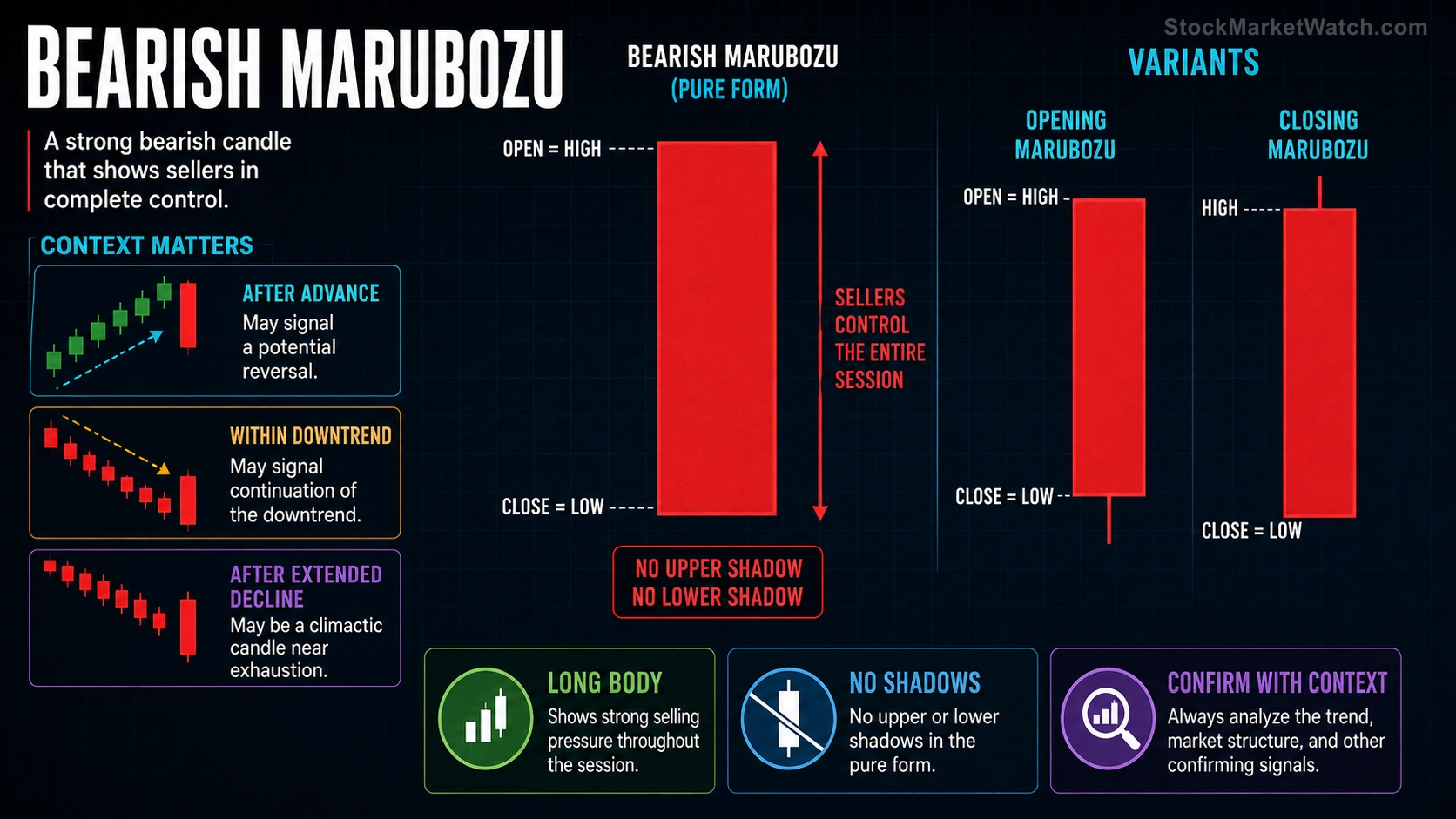
- A long bearish (black/red) real body, substantially larger than the recent average candle
- No upper shadow: the open is the session high
- No lower shadow: the close is the session low
- Tick-sized shadows are tolerated in practice; any wick large enough to represent a real counter-move disqualifies the pattern
The Variants
- Black opening marubozu — no upper shadow (opens at the high), small lower shadow allowed. Sellers dominated from the open; a late bounce lifted the close slightly off the low. After an advance, this is the same structure as the bearish belt hold.
- Black closing marubozu — no lower shadow (closes at the low), small upper shadow allowed. Buyers tried early, failed, and the session finished at its absolute worst price. Generally read as the stronger partial form: closing on the dead low means selling pressure persisted into the bell.
- Long black candle — a dominant bearish body with small shadows at both ends. Same message, slightly diluted, far more common.
Market Psychology
Opening at the high means the first print of the day was the best exit anyone got — every holder who hesitated sold lower or is still holding. Closing at the low means supply was still coming at the final bell, with no dip-buyers willing to lift price even into the close. The session contained no successful defense by bulls at any point.
After an uptrend, a black marubozu marks a decisive change of control and often begins a deeper correction. Within an established downtrend, it confirms the sellers remain in charge. The caveat mirrors the bullish case: deep into an extended decline, a climactic all-day sell-off is frequently capitulation — the final flush that precedes a bounce — rather than the start of another leg down. A gap-down black marubozu after weeks of decline is closer to panic than to information.
Trading the Bearish Marubozu
Entry
Traders shorting on the pattern typically act on the close when it breaks support or rejects a key level, or wait for the next session to fail below the candle's midpoint — the retrace-then-fail sequence shows the sellers who drove the candle are defending it.
Stop-Loss
The invalidation level is the marubozu's open (its high); a reclaim of that price erases the one-sided session entirely. On oversized candles, the midpoint offers a tighter alternative at the cost of more shake-out risk.
Targets
No measured move is implied; the next support level, or a trailing stop above each lower high, does the work. Long-holders use the pattern defensively — a black marubozu through a stop level is a reason to be gone, not to negotiate.
Combining With Indicators
- Volume: heavy volume marks distribution; light volume marks an easily-reversed drift.
- Location: the candle matters most breaking support, rejecting resistance, or ending an advance — and least mid-range.
- Momentum: an RSI already near oversold before the candle prints raises the odds it is climax rather than commencement; pairing with ATR helps distinguish a genuinely outsized session from ordinary volatility.
Common Mistakes
- Shorting the third act. A black marubozu after a long decline is the classic capitulation candle; chasing it sells the low.
- Ignoring the bounce. Full-range down candles invite a reflex rally into the body; short entries at the close must be sized to survive it.
- Reading every red candle as a marubozu. The pattern demands both range dominance and shaven ends — an ordinary down day carries none of the same information.
FAQs
Is the bearish marubozu a reversal or continuation signal? Either — context decides. After an advance it warns of reversal; inside a downtrend it confirms continuation; after a long decline it may be capitulation.
How does it relate to the bearish belt hold? The belt hold is a black opening marubozu appearing specifically after an advance. The full marubozu is the stricter, shadowless form.
What about three black marubozu-like candles in a row? Three consecutive long black candles stepping lower is its own classic pattern — the three black crows.
Conclusion
The bearish marubozu is total seller control compressed into one bar. At the break of support or the top of a tired advance it is one of the strongest single-candle warnings available; at the bottom of a waterfall decline it is usually the flush that ends the move. As with its bullish twin, the candle states only who won the session — the chart around it states what that victory means.