Bullish Marubozu
Updated Sep 2, 2026 · Reviewed by Terence Scott, founder
- Signal
- Bullish Continuation/Reversal
- Reliability
- Moderate to Strong
- Rarity
- Uncommon
- Confirmation
- Recommended
- Trend Position
- Any (context decides)
- Best Timeframes
- Daily+
On this page
A bullish marubozu — also called a white marubozu — is a single candle with a long bullish real body and no shadows at either end: the session opens at its exact low and closes at its exact high. The name comes from the Japanese for "bald" or "shaven head," because nothing sticks out beyond the body. It is the purest one-candle statement the market can make: buyers were in control from the first trade to the last, and sellers never once forced price below the open or off the high.
Recognition Criteria
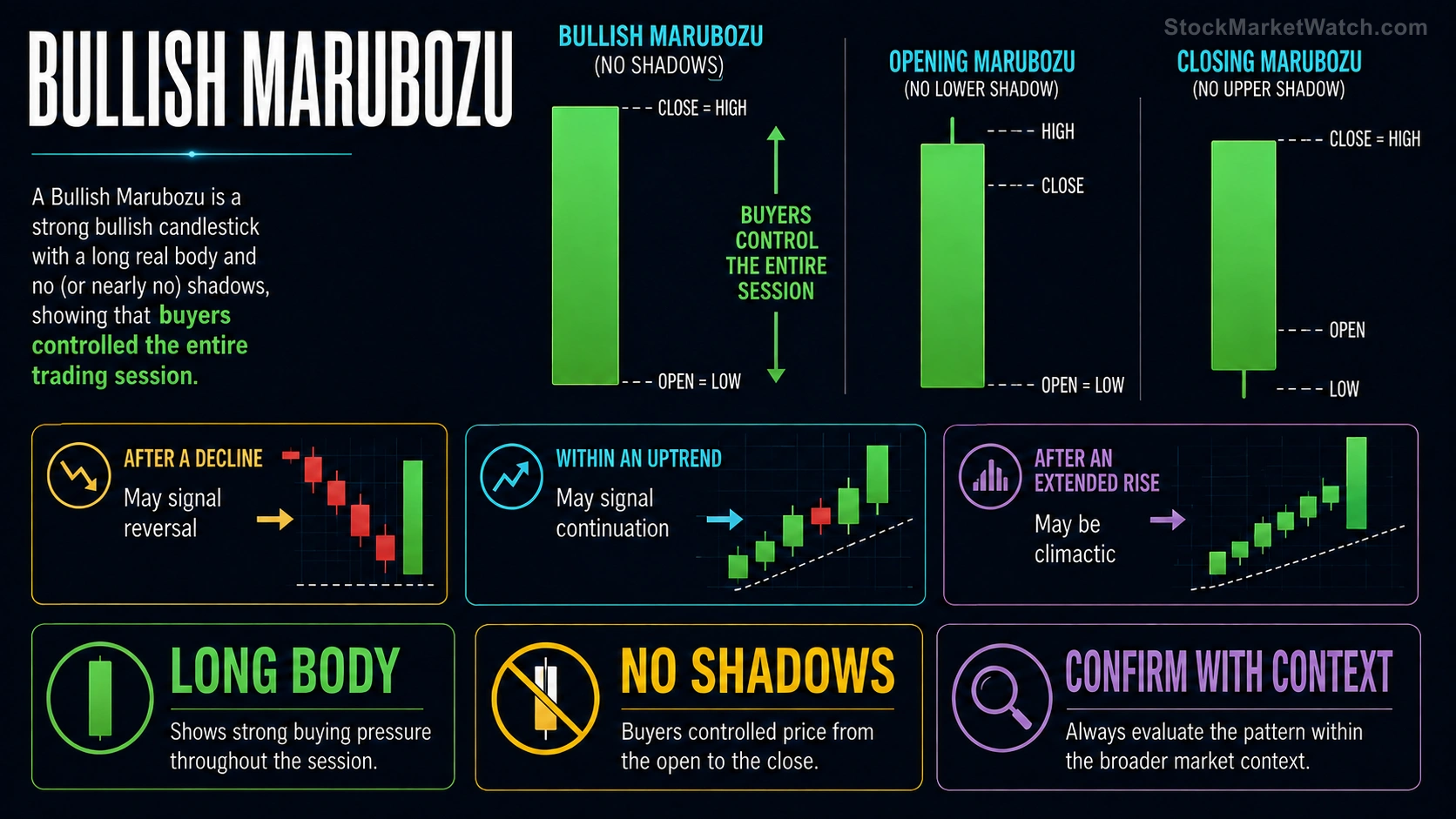
- A long bullish (white/green) real body — substantially larger than the recent average candle
- No lower shadow: the open is the session low
- No upper shadow: the close is the session high
- In practice, tiny shadows of a few ticks are usually tolerated; what disqualifies the pattern is any shadow large enough to show a meaningful counter-move
The full pattern is uncommon precisely because it is demanding — most strong sessions still print at least a small wick on one end. That rarity is part of the signal.
The Variants
Traditional candlestick charting names two partial forms, each dropping one of the requirements:
- White opening marubozu — no lower shadow (opens at the low), but a small upper shadow is present. Buyers dominated from the open, though the close slipped slightly off the high. When this candle appears after a downtrend, it is the same structure as the bullish belt hold.
- White closing marubozu — no upper shadow (closes at the high), but a small lower shadow is present. Sellers made an early stand, lost it, and price finished at its best level of the day. Many traders consider this the stronger partial form: closing on the absolute high means conviction into the bell, with no late profit-taking.
- Long white candle — the loosest relative: a dominant bullish body with small shadows on both ends. It carries the same essential message with slightly less force, and appears far more often.
All four candles sit on one spectrum — the message is "one-sided session," and the fewer and smaller the shadows, the more absolute the statement.
Market Psychology
Opening at the low means the very first print was the cheapest price of the day — every buyer who acted got filled at levels never seen again that session. Closing at the high means demand was still unsatisfied at the final bell; nobody holding profits felt compelled to sell before the close. Between those two facts sits a session with no successful counterattack by sellers at all.
Context decides what that means. After a decline, a bullish marubozu marks a sudden, decisive change of control — capitulation met by aggressive buying. Inside an established uptrend, it is a continuation statement: the trend's sponsors are still paying up. After a long, extended advance, however, the same candle deserves suspicion — climactic one-sided sessions frequently appear near the end of moves, when the last buyers rush in (the same crowd behavior behind an exhaustion gap).
Trading the Bullish Marubozu
Entry
Aggressive traders act on the close of the marubozu itself, particularly when it breaks out of a base or reclaims a key level on strong volume. Conservative traders wait for the next session to hold above the marubozu's midpoint — a full-range candle invites a partial retrace, and the midpoint hold shows the buyers who drove it are defending their territory.
Stop-Loss
The natural invalidation is the marubozu's open (its low). A return below that level erases the entire one-sided session and with it the premise of the trade. On a very large candle, some traders use the midpoint as a tighter stop, accepting more shake-out risk for better sizing.
Targets
The pattern itself projects no measured target; traders typically work toward the next resistance level or manage the position with a trailing method such as a fast moving average or Parabolic SAR.
Combining With Indicators
- Volume: a marubozu on heavy volume is institutional conviction; the same candle on thin volume is far easier to reverse.
- Location: the candle gains meaning at support, at a breakout level, or after a downtrend — and loses it in the middle of nowhere.
- Momentum: an RSI already deep in overbought territory before the candle warns that the one-sided session may be climax, not commencement.
Common Mistakes
- Chasing an extended move. The third marubozu-like candle in a near-vertical run is more likely exhaustion than fresh strength.
- Ignoring the retrace. Full-range candles are frequently followed by a pullback into the body; entering at the close with a stop at the low means enduring that retrace by design.
- Treating small candles as marubozu. A shadowless but short body is just a quiet session — the pattern requires dominance of range, not merely absence of wicks.
FAQs
Is a bullish marubozu a reversal or continuation pattern? Either — the candle shows total buyer control, and the prevailing trend supplies the interpretation. After a decline it suggests reversal; within an uptrend, continuation.
How is it different from a bullish belt hold? The belt hold is a white opening marubozu (no lower shadow, small upper shadow allowed) appearing specifically after a decline. The full marubozu is stricter — no shadows at all — and is read in any trend context.
What is the bearish equivalent? The bearish (black) marubozu — the mirror image, where sellers control the session from open to close.
Conclusion
The bullish marubozu is candlestick charting reduced to its essence: one bar, one message, no ambiguity about who won the session. Its value comes entirely from context — at support or out of a base it is among the most decisive single-candle signals; at the top of a vertical move it is a warning dressed as strength. Read the location first, the candle second.