Bullish Upside Gap Three Methods
Updated Aug 26, 2026 · Reviewed by Terence Scott, founder
- Signal
- Bullish Continuation
- Reliability
- Moderate
- Rarity
- Extremely Rare
- Confirmation
- Required
- Trend Position
- Mid-Trend
- Best Timeframes
- Daily+
On this page
The Bullish Upside Gap Three Methods is a three-candle continuation pattern that appears during an uptrend. Two bullish candles form with a true gap up between them, and then a bearish candle opens inside the second candle's real body and closes back inside the first candle's body — completely filling the gap. Despite that gap being erased, the traditional reading is that the uptrend resumes: the pullback is treated as concentrated profit-taking that clears the way for the advance to continue.
How to Recognize the Pattern
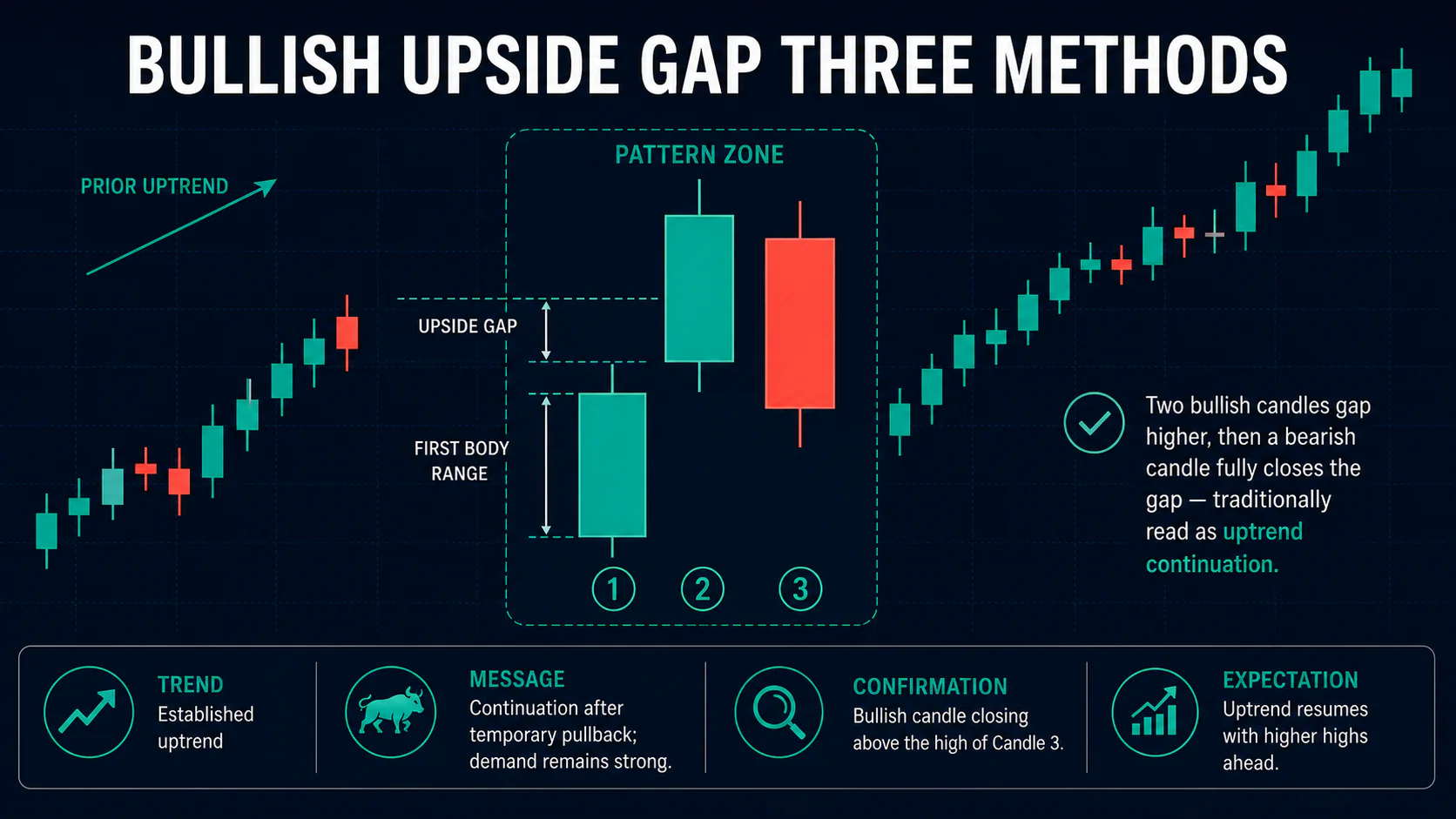
- First candle: a long bullish candle within an established uptrend.
- Second candle: another bullish candle that gaps up from the first — no overlap with the first candle's high, including shadows.
- Third candle: a bearish candle that opens within the second candle's real body and closes within the first candle's real body, completely closing the gap between the first two candles.
A genuine gap between the first two candles is essential — if their ranges overlap at all, the pattern doesn't apply. Equally essential is that the third candle fully closes the gap. A bearish candle that only dips partway into the gap and leaves it open is a different pattern (the Upside Tasuki Gap) with its own logic.
| Check | What to look for |
|---|---|
| Prior trend | Established uptrend before the first candle |
| Gap | True gap between candles one and two, no shadow overlap |
| Third candle | Bearish, opens in the second body, closes inside the first body |
| Gap status | Completely filled by the third candle's close |
Market Psychology
The gap between the first two candles reflects buying pressure strong enough to leave a void on the chart. The third candle looks alarming — it gives back the entire gap in a single session. The traditional interpretation is that this flush is driven by short-term traders locking in gains after a fast advance, not by a genuine change in the balance of supply and demand. Once that profit-taking is absorbed, the argument goes, the path of least resistance remains higher, and the market resumes the trend from a healthier footing. What the pattern cannot tell you on its own is whether the gap-fill really was profit-taking or the start of genuine distribution — which is why confirmation matters so much here.
What the Track Record Suggests
This is a rare pattern, and its real-world behavior is less settled than the traditional label implies. Pattern research (notably Thomas Bulkowski's testing of its bearish mirror, the Downside Gap Three Methods) has found that gap-three-methods formations frequently resolve opposite to their textbook classification. A filled gap removes a support reference other traders were watching, and whether price reclaims the gap area afterward is far more informative than the three-candle structure alone. Treat the pattern as a setup to watch, not a signal to act on by itself.
How It Differs From Similar Patterns
Upside Tasuki Gap: same first two candles, but the third candle only partially fills the gap and closes inside it. In the Tasuki Gap the surviving gap acts as support; in Upside Gap Three Methods the gap is fully erased and the bullish case rests on the trend reasserting itself afterward. The two are distinguished by exactly one criterion — whether the gap closes.
Rising Three Methods: also a bullish continuation with a counter-trend middle, but built from three small pullback candles contained within one long candle's range, with no gap involved.
Downside Gap Three Methods: the bearish mirror image — two gapping black candles and a white candle that fills the gap in a downtrend.
Trading the Pattern
Entry
Because the third candle erases the gap, most traders require the trend to prove itself again before entering: a subsequent close above the third candle's open, or better, above the second candle's high. Entering on the third candle's close — before any resumption — leans entirely on the traditional label and offers no evidence the pullback has actually ended.
Stop-Loss
A stop below the third candle's low is the natural placement: if selling continues below the level where the gap-fill ended, the profit-taking explanation has failed. A stop below the first candle's low is more conservative and gives the pattern more room at the cost of a wider risk.
Profit Targets
The prior swing high and the second candle's high are the first natural objectives, since the pattern's claim is simply that the advance resumes. Beyond that, use the stock's own resistance levels rather than a formula — this pattern has no widely accepted measured-move rule.
Confirmation
Confirmation is not optional here. Wait for at least one session closing back above the third candle's open (or the second candle's high for a stricter standard), ideally with volume picking up again on the resumption. If instead the next sessions keep closing lower, the "profit-taking pause" reading is dead and the same three candles are better understood as the start of a reversal.
Combining With Indicators
The continuation case is more credible when the broader trend context stays intact through the pullback: price holding above a rising moving average, RSI pulling back toward the midzone rather than breaking below it, and a MACD histogram that shrinks without a decisive bearish crossover. Volume adds useful color — lighter volume on the third candle supports the profit-taking interpretation, while heavy volume on the gap-fill suggests genuine distribution and argues against the pattern.
Common Mistakes
- Confusing it with the Upside Tasuki Gap. If the gap survives the third candle, it's a Tasuki Gap; if it's fully closed, it's Upside Gap Three Methods. The trading logic differs, so the distinction isn't pedantic.
- Trading it without a true gap. Any overlap between the first candle's range and the second candle's range invalidates the setup.
- Acting without confirmation. The third candle alone shows only that the gap filled — it says nothing about what happens next.
- Ignoring volume on the third candle. A high-volume gap-fill looks like distribution, not profit-taking, and undermines the pattern's premise.
- Forcing it outside an uptrend. Without an established prior trend, there is nothing for the pattern to continue.
FAQs
Why is a fully filled gap still considered bullish?
The traditional reasoning is that the gap-fill concentrates all the profit-taking into one visible flush, after which the underlying demand that created the gap can push price higher again. That logic only holds if the trend actually resumes — which is why the pattern requires confirmation.
How is this different from the Upside Tasuki Gap?
By one criterion: the Tasuki Gap's third candle leaves part of the gap unfilled, and the surviving gap acts as support. In Upside Gap Three Methods, the third candle closes the gap entirely. Same cast of candles, different mechanics.
Is this pattern reliable?
It's rare, and research on gap-three-methods patterns suggests they resolve against their traditional label often enough that the honest answer is: only with confirmation. The resumption after the gap-fill is the signal; the three candles alone are just the setup.
Does the third candle have to close inside the first candle's body?
Yes — that's what "completely closing the gap" means in practice. A close that stops inside the gap area leaves the gap partially intact and makes the formation a Tasuki Gap instead.
What invalidates the pattern after it forms?
Continued selling below the third candle's low. At that point the pullback has outgrown the profit-taking explanation, and the formation reads as a failed continuation rather than a pause.
Conclusion
The Bullish Upside Gap Three Methods describes a sharp, contained give-back within an uptrend: a gap up, then a single bearish candle that erases the gap entirely. Tradition classifies it as a continuation signal, but the pattern's real message is conditional — if buyers promptly reclaim the lost ground, the trend is intact; if they don't, the same candles mark the beginning of a reversal. Wait for the market to show which one you're looking at before committing to a trade.