Bullish Piercing Line
Updated Aug 26, 2026
- Signal
- Bullish Reversal
- Reliability
- Moderate
- Rarity
- Common
- Confirmation
- Recommended
- Trend Position
- Downtrend Bottom
- Best Timeframes
- Daily+
On this page
A bullish piercing line is a two-candlestick reversal pattern that appears after a downtrend. The first candle is a long bearish candle; the second opens below the first candle’s low, then rallies to close above the midpoint of the first candle’s real body — without closing above the first candle’s open. Named for the way the second candle “pierces” back up through the first candle’s body, it shows a session that opened weak but recovered convincingly.
Recognition Criteria
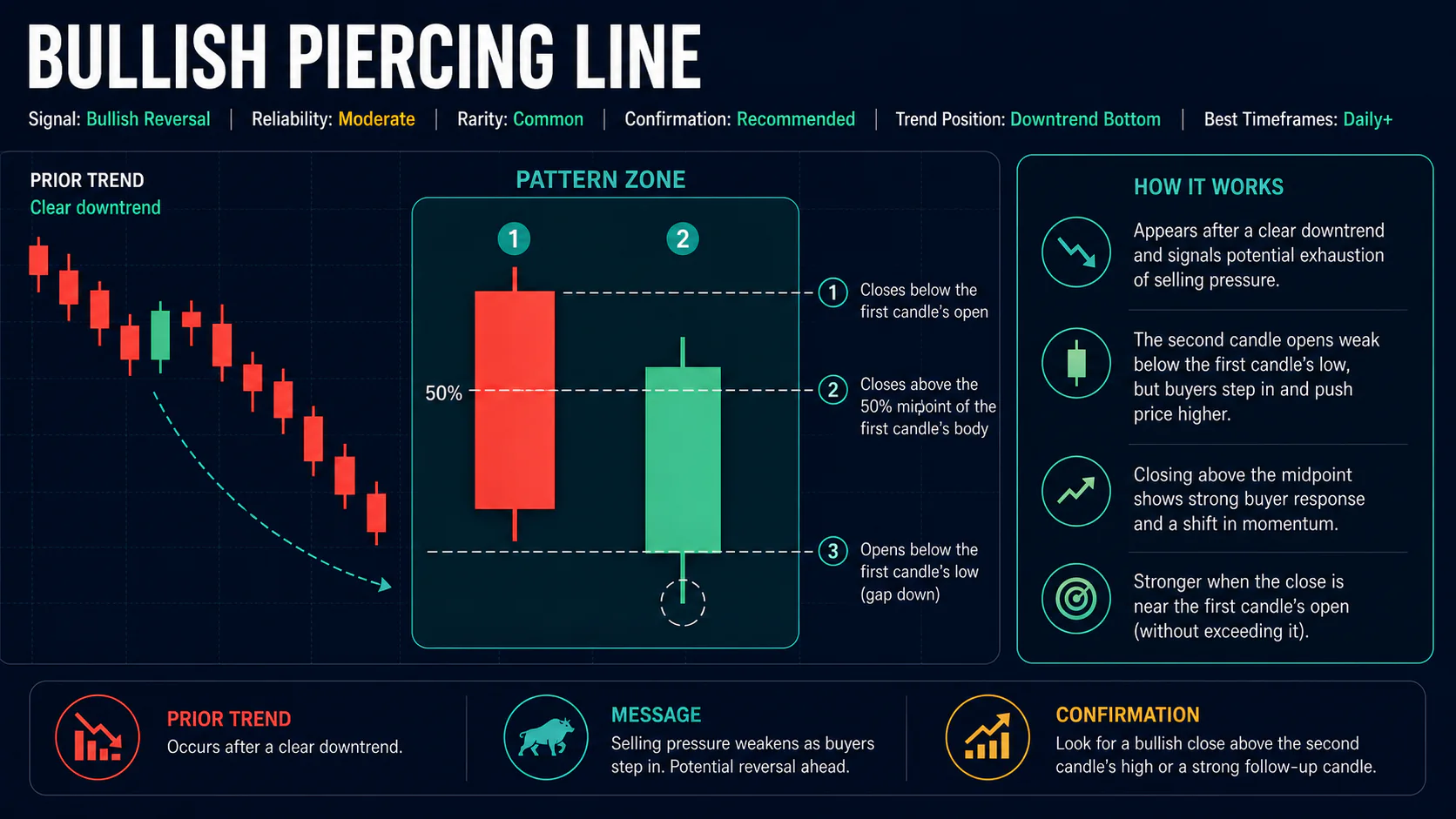
First candle: A substantial bearish candle continuing the existing downtrend, with a real body large enough to make the piercing that follows meaningful.
Second candle: A bullish candle that opens below the first candle’s low (a gap down) and closes above the midpoint of the first candle’s real body.
- The pattern must appear after a clear downtrend, not during consolidation
- The second candle must open below the first candle’s low
- The second candle must close above the 50% mark of the first candle’s real body
- The second candle’s close should stay below the first candle’s open — a close above the open would make it a bullish engulfing pattern instead
The deeper the second candle penetrates into the first candle’s body, the stronger the signal is generally considered. A close very near the first candle’s open — right at the edge of becoming an engulfing pattern — represents about as strong a piercing line as the pattern allows.
Market Psychology
The first candle reflects continued selling pressure, often the tail end of a decline driven by negative sentiment or a technical breakdown. The second candle’s gap-down open initially suggests more of the same, but the strong rally that follows shows value buyers stepping in, short sellers covering, and sentiment shifting mid-session. Anyone who sold into the opening weakness or added new short positions early in that second session ends up on the wrong side of the move by the close — a dynamic often described as a bear trap.
Variations
A piercing line where the second candle closes only slightly above the 50% midpoint is the minimum valid version of the pattern. Deeper penetration — well above the midpoint and approaching the first candle’s open — is generally viewed as a stronger signal. Volume expansion on the second candle is a reasonable supporting factor, though not a formal requirement.
Trading the Piercing Line
Entry
A conservative approach waits for the next session to close above the piercing candle’s high before entering, reducing false signals at the cost of some of the initial move. A more active approach enters on a break above the piercing candle’s high with reasonable volume, typically during the third session.
Stop-Loss
Stops are commonly placed below the low of the piercing candle, since a break below that level would call the reversal into question. A more conservative stop below the low of the entire two-candle pattern offers additional room for normal volatility at the cost of a wider risk.
Targets
The next meaningful resistance level above the pattern — a prior swing high or a round number — is the most realistic first target. Some traders project the height of the first bearish candle upward from the piercing candle’s close as a rough measured-move estimate.
Confirmation
Confirmation means the session following the piercing candle continues higher, ideally closing above the piercing candle’s high. Waiting for this reduces the risk of acting on a pattern that stalls right at the midpoint, though it does mean entering at a somewhat higher price.
Combining With Indicators
A piercing line forming while the RSI is below 30, or while stochastic readings are oversold, adds context suggesting the decline was overextended. Formation at a major moving average, a prior support level, or a Fibonacci retracement level adds further weight. None of these are requirements of the pattern itself — they simply help judge whether the broader setup supports a reversal.
Common Mistakes
- Accepting a second candle that closes below the 50% midpoint of the first candle’s body — this falls short of a valid piercing line
- Confusing a piercing line with a bullish engulfing pattern by overlooking that the second candle’s close should stay below the first candle’s open
- Using a first candle with too small a real body, which weakens the significance of the piercing that follows
- Trading the pattern in a sideways market or a shallow pullback rather than after a genuine downtrend
FAQs
What’s the difference between a piercing line and a bullish engulfing pattern?
Both start with a bearish candle followed by a strong bullish one. In a piercing line, the second candle closes above the midpoint of the first candle’s body but below its open. In an engulfing pattern, the second candle closes above the first candle’s open, fully containing its body.
Does the second candle have to gap down at the open?
Yes — the gap below the first candle’s low is part of the definition. Without it, the pattern doesn’t qualify as a piercing line, even if the close still lands above the midpoint.
How does this compare to the bullish morning star?
The piercing line is a two-candle pattern; the morning star adds a third, small-bodied candle between the bearish and bullish candles. The morning star is rarer and generally considered somewhat more reliable, but the piercing line occurs more often and offers a comparable story in fewer sessions.
Is deeper penetration into the first candle’s body always better?
Generally, yes — deeper penetration reflects more decisive buying. But once the second candle closes above the first candle’s open, the pattern is no longer a piercing line; it becomes a bullish engulfing pattern instead.
Conclusion
The bullish piercing line captures a concise two-session story: continued weakness followed by a strong intraday reversal that closes back above the midpoint of the prior candle’s body. It occurs more frequently than three-candle formations like the morning star, making it a practical pattern to watch for, provided traders confirm the setup, respect the pattern’s stop level, and account for nearby resistance when setting targets.