Bullish Mat Hold
Updated Aug 26, 2026 · Reviewed by Terence Scott, founder
- Signal
- Bullish Continuation
- Reliability
- Moderate
- Rarity
- Rare
- Confirmation
- Recommended
- Trend Position
- Uptrend
- Best Timeframes
- Daily+
On this page
Bullish Mat Hold is a five-candle continuation pattern that appears during an established uptrend. A strong bullish candle is followed by a brief pullback of two or three small candles that stay above the first candle's low, and the pattern completes when a final bullish candle pushes to a new high. It's a close relative of the Rising Three Methods pattern, distinguished mainly by an initial gap up and a slightly looser consolidation phase.
Recognition Criteria
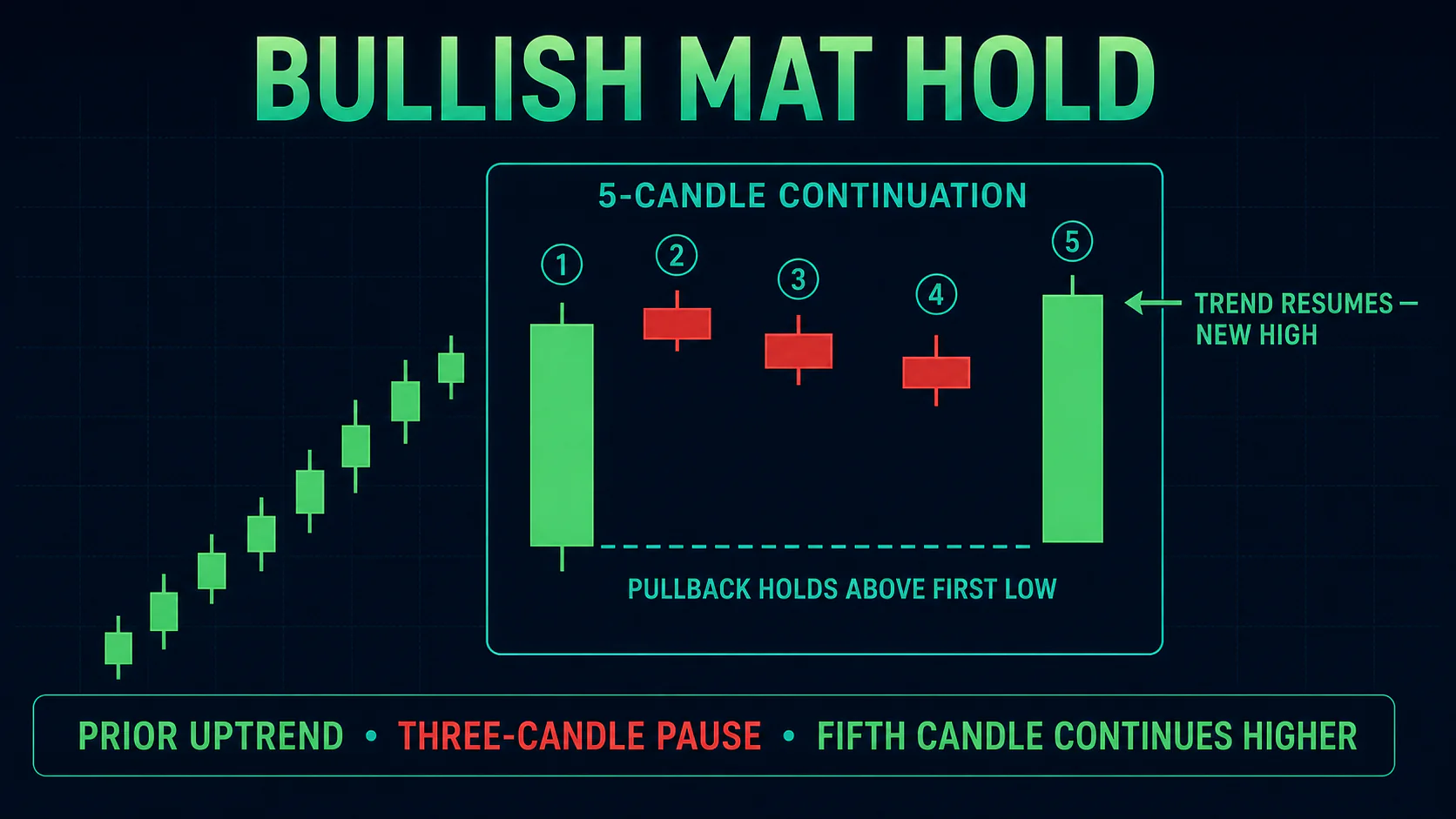
First candle: a long bullish candle that continues the existing uptrend with strong buying pressure.
Second candle: typically gaps higher on the open but often drifts to a bearish close, marking the start of a short corrective phase.
Third and fourth candles: small-bodied candles, bullish or bearish, that consolidate within a narrow range and — critically — do not trade below the first candle's low.
Fifth candle: a long bullish candle that closes above the high of the first candle, and of the pattern as a whole, confirming that the uptrend has resumed.
The first and fifth candles should be noticeably larger than the three consolidation candles in between — that size contrast is what makes the "hold" in the middle visually and structurally distinct.
Market Psychology
The first candle shows bulls firmly in control. The second candle's gap up followed by a weak close reflects early profit-taking, as some buyers lock in gains from the initial move. Over the third and fourth candles, neither side gains a decisive edge, but the key detail is what doesn't happen: sellers are never able to push price back below the first candle's low. That held support shows the correction is running out of selling pressure rather than turning into a genuine reversal. The fifth candle's push to a new high confirms buyers have reasserted control and the uptrend is continuing.
Variations
Some Mat Hold patterns show four small consolidation candles instead of three. The consolidation candles can be any mix of bullish and bearish bodies, as long as they respect the first candle's low. A gap up on the second candle is the classic form, but the pattern is still generally treated as valid without one if the other criteria hold. Mat Hold is closely related to the Rising Three Methods pattern; the practical distinction is Mat Hold's initial gap up and its generally looser, sometimes higher-closing consolidation phase.
Trading the Pattern
Entry
The straightforward approach is to enter once the fifth candle closes above the high of the first candle, confirming the pattern. More aggressive traders enter intraday during the fifth candle once it's clearly tracking toward a new high with supporting volume.
Stop Loss
Place stops below the low of the consolidation phase, candles two through four. A more conservative stop sits below the low of the first candle, giving the position more room at the cost of wider risk.
Targets
Measure the height of the entire pattern and project it upward from the breakout point as a starting estimate, then look to the next meaningful resistance level in the broader uptrend for a more realistic target.
Confirmation and Indicators
Volume tends to fall during the consolidation phase and should pick up again on the fifth candle — that volume signature is a useful confirmation that the breakout reflects renewed buying rather than drift. Moving averages, RSI, or MACD holding in bullish territory throughout the consolidation add further confidence that the underlying uptrend never actually broke down.
Common Mistakes
Trading it outside an uptrend: the pattern only has continuation meaning inside an established uptrend; in a sideways or bearish market it loses its significance.
Accepting range violations: if any of the consolidation candles trade below the first candle's low, the pattern's core structure has failed.
Undersized first or fifth candles: without meaningful size contrast between the outer candles and the consolidation, the pattern's psychology doesn't hold.
Entering before the fifth candle completes: acting during the consolidation phase, before confirmation, increases risk unnecessarily.
FAQs
How often does the Bullish Mat Hold pattern occur?
It's a relatively rare pattern — the specific five-candle sequence with a respected low doesn't form often, which is part of why it's considered a useful signal when it does.
Can the pattern work in a downtrend?
No. Bullish Mat Hold specifically requires an uptrend context. The mirror-image bearish version would require a downtrend instead.
How many consolidation candles are required?
Traditionally two or three — the second, third, and fourth candles — though variations with more small candles are generally accepted if the pattern still respects the first candle's low.
Is the pattern reliable enough to trade on its own?
It has moderate-to-good reliability as continuation patterns go, but like any single candlestick formation it works best combined with trend, volume, and momentum confirmation rather than traded in isolation.
How does this differ from Rising Three Methods?
The two patterns are close cousins. Rising Three Methods doesn't require a gap up on the second candle and typically shows a tighter, more contained consolidation than Mat Hold.
Conclusion
Bullish Mat Hold describes a healthy pattern of behavior inside an uptrend: a strong move, a shallow pullback that respects support, and a return to new highs. The consolidation phase isn't weakness — it's the market testing whether the prior advance can hold, and the fifth candle's new high is the answer. As with any continuation pattern, confirm with volume and be sure the setup is genuinely forming within an established uptrend before trading it.