Bullish Three Inside Up
Updated Aug 26, 2026
- Signal
- Bullish Reversal
- Reliability
- Moderate
- Rarity
- Common
- Confirmation
- Recommended
- Trend Position
- Downtrend Bottom
- Best Timeframes
- Daily+
On this page
Three Inside Up is a bullish reversal pattern built from a bullish harami plus one confirming candle. It forms after a downtrend: a large bearish candle is followed by a small bullish candle contained entirely within the first candle's body, and then a third candle that closes above the first candle's high. The harami on its own only hints at hesitation; the third candle is what turns that hesitation into a confirmed reversal signal.
How to Recognize the Pattern
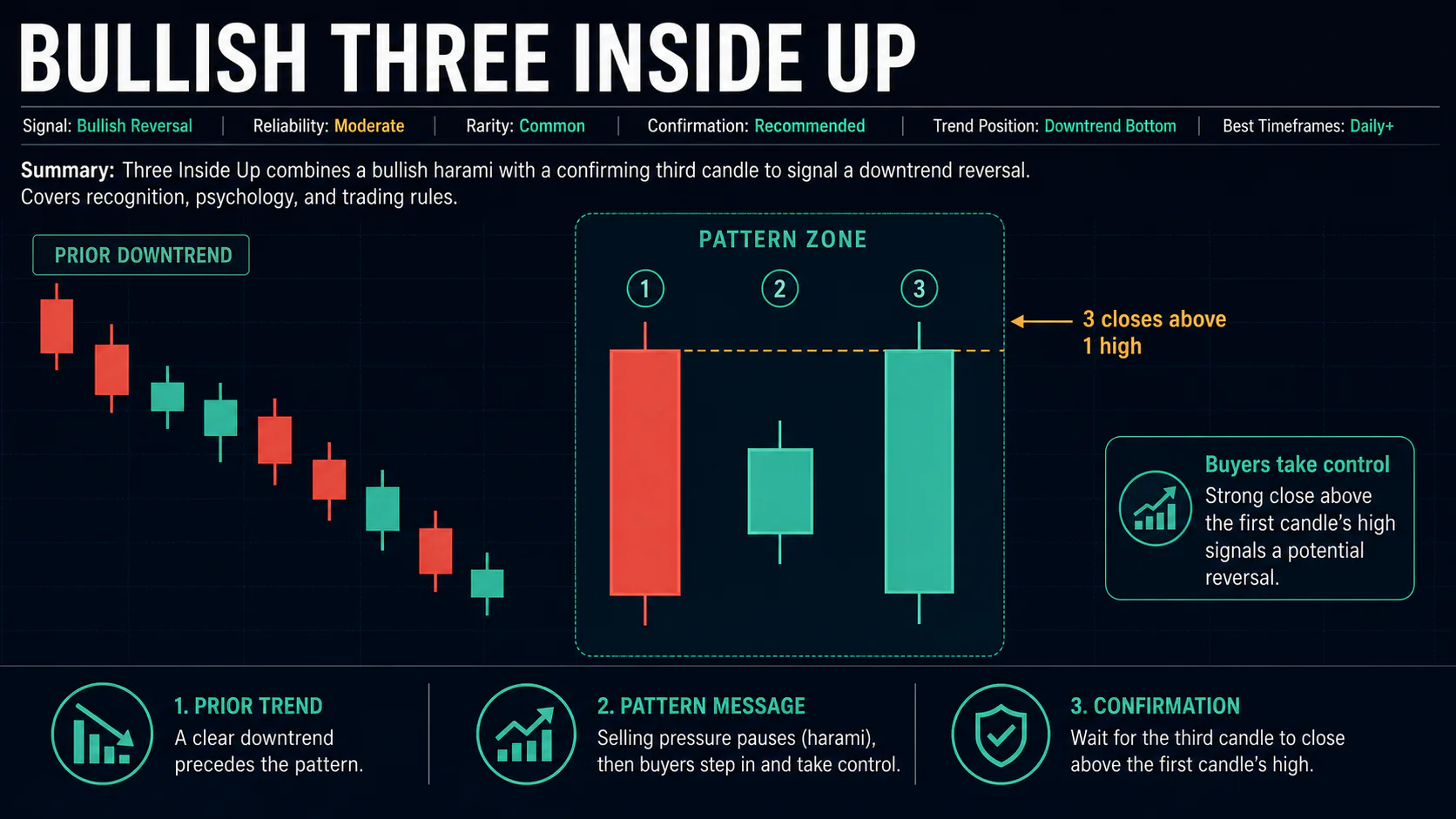
- First candle: a large bearish candle that continues the existing downtrend, with a substantial real body.
- Second candle: a smaller bullish candle whose entire real body sits inside the first candle's real body — this is the bullish harami. The smaller and more centrally contained this candle is, the cleaner the setup.
- Third candle: a bullish candle that closes above the high of the first candle, confirming that buyers have taken control.
The requirement that the third candle clear the first candle's high (not just its body) is what separates a confirmed Three Inside Up from a harami that simply fizzles out. Without that close, all you have is an unconfirmed harami.
| Check | What to look for |
|---|---|
| Prior trend | Genuine downtrend before the first candle |
| First candle | Large bearish body, not a doji or spinning top |
| Second candle | Fully contained within the first candle's real body |
| Third candle | Closes above the first candle's high, not just its body |
Market Psychology
The pattern moves through three distinct phases of sentiment:
- First candle: continued bearish control — sellers push the decline further, often on above-average volume, in what looks like a routine continuation of the downtrend.
- Second candle (the harami): sellers can no longer extend the range. The close stays inside the prior candle's body, meaning the bears have lost the ability to make meaningful new progress even though the session may still close red or only marginally green.
- Third candle: buyers push price decisively back above the first candle's high, invalidating the bearish structure and often triggering stop-outs among traders who were short into the decline.
The pattern is essentially "harami plus proof" — it takes the ambiguous signal of a harami, which on its own could resolve in either direction, and resolves it in the bulls' favor with a clear, measurable break.
Variations
Deep harami: the second candle is very small and sits near the bottom of the first candle's range, suggesting sellers lost momentum quickly rather than gradually.
Doji second candle: when the harami candle is a doji rather than a small body, it emphasizes indecision even more strongly before the third-candle resolution — this variant is sometimes referred to separately as a harami cross, but the same Three Inside Up confirmation logic still applies once the third candle breaks out.
Extended confirmation: a third candle that closes well above the first candle's high (not just marginally) is a stronger version of the pattern than a bare-minimum breakout, since it shows conviction rather than a narrow technical clearing of the level.
Multiple inside candles: occasionally two or more small candles form inside the first candle's range before the confirming break, extending the consolidation. The underlying logic doesn't change — the confirming candle still needs to close above the first candle's high — but the longer pause can indicate a more thorough absorption of selling pressure before the reversal.
How It Differs From Similar Patterns
The plain bullish harami is only the first two candles of this pattern — it flags hesitation but doesn't confirm a reversal on its own. Three Outside Up is a related three-candle reversal that uses a full engulfing candle instead of a contained harami, which generally reflects a more aggressive, single-session shift in control rather than the gradual stall-then-break structure seen here.
Trading the Pattern
Entry
The standard entry is on the close of the third candle, once it has confirmed by closing above the first candle's high. A more aggressive approach enters intraday as price crosses that level, ahead of the close, accepting some risk that the session could reverse back below it before the close.
Stop-Loss
Place a stop below the low of the second (harami) candle for a tighter risk level, or below the low of the entire three-candle pattern for more breathing room against normal volatility. When the harami candle sits near an existing support level, that level can serve as a cleaner reference than the candle low alone.
Profit Targets
Project the height of the first candle upward from the breakout point as a baseline, and look to nearby resistance — prior swing highs or Fibonacci retracements (38.2%, 50%, 61.8%) of the preceding decline — for realistic profit-taking levels. Taking partial profits at the first resistance level while trailing the remainder is a reasonable way to manage the trade.
Managing the Trade
As the position develops, moving the stop up to the low of each successive candle is a straightforward way to protect gains without exiting on ordinary pullbacks. If the trade was entered aggressively (before the third candle's close), it's worth reassessing the position once the session actually closes — if the close comes in weaker than expected, tightening the stop or reducing size is more prudent than assuming the pattern will complete as anticipated.
Confirmation
Beyond the third candle's break above the first candle's high, additional confirmation comes from what follows: a fourth candle that holds the breakout level, or continues higher, supports the reversal. If price immediately falls back into the first candle's body after the "confirmed" breakout, treat the setup with more caution even if the stop hasn't technically been hit — that kind of quick failure often means the breakout lacked real conviction.
Combining With Indicators
The pattern carries more weight when RSI was oversold (below 30) heading into the first candle, or shows bullish divergence during the harami. Price reclaiming a key moving average on the third candle is another useful confluence factor, as is the harami forming near an existing support level rather than in open space. Watching volume across the three sessions — heavier on the first candle, lighter on the harami, and expanding again on the confirming candle — fits the psychology of the pattern and adds a layer of supporting evidence.
Where It's Most Meaningful
Because the pattern depends on identifying a genuine downtrend and a clean containment relationship between two candles, it works better on daily and weekly charts than on short intraday timeframes, where random noise can produce a similar shape without the same significance. It's also more meaningful when the harami candle forms near a level with independent technical importance — a prior low, a long-term moving average, or a well-established support zone — rather than appearing in the middle of an otherwise unremarkable decline.
Common Mistakes
- Accepting partial containment. If the second candle's body extends outside the first candle's body even slightly, it is not a valid harami and the pattern doesn't apply.
- Trading before confirmation. Entering on the harami alone, before the third candle closes above the first candle's high, skips the step that actually confirms the reversal.
- Ignoring trend context. The pattern only has reversal significance after a genuine downtrend — the same three candles mid-uptrend are just noise.
- Using a first candle that's too small. A weak, small-bodied first candle undercuts the "bears were in control" premise the pattern depends on.
- Treating a marginal breakout as strong confirmation. A third candle that barely closes above the first candle's high, with a long upper shadow, is a weaker signal than one that closes firmly above it.
FAQs
How is Three Inside Up different from a plain bullish harami?
A harami is just the first two candles — a large bearish candle followed by a small contained bullish one. It signals hesitation, not a confirmed reversal. Three Inside Up adds the third candle's close above the first candle's high, which is what actually confirms the trend change.
Does the second candle have to be bullish?
In the classic definition, yes — a small bullish candle contained in the first candle's body. Some traders are more lenient and accept a small-bodied candle of either color, provided it's fully contained.
What if the third candle doesn't clear the first candle's high?
Then the pattern isn't confirmed. You still have a plain bullish harami, which is a weaker, more ambiguous signal.
Where should the stop go?
Below the low of the harami candle for a tighter stop, or below the low of the whole three-candle pattern for a more conservative one.
Why is this pattern more common than some other three-candle reversals?
Because a harami — a large candle followed by a smaller contained one — is a fairly frequent occurrence on its own. What makes Three Inside Up specifically less common than a bare harami is the added requirement that a third candle actually confirm the reversal with a clean break higher.
Does the pattern work the same way on weekly charts as on daily charts?
The same structural rules apply regardless of timeframe, but a weekly Three Inside Up represents a much larger shift in sentiment than a daily one, since each candle covers a full week of trading. Weekly formations tend to carry more significance but take longer to develop and confirm.
Conclusion
Three Inside Up takes the ambiguous bullish harami and adds the one thing it's missing: confirmation. The large bearish candle establishes the sellers' control, the contained harami shows that control fading, and the third candle's break above the first candle's high proves buyers have taken over. It's common enough to offer regular opportunities, and the confirmation requirement makes it more dependable than trading a bare harami alone.