Bullish Breakaway
Updated Aug 26, 2026
- Signal
- Bullish Reversal
- Reliability
- High
- Rarity
- Rare
- Confirmation
- Recommended
- Trend Position
- Downtrend Bottom
- Best Timeframes
- Daily+
On this page
Bullish Breakaway is a five-candle reversal pattern that forms at the bottom of a downtrend. It opens with a long bearish candle and a gap down, drifts sideways to lower over the next three candles, and finishes with a long bullish candle that closes back inside the original gap — without necessarily closing it completely. That partial reclaim of the gap, achieved by a decisive final candle, is what confirms buyers have taken control.
Recognition Criteria
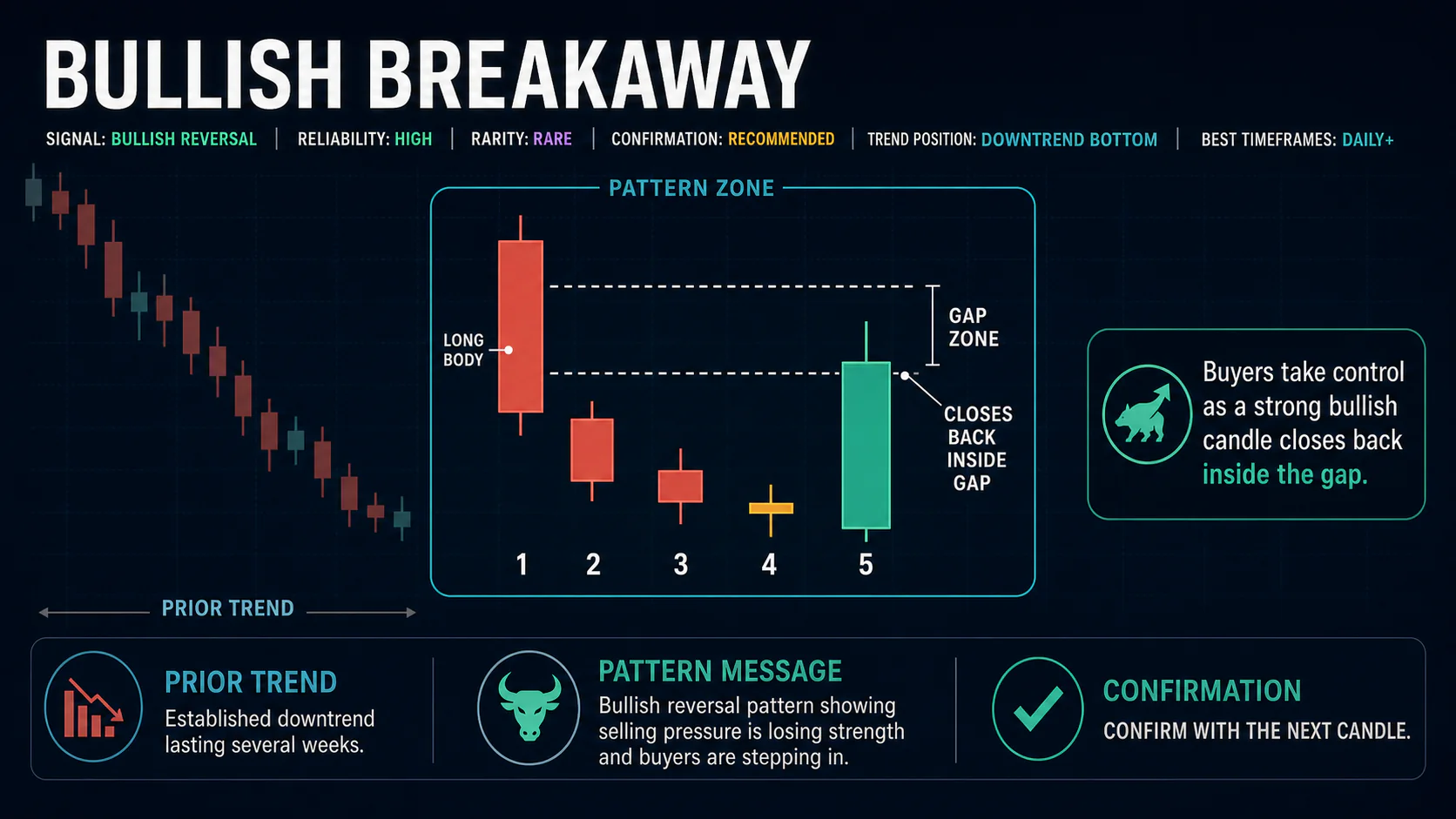
First candle: a long bearish candle continuing the downtrend.
Second candle: a bearish or small candle that gaps down from the first candle's close, opening the separation that the pattern will later partially close.
Third and fourth candles: small candles, typically drifting a little lower in short steps, that show selling losing momentum without producing a strong reversal candle of their own.
Fifth candle: a long bullish candle that closes back within the gap left between the first and second candles. It does not need to close the entire gap or reach above the first candle's close — closing anywhere inside that gap is sufficient to complete the pattern.
Trend context: the setup only carries reversal weight after a genuine, multi-week downtrend; the same five-candle shape appearing during a shallow pullback is far less meaningful.
Market Psychology
The long first candle and the gap down represent a final push of selling pressure, often the most emotional part of the decline. The three small candles that follow show that push running out of energy — sellers can no longer produce a strong follow-through candle, but buyers haven't yet stepped in with force either. The long fifth candle is the turning point: a decisive rally that reclaims part of the gap shows buyers have absorbed the remaining supply and are now setting the direction. The pattern doesn't require the gap to be fully closed because the point isn't erasing the decline outright — it's demonstrating that the selling pressure behind the gap has been overwhelmed.
Variations
Some Breakaway patterns show only two small consolidation candles instead of three, or an extended consolidation of four or more; the core requirement is a genuine pause in momentum between the initial gap and the final reversal candle. A fifth candle that closes above the first candle's close as well — a full gap fill — is a stronger version of the pattern than the minimum requirement of closing back inside the gap, but both are valid completions.
Trading the Pattern
Entry
Enter at or near the close of the fifth candle once it has closed back inside the gap with a long real body. More conservative traders wait for a break above the high of the entire five-candle pattern before entering.
Stop Loss
Place stops below the low of the gap, typically the second candle's low — a move back below that level undermines the reversal thesis. A stop below the lowest point of the full five-candle pattern is a wider, more conservative alternative.
Targets
Favor resistance-based targets — prior swing highs, moving averages, or the top of the range that preceded the downtrend — over a fixed measured move. The distance from the pattern's low to the fifth candle's close can serve as a rough minimum projection.
Confirmation and Indicators
Volume on the fifth candle that clearly exceeds the volume on the consolidation candles, and ideally the first candle too, supports the idea that real buying, not a thin bounce, drove the reversal. On-Balance Volume turning up during the consolidation phase is a useful early clue, and bullish divergence on RSI or MACD building through the three-candle consolidation adds confluence, since it suggests downside momentum was already fading before the fifth candle confirmed it.
Common Mistakes
Requiring a full gap fill: the fifth candle only needs to close back inside the gap, not above the first candle's close — waiting for a complete fill can mean missing the pattern's actual completion point.
Skipping the consolidation check: without a genuine pause in the third and fourth candles, the "drift" that signals selling exhaustion isn't there, and the pattern loses its psychological basis.
Trading it without a real downtrend: the pattern needs an established decline behind it to function as a reversal signal.
Ignoring volume on the fifth candle: a low-volume fifth candle is a weaker signal than one that stands out from the recent volume pattern.
FAQs
Does the fifth candle have to close the entire gap?
No. It only needs to close somewhere back inside the gap between the first and second candles. A full gap fill is a stronger version of the pattern, but it isn't required.
How many consolidation candles are required?
The classic pattern has two small candles, the third and fourth, but variations with three or four are also treated as valid as long as they show a genuine pause rather than continued strong selling.
What's the difference between the second candle and the gap itself?
The gap is the price space between the first candle's close and the second candle's open. The second candle then trades within or near that lower area, setting up the range the fifth candle will partially reclaim.
Is Bullish Breakaway common?
No — the five-candle structure with a genuine gap and a clean consolidation phase doesn't occur often, which is part of why traders pay attention when a clear example does appear.
How is this different from a Bullish Kicking pattern?
Bullish Kicking is a two-candle pattern built around a single clean gap with no overlap at all. Breakaway is a five-candle pattern where the gap is partially — not necessarily fully — reclaimed after a consolidation phase.
Conclusion
Bullish Breakaway tells a five-session story of a downtrend running out of steam: a final push lower, a pause, and then a decisive rally back into the gap that push created. Because the reversal candle only needs to close inside the gap rather than erase it completely, the pattern can confirm a bottom before the entire decline has been retraced. Combine it with volume and momentum confirmation, and use the gap's low as your primary invalidation level.