Bullish Stick Sandwich
Updated Aug 26, 2026 · Reviewed by Terence Scott, founder
- Signal
- Bullish Reversal
- Reliability
- Moderate
- Rarity
- Rare
- Confirmation
- Required
- Trend Position
- Downtrend Bottom
- Best Timeframes
- Daily+
On this page
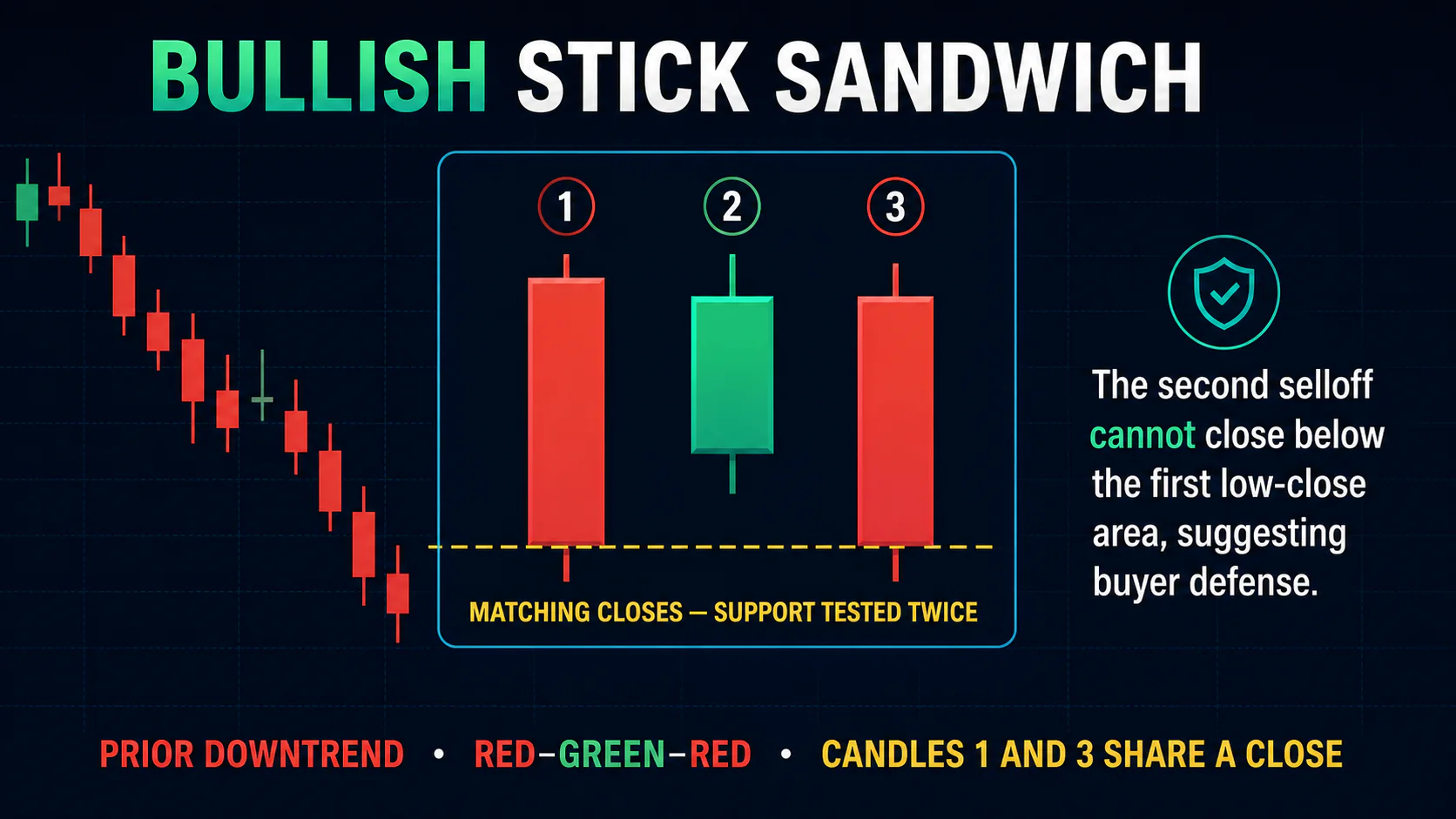
A bullish stick sandwich is a three-candlestick reversal pattern with a bearish-bullish-bearish color sequence, where the first and third candles close at nearly the same price. The bullish middle candle sits between the two matching bearish closes like the filling in a sandwich. Sellers get a second chance, in the third candle, to push the close below the level set by the first candle and fail, a repeated, multi-session defense of that closing price that is read as a sign of building support.
Recognition Criteria
First Candle
A meaningful bearish candle that establishes the closing price the pattern is built around, ideally with real selling pressure and above-average volume behind it, so the level being defended has genuine technical weight.
Second Candle
A bullish candle that opens and closes above the first candle's close, showing buyers stepping in and, for a session, gaining the upper hand over the prior day's bearish tone.
Third Candle
A bearish candle that may open higher but closes at nearly the same price as the first candle's close, conventionally within a small fraction of a percent. Despite renewed selling, the close cannot get through the level the first candle established.
Critical Requirements
- Matching closes on the first and third candles: this, not matching lows, is what defines the pattern and creates the "sandwich."
- Color sequence: bearish, bullish, bearish, in that order.
- Downtrend context: the pattern needs a genuine prior decline to carry reversal significance.
- Volume: supportive volume across the three sessions adds confidence but is not a strict requirement.
Market Psychology
Establishing the Level
The first candle sets a closing level under continued selling pressure, giving the market a specific price to react to over the following sessions and a reference point that later action can be measured against.
The Buyer Challenge
The second candle shows buyers testing higher prices and, for a session, succeeding, a meaningful shift from the prior day's bearish tone, even if it does not yet confirm a reversal on its own. This is the session that first suggests sellers may not have things entirely their own way.
The Failed Retest
The third candle shows sellers trying again, and this time failing to close below the level the first candle set, despite a full session's opportunity to do so. That the market tested the level twice, from both directions, and held both times is what gives the closing-price defense more weight than a single-session support test.
Variations
Classic stick sandwich: a clean bearish-bullish-bearish sequence with the first and third closes matching closely.
Support-confluence sandwich: the matching close level coincides with a prior swing low, moving average, or round number, adding technical significance.
Extended-range sandwich: the middle candle shows a larger advance before sellers attempt to retest the support close, illustrating a more pronounced buyer-seller battle before the third candle settles back to the defended level.
High-volume sandwich: all three candles show above-average volume, suggesting sustained participation throughout the formation rather than a quiet, low-conviction sequence.
Why Three Sessions Say More Than One
A single bearish candle holding a level tells you very little; a market can pause almost anywhere for a session without that pause meaning much. The stick sandwich is more convincing precisely because it packages two separate tests of the same closing level, from opposite starting conditions, into one recognizable structure. The first test comes from a market already in a bearish posture; the second comes after buyers have just shown they can push higher. That a determined new attempt to sell, launched from a position of apparent strength on the third day, still cannot close below the level set two sessions earlier is a more demanding bar to clear than a single candle holding support once, which is part of why the pattern is treated as more than just two matching lows with an extra step in between.
Market Context
The matching close level means more when it has independent significance, such as a prior swing low, a round number, or a level aligned with a major moving average, than when it is simply wherever the first candle happened to close. The pattern also carries more weight the more mature the preceding downtrend is, since a three-session support test appearing early in a fresh decline is a much weaker signal than one appearing after an extended slide that already shows other signs of stabilizing.
Trading the Bullish Stick Sandwich
Because the pattern unfolds over three sessions rather than one or two, it rewards patience: the setup is not complete, and should not be acted on, until the third candle has actually closed and confirmed the match with the first.
Entry
Wait for a subsequent session to close above the high of the three-candle pattern, confirming that the closing-price defense has turned into upward momentum. Some traders take an initial position as the third candle confirms the matching close, adding on a later breakout rather than waiting entirely for that final confirmation.
Stop Loss
Place stops below the matching close level shared by the first and third candles. A break below that level negates the support defense the pattern represents, since sellers would finally be succeeding at the level they twice failed to break.
Profit Targets
Target the next meaningful resistance level above the pattern. Some traders measure the height of the middle candle above the matching close and project that distance upward from the confirmation breakout as a rough guide, adjusting toward actual resistance rather than following the projection mechanically.
Confirmation and Combining with Indicators
It also helps to look at how the broader market or sector behaved during the same three sessions; a support defense that holds while peers continue to weaken is a more distinctive achievement than one that simply moves in step with a market-wide bounce.
Supporting evidence includes RSI in oversold territory with bullish divergence, and the matching-close level coinciding with a well-established support zone or major moving average. A closely related, two-candle version of the same closing-price-defense idea is the matching low, which omits the middle bullish candle and instead shows both bearish candles closing at the same level back to back.
Common Mistakes
Most errors with this pattern come down to being too generous with what counts as "matching," either between the closes or in the required color sequence, rather than any deeper misunderstanding of the underlying logic.
Recognition Errors
- Accepting closes on the first and third candles that differ too much to represent genuine support.
- Overlooking the required color sequence: the middle candle must be bullish, not just smaller.
Trading and Risk Mistakes
- Trading the pattern outside of a real downtrend, where the matching closes carry no reversal significance.
- Entering before a confirmed breakout above the pattern's high.
- Overweighting the setup when the matching close level has no independent technical significance of its own.
- Assuming the pattern is complete after only the second, bullish candle appears, before the third candle has actually confirmed the matching close.
FAQs
What makes it a "sandwich"?
The bullish middle candle is enclosed between two bearish candles that close at nearly the same price; visually and structurally, the bullish candle is the filling between two matching bearish "slices."
How is this different from the matching low pattern?
The matching low is a two-candle pattern where both candles are bearish with matching closes. The stick sandwich adds a bullish middle candle between two bearish candles with matching closes, giving a more complete three-session picture of the support test.
Does the middle candle need to gap up?
No gap is required; the key requirement is that the second candle's open and close are both above the first candle's close.
Is this a common pattern?
No, it's considered relatively rare, so genuine, clean examples with precisely matching closes do not appear often.
Can the pattern fail even after it forms cleanly?
Yes, a clean stick sandwich still needs confirmation. If the market fails to break above the pattern's high and instead closes below the matching support level, the defense has failed and the setup should be abandoned.
Does the first candle need to be larger than the third?
Not necessarily; what matters most is that their closes match closely. Differences in body size between the first and third candles do not by themselves invalidate the pattern.
How is this different from a three-candle matching low?
A run of three bearish candles with matching closes is not a stick sandwich, since the pattern specifically requires the middle candle to be bullish. That bullish middle session, and the fact that sellers had to overcome it to retest the level, is what gives the stick sandwich its added significance over a simple repeated bearish close.
Conclusion
The bullish stick sandwich builds its case for a reversal over three sessions rather than one: a bearish close, a bullish push higher, and a second bearish attempt that fails to close any lower than the first.
That repeated defense of the same closing level, tested from both directions, is the core of the pattern's signal, and a confirmed move above the pattern's high adds the follow-through needed to act on it. As with any support-based setup, the level's significance beyond the pattern itself, and the confirmation that follows, matter more than the three candles alone.