Bullish Gravestone Doji
Updated Aug 26, 2026
- Signal
- Bullish Reversal
- Reliability
- Low
- Rarity
- Common
- Confirmation
- Required
- Trend Position
- Downtrend Bottom
- Best Timeframes
- Daily+
On this page
A gravestone doji is a single-candle pattern in which the open, close, and low all sit at or near the same price while the high extends well above, leaving one long upper shadow and little or no body or lower shadow. It gets its name from its resemblance to a headstone. Conventionally, the gravestone doji is a bearish signal used to call tops: buyers push price up during the session but sellers reject the advance entirely, dragging it back down to close near the open. This page covers the less common, context-dependent case where the same shape appears at the bottom of a downtrend, which some traders read as a sign of selling exhaustion, but that bullish reading is the exception, not the rule, and needs strong confirmation before it should be trusted.
Recognition Criteria
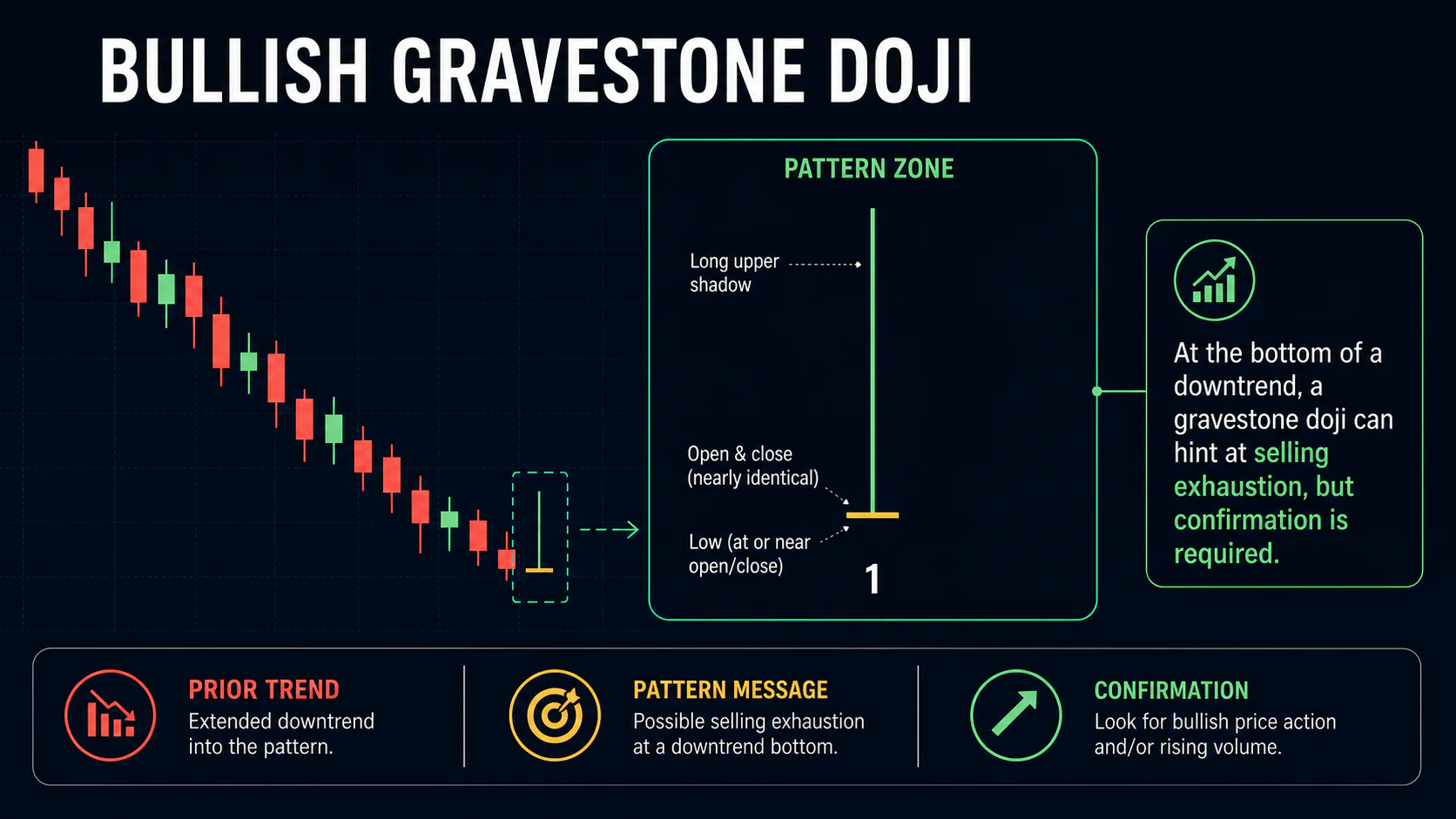
- Open, close, and low nearly identical: the real body is negligible and sits at the bottom of the session's range.
- Long upper shadow: conventionally at least three to four times the length of the tiny body, showing an intraday advance that was completely given back.
- Minimal or no lower shadow: sellers controlled the bottom of the range into the close.
- Trend context determines the reading: at the top of an uptrend it is a standard bearish reversal warning; at the bottom of an extended downtrend it can, in limited cases, be read as a bullish exhaustion signal, but only with confirmation.
- Volume: heavy volume during the session more often points to continued distribution than exhaustion, while moderate volume is more consistent with a genuine, if tentative, equilibrium.
Why the Bullish Reading Requires Caution
The gravestone doji's defining feature, a strong rejection of higher prices, is inherently a bearish signature. Buyers tried to lift the price and failed outright. That is exactly why it is the standard bearish reversal candle at tops. Reading it as bullish at the bottom of a downtrend asks you to interpret the same rejection of higher prices as a sign that sellers are running out of ammunition rather than as continued weakness. That interpretation only holds up when several things line up: the downtrend is extended and shows other signs of exhaustion, the pattern forms at a meaningful support level, and, critically, the next session or two confirms with a strong move higher on good volume. Absent that confirmation, treat a gravestone doji in a downtrend as more likely to mean continued weakness than a bottom.
It helps to think about why the pattern is normally bearish in the first place: buyers had an entire session to establish that higher prices were acceptable, and by the close the market had rejected that idea completely. Asking that same rejection to mean the opposite thing simply because the broader trend has been down for a long time is a real stretch, which is why this variant is treated as the weakest reading among the common bullish reversal candles rather than an equally valid alternative interpretation.
Market Psychology
Buyers push the price up during the session, testing whether the market will accept higher prices. Sellers reassert control and erase the entire advance by the close. In a downtrend, this can simply mean supply still dominates at higher levels, the bearish default reading. The more constructive interpretation, used sparingly, is that the failed rally at least demonstrates buyers are willing to test higher levels after a long decline, and that if the very next session confirms with strength, the failed test may have flushed out the last of the selling pressure. That is a genuinely different and weaker case than the dragonfly doji's bullish signature, a rejection of lower prices, so it should be treated with correspondingly less confidence.
Variations
Classic gravestone: open, close, and low identical, with a long, clean upper shadow.
High-volume gravestone: often points toward continued distribution and is generally the least convincing candidate for a bullish reading.
Moderate or low-volume gravestone: less conviction behind the failed rally, which can be read either as reduced bearish pressure or simply as noise; confirmation is what separates the two.
Support-level gravestone: forms exactly at a major support level, adding technical confluence that improves the odds of the bullish reading.
Trading the Bullish Gravestone Doji
Entry
Never enter on the gravestone doji alone. Wait for the following session, or ideally two, to close decisively above the gravestone's high with supportive volume before treating this as anything other than a bearish candle in a downtrend. Given the low base reliability, some traders prefer to see a second confirming session before committing full size, effectively treating the setup as two separate confirmations stacked on top of each other.
Stop Loss
Place stops below the gravestone's low, which is also its open and close. Any move back below that level fully negates the exhaustion thesis, and given the pattern's weaker footing, a tighter time-based exit, abandoning the setup if confirmation stalls within a session or two, is reasonable.
Profit Targets
Keep targets conservative and tied to the nearest resistance level rather than an extended projection, given the pattern's weaker reliability in this context. Scaling out early, rather than holding for a larger move, better reflects how much less certain this setup is than a standard bullish reversal candle.
Confirmation and Combining with Indicators
Because this is the less reliable, context-dependent reading of the pattern, lean more heavily on confirmation than usual: deeply oversold RSI with bullish divergence, a MACD turn from oversold levels, and formation at a well-established support level or major moving average. Multiple confluence factors matter more here than for most other reversal candles, and a declining, rather than expanding, volume trend into the pattern is a modestly more encouraging sign than a volume spike.
Common Mistakes
- Treating any gravestone doji in a downtrend as automatically bullish without weighing its normal bearish implications.
- Skipping confirmation, which is not optional for this pattern.
- Ignoring volume: a high-volume gravestone is more consistent with continued distribution than exhaustion.
- Using standard position sizing for a pattern with below-average reliability in this context.
FAQs
Is the gravestone doji usually bullish or bearish?
Bearish. It is one of the standard top-reversal candlesticks. The bullish bottom-reversal reading discussed here is a context-dependent exception that requires strong confirmation.
Why would a bearish-looking candle ever be bullish?
In an extended downtrend, a failed rally can sometimes mark the point where sellers have exhausted their supply, but this reading is weaker and less reliable than the standard bearish case, which is why confirmation is mandatory.
How does it differ from the dragonfly doji?
The dragonfly doji has a long lower shadow and is conventionally bullish at bottoms. The gravestone doji has a long upper shadow and is conventionally bearish at tops; its bullish use is the exception covered on this page.
What confirms the bullish reading?
A subsequent session, or two, closing well above the gravestone's high on above-average volume, ideally alongside oversold momentum indicators.
Should beginners trade this pattern?
It's a reasonable pattern to learn to recognize, but given its low reliability in the bullish context, it is better suited to traders comfortable requiring multiple forms of confirmation before acting.
What does the pattern look like at a market top instead?
The standard, more common use of the gravestone doji is at the top of an uptrend, where the failed rally and close near the low is read as a straightforward bearish warning, without needing the extra confirmation this bottom-reversal variant requires.
Conclusion
The gravestone doji is fundamentally a bearish rejection candle, and that should be the default assumption whenever one appears. Its use as a bullish signal is limited to a specific, less common case: an extended downtrend, formation at meaningful support, and strong confirmation in the sessions that follow.
Treat it as the weaker, higher-scrutiny cousin of the dragonfly doji rather than a reliable bottom signal on its own, and default to skepticism until the market itself confirms the more constructive reading.