Bullish Three Outside Up
Updated Aug 26, 2026 · Reviewed by Terence Scott, founder
- Signal
- Bullish Reversal
- Reliability
- High
- Rarity
- Common
- Confirmation
- Recommended
- Trend Position
- Downtrend Bottom
- Best Timeframes
- Daily+
On this page
Three Outside Up is a bullish reversal pattern built from a bullish engulfing pattern plus a confirming third candle. It appears after a downtrend: a bearish candle is followed by a larger bullish candle that completely engulfs the first candle's entire range (not just its body), and then a third bullish candle that closes higher still. The engulfing candle alone is already a well-known reversal signal; the third candle adds the follow-through that separates a real trend change from a one-session bounce.
How to Recognize the Pattern
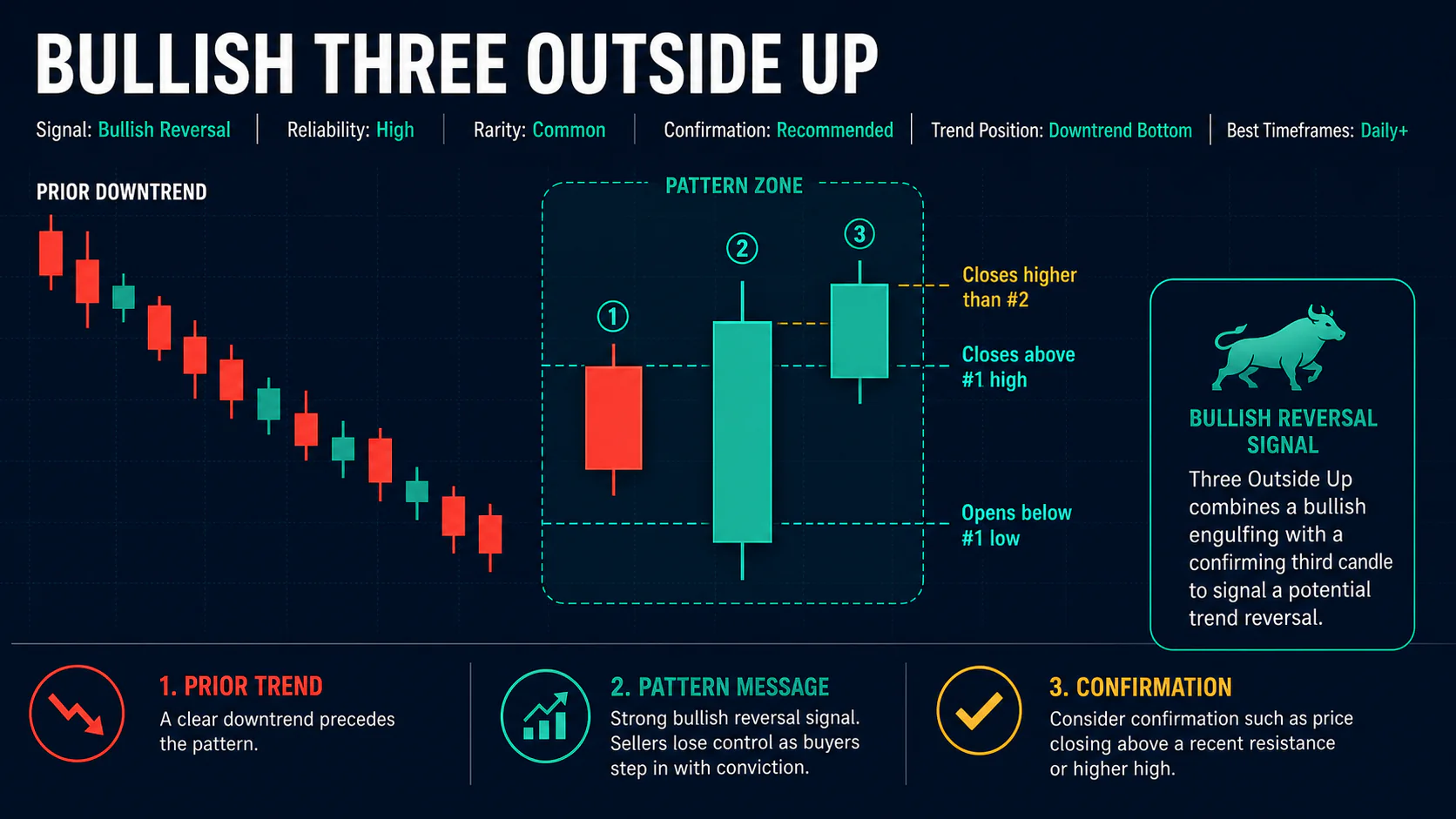
- First candle: a bearish candle continuing the downtrend. It doesn't need to be especially large — its role is mainly to set the range that gets engulfed.
- Second candle: a bullish candle that opens below the first candle's low and closes above the first candle's high, fully engulfing its entire trading range. This is the bullish engulfing pattern.
- Third candle: a bullish candle that closes higher than the second candle's close, confirming the reversal has follow-through rather than fading immediately.
The engulfment must cover the first candle's full high-to-low range, not just the real bodies — a candle that only engulfs the prior body is a weaker signal and doesn't qualify as a true outside pattern. The engulfing candle should also have a real body that makes up most of its range; an engulfing candle built mostly from long shadows with only a small body reflects more indecision than genuine conviction, even if it technically covers the first candle's range.
| Check | What to look for |
|---|---|
| Prior trend | Genuine downtrend before the first candle |
| Engulfment | Second candle's full range (not just body) covers the first candle entirely |
| Third candle | Closes above the second candle's close |
| Body strength | Engulfing candle has a substantial body, not just long shadows |
Market Psychology
The pattern unfolds across three sessions of shifting control:
- First candle: the tail end of ongoing selling — sellers still nominally in charge, but the decline may be losing conviction.
- Second candle (the engulfment): buyers don't just absorb the prior session's selling, they overwhelm it. The entire prior session's range is wiped out and exceeded within a single session, which often triggers short covering as sellers realize the level has failed.
- Third candle: continued buying at higher prices confirms the reversal wasn't a single aggressive session that immediately faded. New demand is showing up, not just profit-taking bounce-backs from oversold shorts.
Variations
Large engulfment: when the second candle's range is markedly larger than the first candle's (not just barely containing it), the reversal signal is stronger.
Gap-up confirmation: if the third candle gaps up from the second candle's close before continuing higher, it reinforces that buyers remain aggressive.
Doji first candle: when the first candle is a doji or spinning top rather than a clean bearish candle, the subsequent engulfment still counts, though the setup reflects indecision resolving upward rather than outright reversal of strong selling.
Extended engulfment: occasionally the engulfing candle's range extends well beyond just containing the first candle, leaving visible white space above the first candle's high. This more dramatic version tends to draw more attention and can attract additional momentum-driven buying on top of the pattern's own signal.
How It Differs From Similar Patterns
The plain bullish engulfing pattern is only the first two candles here — a legitimate reversal signal on its own, but one that can fail to hold. Three Inside Up is the more gradual cousin of this pattern: instead of one large candle engulfing the prior session's full range, it uses a small contained harami candle before the confirming break. Three Outside Up tends to reflect a sharper, more aggressive shift in sentiment because the reversal happens within a single session rather than developing gradually.
Trading the Pattern
Entry
The conservative approach waits for the third candle to close above the second candle's close before entering. A more aggressive entry comes right after the engulfing candle completes, accepting the risk that the third candle might not follow through.
Stop-Loss
A stop below the low of the engulfing (second) candle marks the level at which the reversal thesis fails. A stop below the low of the entire three-candle pattern is more conservative. If the engulfing candle's low aligns with a known support level, that confluence can make for a cleaner stop reference than the candle alone.
Profit Targets
Project the height of the engulfing candle upward from the pattern's completion point as a starting target, then look to the next real resistance — prior swing highs, moving averages, or Fibonacci retracements (38.2%, 50%, 61.8%) of the preceding decline. Scaling out at the first resistance level while letting a portion of the position run is a reasonable way to balance locking in gains against capturing a larger move.
Managing the Trade
Once the position is open, raising the stop to the low of each new higher candle is a simple way to protect gains as the move develops. If entry came before the third candle's confirmation, treat the first close after entry as a checkpoint — a weak or reversing close is a signal to reduce risk rather than assume the pattern will still complete as expected.
Confirmation
The third candle's higher close is the pattern's built-in confirmation step, but what happens afterward still matters. A fourth candle that holds above the third candle's low supports the reversal; a fourth candle that gives back most of the third candle's gains — even without triggering the stop — suggests the follow-through was weaker than it looked and warrants tighter risk management.
Combining With Indicators
The pattern is more convincing when RSI is oversold (below 30) heading into the first candle, especially with bullish divergence forming. A rising-volume engulfing candle, or one that reclaims a key moving average, both add weight without being strictly required. Because the engulfing candle is the dramatic centerpiece of the pattern, comparing its volume to the average of the preceding sessions is a useful gut check on whether the move reflects genuine participation rather than a thin, low-volume print. A MACD crossover developing around the same time as the engulfing candle offers another point of confluence, particularly when the crossover happens near the zero line rather than deep in negative territory.
Where It's Most Meaningful
Complete engulfment is easiest to evaluate cleanly on daily and weekly charts, where each candle represents a full session or week of trading activity. On very short intraday timeframes, engulfing shapes can appear frequently without carrying the same weight, simply because there's less time and participation behind each candle. The pattern also tends to matter more in liquid names, where a full-range engulfment reflects broad participation rather than a single large order moving a thinly traded stock. It also carries more weight when the first candle's low lines up with a level that already has some technical relevance — a prior swing low or a well-tested support zone — rather than an arbitrary point partway through an unremarkable decline.
Common Mistakes
- Accepting partial engulfment. If the second candle doesn't fully cover the first candle's high-to-low range, it isn't a true engulfing pattern.
- Skipping the third candle. Trading off the engulfing pattern alone, without requiring the confirming close, misses the "outside up" distinction entirely — that's just a plain bullish engulfing trade.
- Ignoring trend context. The same two-candle engulfment mid-uptrend is just continuation, not a reversal signal.
- Trading into heavy overhead resistance. A strong pattern can still stall immediately below a dense resistance zone — check the chart above the pattern, not just the pattern itself.
- Assuming bigger is always better. An unusually large engulfing candle driven by a single news event can be harder to build a normal risk-reward trade around than a more moderate, orderly engulfment.
- Overlooking the engulfing candle's shadow. A long upper shadow on the second candle indicates some intraday selling pressure even within an otherwise valid engulfment, and is worth weighing against a cleaner, shadow-free version of the same pattern.
FAQs
How is Three Outside Up different from a plain bullish engulfing pattern?
Bullish engulfing is just the first two candles. Three Outside Up adds a third candle that closes higher, confirming the reversal has follow-through rather than being a single aggressive session that immediately fades.
Does the engulfing candle need high volume?
It's not required by the classic definition, but a volume increase on the engulfing candle is a useful piece of supporting evidence.
What invalidates the pattern?
A close back below the low of the engulfing candle undermines the reversal, since it gives back the ground the pattern gained.
Can the first candle be small?
Yes — its size matters less than the second candle's ability to fully engulf its range. A small first candle just means a smaller engulfment is needed to qualify.
Is this pattern more reliable than Three Inside Up?
Both are considered dependable reversal signals, and the two share the same basic logic of a setup candle followed by confirmation. The engulfing structure here tends to reflect a more forceful single-session shift, while Three Inside Up shows a more gradual stall-and-break sequence — neither is universally superior, and context (trend strength, volume, support levels) matters more than the choice between them.
What if the engulfing candle has a long upper shadow?
A long upper shadow on the engulfing candle suggests sellers pushed back before the close, which is a mild negative even if the candle still technically engulfs the first candle's range. A clean engulfing candle with a small upper shadow and a close near its high is a stronger version of the setup.
Does the pattern work the same way on weekly charts?
The same rules apply on any timeframe, but a weekly engulfment represents a much larger shift in sentiment than a daily one, since each candle spans a full week. Weekly formations are rarer but tend to mark more significant turning points.
Conclusion
Three Outside Up takes the well-known bullish engulfing pattern and adds a confirming third candle, turning a one-session reversal signal into a slightly more dependable three-session structure. Confirm full engulfment of the first candle's range, require the third candle's higher close, and set your stop below the engulfing candle's low — that gives you a clear, rules-based way to trade one of the more common reversal setups. As with any single-pattern signal, treat it as one piece of evidence rather than a guarantee — the combination of full engulfment, a genuine prior downtrend, and a following candle that actually holds the gains is what separates a dependable setup from one that only looks convincing at a glance.