Bullish Concealing Baby Swallow
Updated Aug 26, 2026
- Signal
- Bullish Reversal
- Reliability
- High
- Rarity
- Extremely Rare
- Confirmation
- Recommended
- Trend Position
- Downtrend Bottom
- Best Timeframes
- Daily+
On this page
Bullish Concealing Baby Swallow is an extremely rare four-candle pattern that appears near the end of a downtrend. All four candles are black, which makes it one of the more unusual reversal signals in candlestick analysis: two marubozu-style candles are followed by a candle with a telling upper shadow, and then a final black candle that completely engulfs that shadow and body. Because every candle in the sequence looks bearish, the pattern is easy to misread, and its reversal signal depends entirely on getting the fine structural details right.
Recognition Criteria
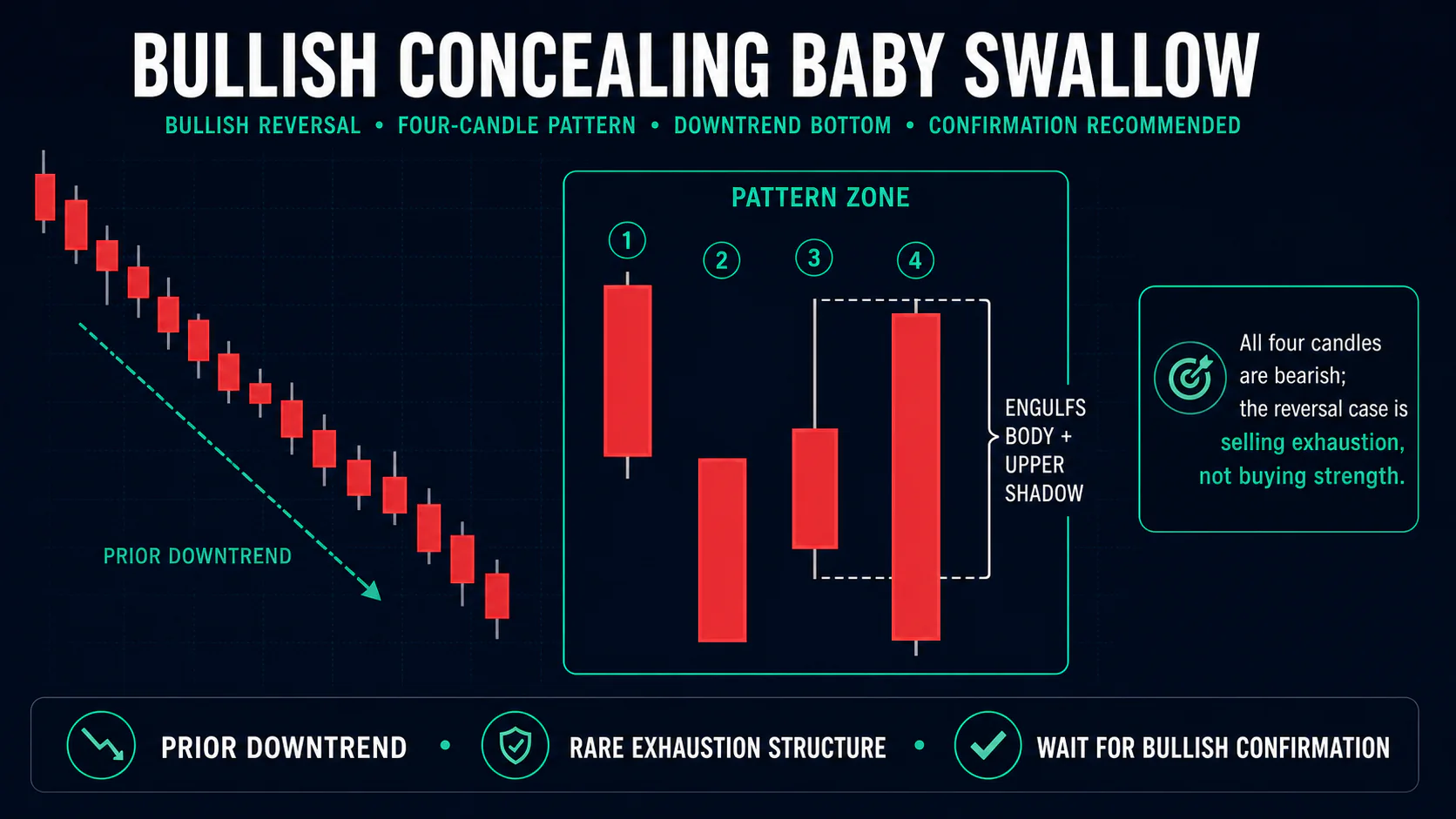
First candle: a long black candle continuing the existing downtrend.
Second candle: a black marubozu, or near-marubozu, that gaps down from the first candle — opening at or near its high and closing at or near its low, with little to no shadow.
Third candle: a black candle that opens within the second candle's real body, then rallies intraday before fading to close lower. The rally attempt leaves a visible upper shadow — the first shadow to appear in the sequence.
Fourth candle: a black candle that opens above the third candle's open and trades lower, completely engulfing the third candle's entire range, including its upper shadow, and closing below the third candle's low.
All four candles are bearish in color; there is no bullish candle anywhere in the formation. The reversal signal comes entirely from the shape of the sequence, not from any single candle's color.
Market Psychology
The first two candles show textbook, one-sided selling — the marubozu second candle in particular leaves no room for buyers to have shown up at all. The third candle's upper shadow is the first crack in that dominance: buyers manage a push higher intraday, even though sellers still win the close. The fourth candle then completely swallows that entire attempt, shadow and all, closing beneath it. Classical candlestick technique reads that "concealing" action — a decline so complete it erases even the failed rally that preceded it — as marking exhaustion after a long slide, on the logic that a market able to produce four consecutive black candles this decisively is running out of sellers rather than gaining new ones. It's a subtle and debated interpretation, since nothing in the sequence shows outright buying strength — the case for reversal rests on the pattern's rarity and its position at the tail of an extended downtrend, not on any bullish candle within it.
Trading the Pattern
Entry
Given that the entire formation is bearish in appearance, most traders wait for a confirming bullish candle after the fourth candle — a close back above the fourth candle's open, or a break above the high of the whole four-candle pattern — before entering.
Stop Loss
Place stops below the low of the fourth candle. Because the pattern offers no bullish candle to anchor a tighter stop against, this level, combined with a conservative position size, is the standard approach.
Targets
Favor the nearest meaningful resistance level or a partial retracement of the preceding downtrend over an aggressive projection — the pattern's reversal case is speculative enough that conservative targets are the more defensible approach.
Confirmation and Indicators
Because none of the four candles is bullish, confirmation matters more here than with almost any other reversal pattern. Deeply oversold readings on RSI or stochastic during the formation, combined with a bullish divergence or crossover as the next session unfolds, provide independent evidence that the exhaustion the pattern implies is actually showing up in momentum. A rise in volume on the confirming candle is a useful practical trigger.
Common Mistakes
Misreading the fourth candle as bullish: it is still a black, bearish candle that closes lower than the third — its significance is that it engulfs the third candle's shadow, not that it shows hidden buying strength within its own body.
Trading it without confirmation: since every candle in the formation is bearish, entering before a genuine confirming candle appears is speculative.
Accepting an incomplete formation: if the third candle lacks a real upper shadow, or the fourth candle doesn't fully engulf it, the defining structure of the pattern isn't present.
Ignoring trend context: the pattern only has any reversal logic after a genuinely extended downtrend; the same four-candle shape mid-range means little.
FAQs
If every candle is black, why is this a bullish pattern?
Classical candlestick technique reads the fourth candle's complete engulfment of the third candle's failed rally as a sign of selling exhaustion at the end of a long decline — the case for reversal is structural, not based on any single candle turning bullish.
How rare is this pattern?
Extremely rare. The exact four-candle sequence — two marubozu, a shadowed candle, and a full engulfment of that shadow — comes together very infrequently.
Should this pattern be traded without confirmation?
No. Because the pattern contains no bullish candle at all, waiting for a confirming close higher or a supporting momentum signal is especially important here.
How does the fourth candle differ from a normal bearish continuation candle?
The defining detail is that it opens above the third candle's open and trades through its entire range, engulfing the upper shadow along with the body — a plain continuation candle wouldn't necessarily erase that prior shadow so completely.
Is this pattern widely used by modern traders?
Not heavily — its extreme rarity and the fact that it contains no bullish candle make it more of a classical curiosity than a pattern most traders actively scan for, though it remains part of the traditional candlestick canon.
Conclusion
Bullish Concealing Baby Swallow is one of the more unusual entries in candlestick analysis: a bullish reversal signal built entirely out of bearish candles. Its case rests on the fourth candle completely engulfing the failed rally attempt in the third, at the tail end of an extended downtrend. Given how rare it is and how little bullish evidence it actually contains, treat it as a prompt to watch closely for confirmation rather than a signal to act on by itself.