Bullish Morning Doji Star
Updated Aug 26, 2026 · Reviewed by Terence Scott, founder
- Signal
- Bullish Reversal
- Reliability
- High
- Rarity
- Rare
- Confirmation
- Recommended
- Trend Position
- Downtrend Bottom
- Best Timeframes
- Daily+
On this page
A bullish morning doji star is a three-candlestick reversal pattern that appears after a downtrend. It is a variant of the bullish morning star where the middle candle is a true doji rather than just a small-bodied candle. That doji represents a session of complete indecision — buyers and sellers ending essentially where they started — sandwiched between a long bearish candle and a long bullish candle that closes well into the first candle’s body.
Recognition Criteria
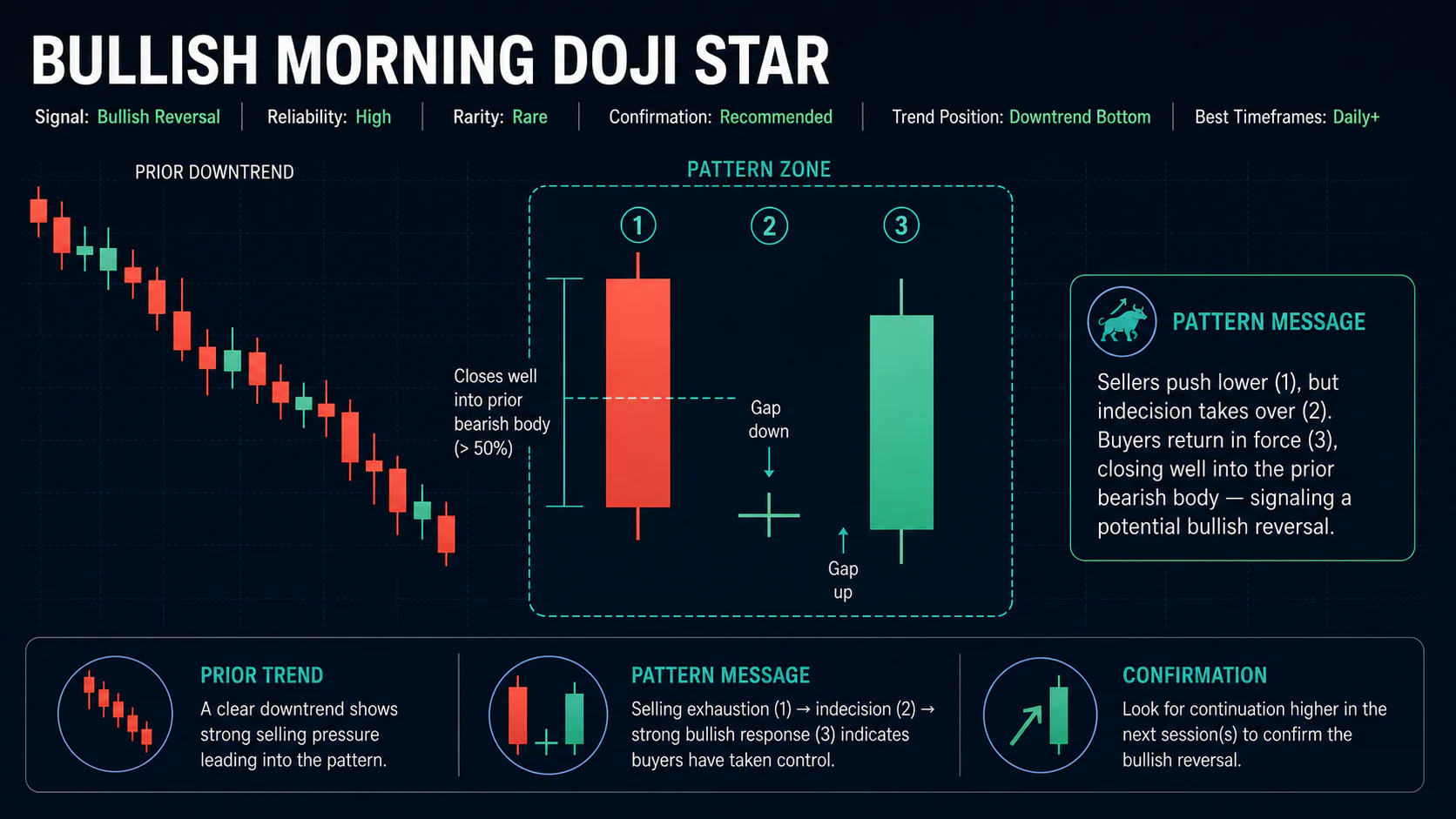
First candle: A long bearish candle continuing the existing downtrend, showing decisive selling pressure.
Second candle: A doji that gaps down from the first candle’s close. Its open and close must be equal or nearly equal — a small real body is not sufficient to qualify as a doji. Any doji subtype (standard, dragonfly, or gravestone) satisfies the requirement.
Third candle: A long bullish candle that closes well into the first candle’s real body, ideally beyond its midpoint, showing buyers have decisively regained control.
- The pattern must appear after a clear, established downtrend
- The doji must gap down from the first candle’s close
- The doji’s open and close must be equal or nearly equal
- The third candle should close more than halfway into the first candle’s body
The third candle often gaps up from the doji as well, which makes for a stronger, more visually distinct pattern — but a true gap on both sides of the doji, with no overlap at all between the doji’s range and either neighboring candle’s range, is a separate and rarer pattern called the bullish abandoned baby.
Market Psychology
The first candle shows sellers firmly in control, continuing the prevailing downtrend. The doji represents a moment of genuine equilibrium — the session opens, moves around, and closes essentially unchanged, showing that neither side could establish dominance after the prior day’s gap down. That pause often coincides with oversold conditions or a level where value buyers start to take interest. The third candle then resolves the standoff decisively in favor of buyers, with a rally large enough to erase a meaningful portion of the first candle’s decline. The presence of a genuine doji — rather than just a small body — is what gives this version of the pattern its extra significance over a standard morning star.
Variations
A dragonfly doji in the middle position (long lower shadow, no upper shadow) suggests sellers pushed price down intraday but buyers reclaimed it by the close, adding some bullish lean even before the third candle confirms it. A gravestone doji (long upper shadow, no lower shadow) suggests the opposite intraday dynamic and is typically viewed as a somewhat weaker version, making the third candle’s confirmation more important. In some cases more than one small candle or doji appears between the first and third candles rather than a single one — the broader pattern remains valid as long as the same three-phase story of decline, indecision, and reversal is intact.
Trading the Morning Doji Star
Entry
The more conservative approach waits for the price to close above the third candle’s high before entering, confirming the reversal has followed through. More active traders may enter on a break above the high of the entire three-candle pattern, or wait for a minor retest of the pattern’s low as support.
Stop-Loss
Stops are commonly placed below the doji’s low, since a move back below that level would undo the indecision-to-reversal narrative the pattern depends on. A wider stop below the entire three-candle pattern’s low provides more room for normal volatility.
Targets
Previous resistance levels broken during the downtrend make reasonable initial targets. A common approach projects the height of the first bearish candle upward from the entry point as a rough estimate, with more ambitious targets set at prior swing highs or significant resistance.
Combining With Indicators
The pattern carries more weight when it forms at a major support level, a significant moving average, or a key retracement level rather than in open space. A doji forming while the RSI is oversold, with the indicator turning back above 50 by the third candle, adds supporting context. A bullish MACD crossover developing around the same time, or volume that builds noticeably into the third candle, can serve as additional, independent confirmation — none of these are requirements of the pattern itself, just context that helps judge whether the setup deserves more confidence.
Common Mistakes
- Mistaking a regular morning star (small body, not a true doji) for a morning doji star — the open and close must be essentially equal
- Accepting a pattern without a genuine gap between the first candle and the doji
- Entering before the third candle closes and confirms the reversal
- Trading the pattern in a market with no meaningful prior downtrend, where the reversal narrative doesn’t apply
FAQs
How often does the bullish morning doji star pattern occur?
It’s relatively rare compared to two-candle patterns, since it requires a true doji — not just a small body — gapping down after a long bearish candle. Its rarity is part of why it’s generally viewed as more reliable than the standard morning star.
Can this pattern appear in an uptrend?
A similarly shaped three-candle sequence could technically form in an uptrend, but it wouldn’t be classified as a bullish morning doji star, which by definition is a reversal pattern that follows a downtrend.
What’s the difference between this and a regular morning star?
The middle candle: a morning doji star has a true doji (equal or nearly equal open and close), while a regular morning star simply has a small real body. The doji version is generally considered the stronger of the two.
What’s the difference between this and a bullish abandoned baby?
Both feature a doji between a bearish and a bullish candle. In an abandoned baby, the doji’s entire trading range is isolated by gaps on both sides — no overlap with either neighboring candle at all. That stricter, rarer condition makes the abandoned baby an even less common (and, by reputation, stronger) pattern than the morning doji star.
Conclusion
The bullish morning doji star combines the three-phase story of the morning star — decline, indecision, reversal — with the sharper indecision signal of a true doji. That combination makes it rarer than a standard morning star, and it is generally treated as one of the more dependable reversal signals in candlestick analysis, though as with any single pattern, it still benefits from a genuine support level, supporting volume, and confirmation before being treated as a firm reversal signal.