Bullish Three White Soldiers
Updated Aug 26, 2026
- Signal
- Bullish Reversal
- Reliability
- High
- Rarity
- Rare
- Confirmation
- Optional
- Trend Position
- Downtrend Bottom
- Best Timeframes
- Daily+
On this page
Three White Soldiers is a bullish reversal pattern made up of three consecutive long white (bullish) candles that appear at the bottom of a downtrend. Each candle opens within the real body of the candle before it and closes at or near its high, so the three candles form a steady staircase of higher closes. It is one of the more visually distinctive reversal signals in candlestick charting, and its relative rarity is part of what makes it useful — when it shows up cleanly, it is hard to miss.
How to Recognize the Pattern
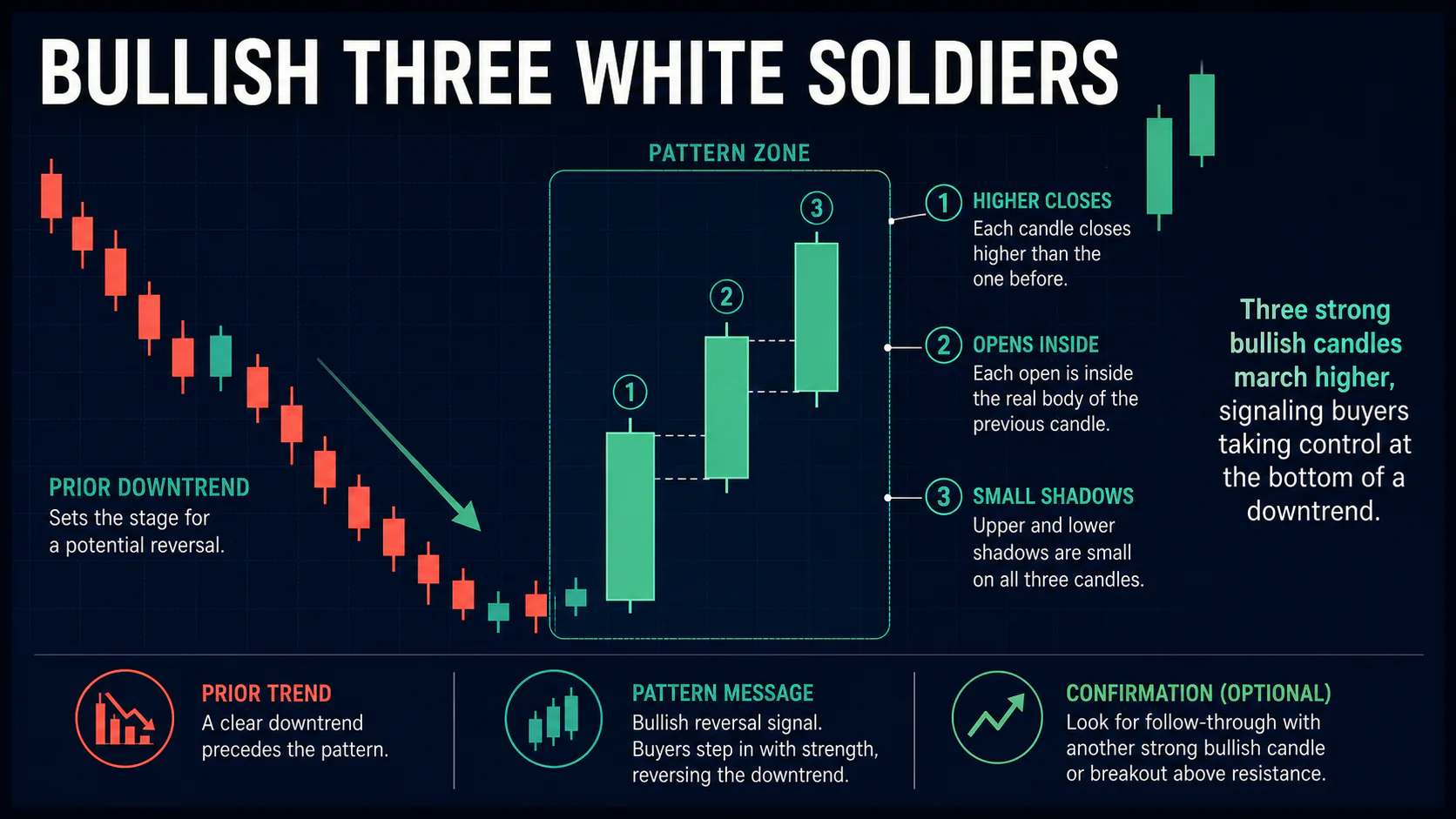
The pattern needs a prior downtrend to reverse; without one, three strong up candles are simply a normal advance, not a reversal signal. Within that context, look for:
- First candle: a long white candle that begins to turn the trend, with a real body that makes up most of its range.
- Second candle: another long white candle that opens inside the first candle's body (ideally in the upper half) and closes above the first candle's close.
- Third candle: a third long white candle that opens inside the second candle's body and closes above the second candle's close.
Shadows on all three candles should be small — long upper shadows suggest sellers are pushing back intraday, which weakens the signal. Bodies should be comparable in size or gradually increasing rather than shrinking, and volume holding up or increasing across the three sessions adds confidence, though it is not part of the strict definition.
| Check | What to look for |
|---|---|
| Prior trend | Genuine, multi-session downtrend before the pattern begins |
| Candle color | All three candles white/bullish, no interrupting bearish or doji candles |
| Opens | Each open sits inside the previous candle's real body |
| Closes | Each close is higher than the one before it |
| Shadows | Small on all three candles, especially the uppers |
Market Psychology
The pattern captures a shift from seller control to buyer control that unfolds over three sessions rather than in a single dramatic move.
- First candle: buyers absorb the tail end of selling pressure and manage to close the session near its high — the first sign that the decline is losing steam.
- Second candle: opening inside the first candle's body and closing higher shows the initial strength wasn't a one-off. New buyers are willing to pay up rather than wait for a better price.
- Third candle: the trend has visibly turned. Traders who shorted into the decline are increasingly underwater, and momentum-driven buying tends to pick up as the pattern completes.
Because this takes three full sessions to confirm rather than one sharp reversal, it tends to reflect sustained buying interest rather than a single news-driven spike. That's also why the pattern is uncommon — it requires buyers to keep showing up for three sessions running without a meaningful pullback in between.
Variations
Advancing soldiers: each candle is larger than the last, showing accelerating momentum as the reversal develops.
Modest soldiers: three solid but unspectacular candles — less dramatic, but the pattern still applies as long as the structural rules hold.
Extended formation: occasionally a fourth or fifth long white candle follows in the same style, sometimes called "four (or five) white soldiers." This simply extends the same signal rather than changing its meaning — the same recognition rules and trading logic apply, just over a longer run of candles.
Gap-supported soldiers: when one of the three candles gaps up from the prior close rather than opening within its body, it still generally counts, and the gap itself can act as a small support zone worth noting for stop placement.
Advance block (a warning sign, not a variant): when the candles show shrinking bodies and growing upper shadows as they progress, that configuration warns of weakening momentum rather than confirming a reversal, and should not be confused with a genuine Three White Soldiers formation.
How It Differs From Similar Patterns
Three White Soldiers is sometimes confused with other three-candle bullish reversals that use fewer or differently shaped candles. Three Inside Up relies on a small contained harami candle in the middle rather than three uniformly long bodies, while Three Outside Up is built around a single engulfing candle rather than a steady three-session climb. The distinguishing feature of Three White Soldiers is the absence of any single dramatic candle — it's defined by consistency across all three sessions rather than one decisive move.
Trading the Pattern
Entry
Most traders wait for the close of the third candle before entering, since that is when the pattern is actually complete. More aggressive traders enter as the third candle is forming once it is clearly tracking the pattern, accepting the risk that it could fail to close as a strong bullish candle. A middle-ground approach is to enter part of the position on the third candle's close and add on a subsequent breakout above the pattern's high.
Stop-Loss
A logical stop sits below the low of the first candle — a break back below that level means the reversal thesis has failed. Tighter stops below the most recent candle's low reduce risk but increase the chance of being stopped out on normal pullback volatility. If the pattern formed at an obvious support level, a stop just below that support can offer a cleaner technical reference than the pattern alone.
Profit Targets
Project the combined height of the three candles upward from the completion point as a baseline target, and adjust toward nearby resistance — prior swing highs, round numbers, or common Fibonacci retracement levels (38.2%, 50%, 61.8%) of the preceding decline. Scaling out in parts (partial profit near the first resistance, remainder trailing) is a reasonable way to manage a position without guessing the exact top.
Managing the Trade
Once in the trade, a common approach is to move the stop up to the low of each new candle as the advance continues, locking in progress without exiting prematurely. If the position was scaled in over the second and third candles, it's reasonable to treat the entries as a single average cost basis for target-planning purposes rather than tracking each piece separately.
Confirmation
The pattern doesn't strictly require a fourth candle to be valid, but watching what happens next tells you whether the reversal has legs. A fourth candle that holds above the third candle's low, or continues making new highs, supports the reversal. A fourth candle that immediately erases most of the third candle's gains — without breaking the pattern's stop level — is a caution sign worth tightening risk around, even if it doesn't formally invalidate the setup. A gap up on the fourth candle, in particular, often reflects the same buying conviction that built the original three-candle advance.
Combining With Indicators
The pattern is strongest when the first candle forms after RSI has been in oversold territory, ideally with the indicator turning up as the soldiers form. A MACD bullish crossover developing alongside the pattern adds another layer of confirmation, particularly if the histogram is expanding rather than flat. The price reclaiming a key moving average during the third candle is another useful confluence factor, and rising volume across the three sessions (rather than declining volume) supports the idea that new participants are joining rather than the move running out of buyers, since a trend that thins out on falling volume is more prone to stalling than one where participation is holding up or growing. None of these are required for the pattern to be valid — they simply improve the odds when they line up.
Where It's Most Meaningful
The pattern is more reliable on daily and weekly charts, where three sessions represent a meaningful stretch of time and genuine participation. On very short intraday timeframes, three consecutive up candles can appear for reasons that have nothing to do with a real trend reversal — thin liquidity, a single large order, or normal noise can produce a similar shape without the same significance. It also tends to matter more in stocks with reasonable trading volume, where a sustained three-session advance is harder to manufacture than in a thinly traded name. The pattern also carries more weight when it forms at or near a level with some independent significance — a prior swing low, a long-term moving average, or a round number — rather than in open space with no obvious reason for buyers to have stepped in there.
Common Mistakes
- Accepting an incomplete pattern. Two strong candles are not three; wait for genuine completion, or treat an early entry as a higher-risk, discretionary trade.
- Ignoring shadow size. Long upper shadows on any of the three candles indicate intraday selling pressure and weaken the signal even if the bodies still close higher.
- Trading it outside a real downtrend. Three up candles in a sideways market or minor pullback are not a reversal signal — the pattern only has meaning after a genuine decline.
- Confusing it with advance block. Shrinking bodies and lengthening upper shadows across the three candles is a warning sign, not confirmation.
- Chasing the third candle late in the session. Entering well after the third candle has already extended far beyond the second candle's close reduces the risk-reward of the trade.
- Overlooking nearby resistance. A textbook-perfect pattern can still stall quickly if it forms directly beneath a dense resistance zone; check the chart above the pattern, not just the three candles themselves.
FAQs
Does Three White Soldiers need a fourth candle to confirm it?
No. The pattern is complete after the third candle. Some traders wait for a fourth candle to hold or extend the gains as extra confirmation, but that's a personal risk preference, not part of the definition.
How is this different from three rising candles in an uptrend?
Context is everything. Three strong white candles appearing mid-uptrend are just trend continuation; the same three candles only qualify as a Three White Soldiers reversal when they appear after an established downtrend.
What invalidates the pattern after it forms?
A close back below the low of the first candle undermines the reversal thesis, since it means the entire advance has been given back.
Does volume need to increase for the pattern to be valid?
No — the classic definition is based on price structure alone. Rising or steady volume across the three sessions is a useful supporting signal, but its absence doesn't invalidate an otherwise correct pattern.
Can the pattern appear in a sideways range instead of a downtrend?
Not in the strict sense. Without a genuine preceding downtrend, three strong up candles are simply a bullish move, not a reversal pattern — the label depends on what came before it.
Is Three White Soldiers more reliable than a single bullish engulfing candle?
It's generally considered a stronger signal simply because it requires three sessions of sustained buying rather than one, which makes it harder to fake and rarer to see. That said, no candlestick pattern works in isolation — trend context and confluence with other tools still matter more than the pattern alone.
Should the three candles all be roughly the same size?
They don't have to be identical, but wildly inconsistent sizing (for example, a very large first candle followed by two much smaller ones) can indicate the initial move was a one-off spike rather than a genuine multi-session shift, so evaluate the overall shape rather than just checking each rule in isolation.
Conclusion
Three White Soldiers is a straightforward, visually clear reversal signal: three long white candles, each opening inside the prior body and closing higher, after a genuine downtrend. Its value comes from showing sustained buying across three sessions rather than a single spike. Confirm the prior downtrend, check for small shadows and consistent body size, and use the first candle's low as your invalidation level — that combination captures most of what makes this pattern useful without over-engineering the read. As with any reversal signal, treat it as one input among several rather than a standalone reason to trade; a clean formation at a level with independent technical significance, backed by supportive momentum readings, is worth more than the same three candles appearing in isolation.