Bullish Doji Star
Updated Aug 26, 2026
- Signal
- Bullish Reversal
- Reliability
- Moderate
- Rarity
- Common
- Confirmation
- Required
- Trend Position
- Downtrend Bottom
- Best Timeframes
- Daily+
On this page
A bullish doji star is a two-candlestick formation that appears after a downtrend: a bearish candle followed by a doji that gaps down from its close. The doji reflects a session of complete indecision, with the open and close nearly identical. On its own, the doji star only signals that selling pressure has stalled — it doesn’t confirm a reversal. That confirmation has to come from the next session, and when that confirming candle also closes deep into the first candle’s body, the three-candle combination is more specifically known as a bullish morning doji star.
Recognition Criteria
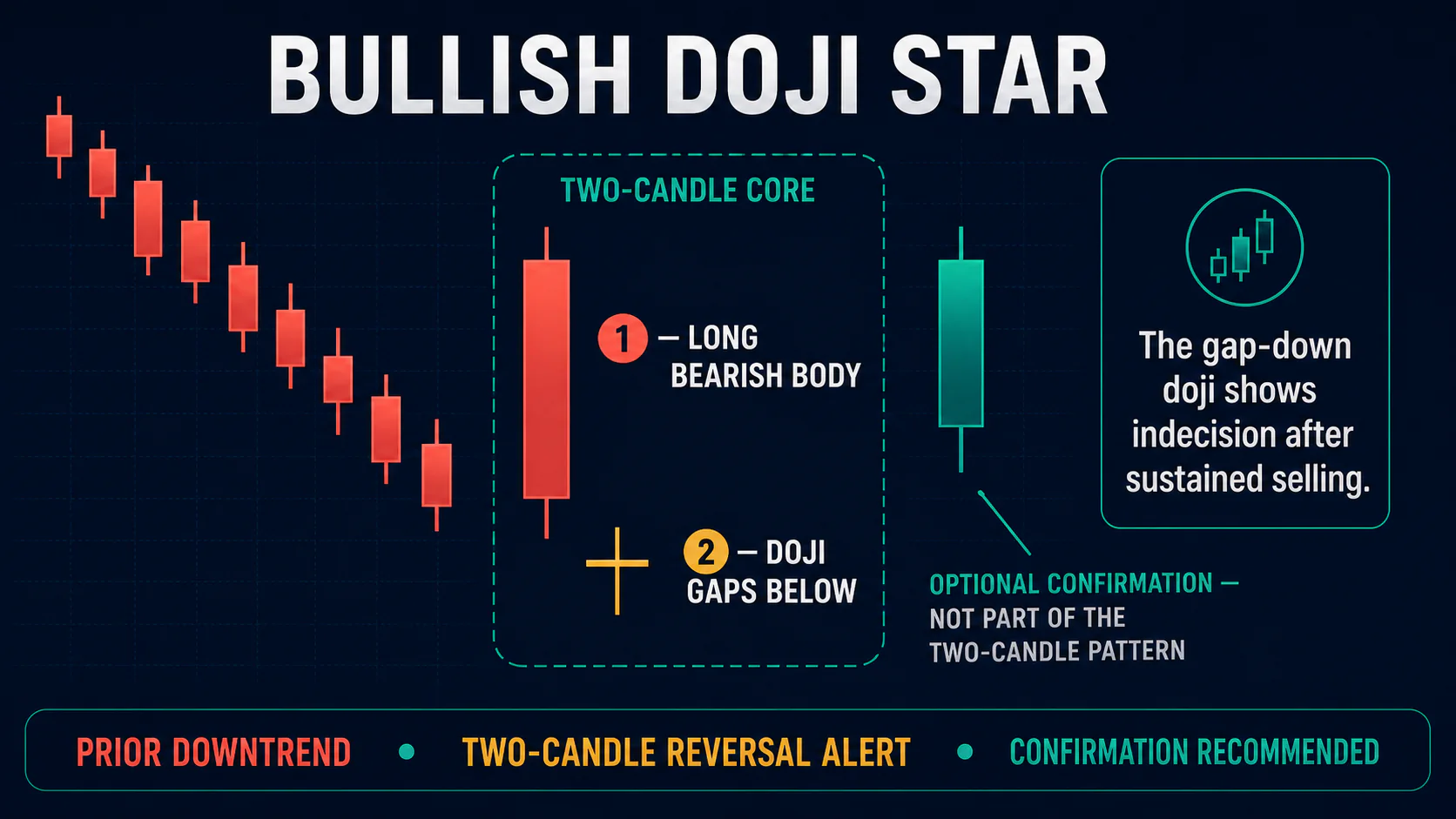
First candle: A bearish candle continuing the existing downtrend, with a real body large enough to make the gap that follows meaningful.
Second candle: A doji — open and close nearly identical — that gaps down from the first candle’s close. This is the core two-candle pattern.
- The pattern must appear after a clear, multi-session downtrend
- The second candle must be a genuine doji, not simply a candle with a small body
- The doji must gap below the first candle’s close
- A third-session bullish confirmation candle is required before treating the setup as an actionable reversal signal
Market Psychology
The first candle shows sellers still in control, continuing the prevailing downtrend. The gapped doji represents a session where that control breaks down completely — price opens lower still, but by the close neither buyers nor sellers have gained any ground, leaving the open and close essentially unchanged. That equilibrium, arriving right after a gap in the direction of the trend, often marks a point where the decline has become exhausted. But indecision by itself doesn’t tell you which way the market will resolve, which is why the pattern is treated as needing confirmation rather than as a complete signal.
Variations
A long-legged doji — with unusually long upper and lower shadows — reflects more extreme intraday indecision and, once confirmed, is generally viewed as a somewhat stronger setup. A dragonfly doji in the star position (long lower shadow, no upper shadow) suggests bulls were already fighting back intraday even before confirmation arrives, while a gravestone doji (long upper shadow, no lower shadow) suggests the opposite and typically calls for more caution. A larger gap between the first candle and the doji generally adds to the pattern’s psychological weight, though a very small or negligible gap doesn’t necessarily invalidate it.
Trading the Doji Star
Entry
Because the two-candle pattern is incomplete without confirmation, entry should wait for the third session to close back into the first candle’s body, ideally above the doji’s high. A gap up on that third candle, with reasonable volume, is the strongest version of confirmation.
Stop-Loss
Stops are commonly placed below the doji’s low, since a move back below that level suggests the indecision resolved in favor of continued selling rather than a reversal. A wider stop below the entire pattern’s low offers more room for normal volatility.
Targets
Nearby resistance is the most realistic first target. Some traders project the height of the first candle upward from the confirmation candle’s close as a rough estimate, or use the size of the initial gap as a secondary reference point.
Combining With Indicators
A doji star forming while the RSI is oversold, with the indicator turning back above 50 by the confirmation candle, adds useful context. A bullish MACD crossover developing around the same time, or formation near a major moving average or prior support level, provides additional independent support. None of these substitute for the confirmation candle itself, which remains the key requirement for this pattern.
Common Mistakes
- Accepting a candle with a small but non-trivial real body as a doji — the open and close need to be essentially equal
- Trading the pattern after only two candles, without waiting for the confirming third session
- Ignoring the requirement for a genuine gap between the first candle and the doji
- Treating a weak, marginal uptick on the third candle as sufficient confirmation rather than requiring a clear close back into the first candle’s body
FAQs
Is a doji star a two-candle pattern or a three-candle pattern?
At its core, it’s two candles — a bearish candle and a gapped doji — signaling indecision. Since that two-candle formation doesn’t confirm a reversal on its own, a third confirming candle is required before acting on it. Once that third candle closes deep into the first candle’s body, the combination is more precisely called a morning doji star.
What’s the difference between a doji star and a morning doji star?
They describe the same underlying sequence at different stages of completion. “Doji star” refers to the initial two-candle indecision signal that still needs confirmation. “Morning doji star” refers to the completed three-candle pattern, where the confirming candle has already closed well into the first candle’s body.
Does the doji need to gap down for the pattern to count?
Yes — the gap is part of what separates a doji star from a doji that simply appears mid-trend without any separation from the prior candle’s range.
Why is confirmation required rather than just recommended?
A doji by definition shows no net direction for the session — it’s pure indecision. Without a following candle to show which way that indecision resolved, there’s no basis for calling the pattern bullish at all.
Conclusion
The bullish doji star flags a moment of genuine indecision after a decline — a bearish candle followed by a doji that gaps away from it. That indecision is a useful signal on its own, but it isn’t a reversal until the next session confirms it, ideally with a candle that closes well back into the first candle’s body. Treat the doji star as a signal to watch closely rather than one to act on immediately.