Bullish Ladder Bottom
Updated Aug 26, 2026
- Signal
- Bullish Reversal
- Reliability
- High
- Rarity
- Extremely Rare
- Confirmation
- Optional
- Trend Position
- Downtrend Bottom
- Best Timeframes
- Daily+
On this page
Bullish Ladder Bottom is a five-candle reversal pattern that appears after an extended downtrend. Three consecutive black candles push to progressively lower closes, a fourth black candle develops a telling upper shadow, and a fifth candle gaps up and closes higher to confirm the reversal. It's an extremely rare pattern, but its step-by-step structure gives a clear picture of selling pressure fading before buyers take over.
Recognition Criteria
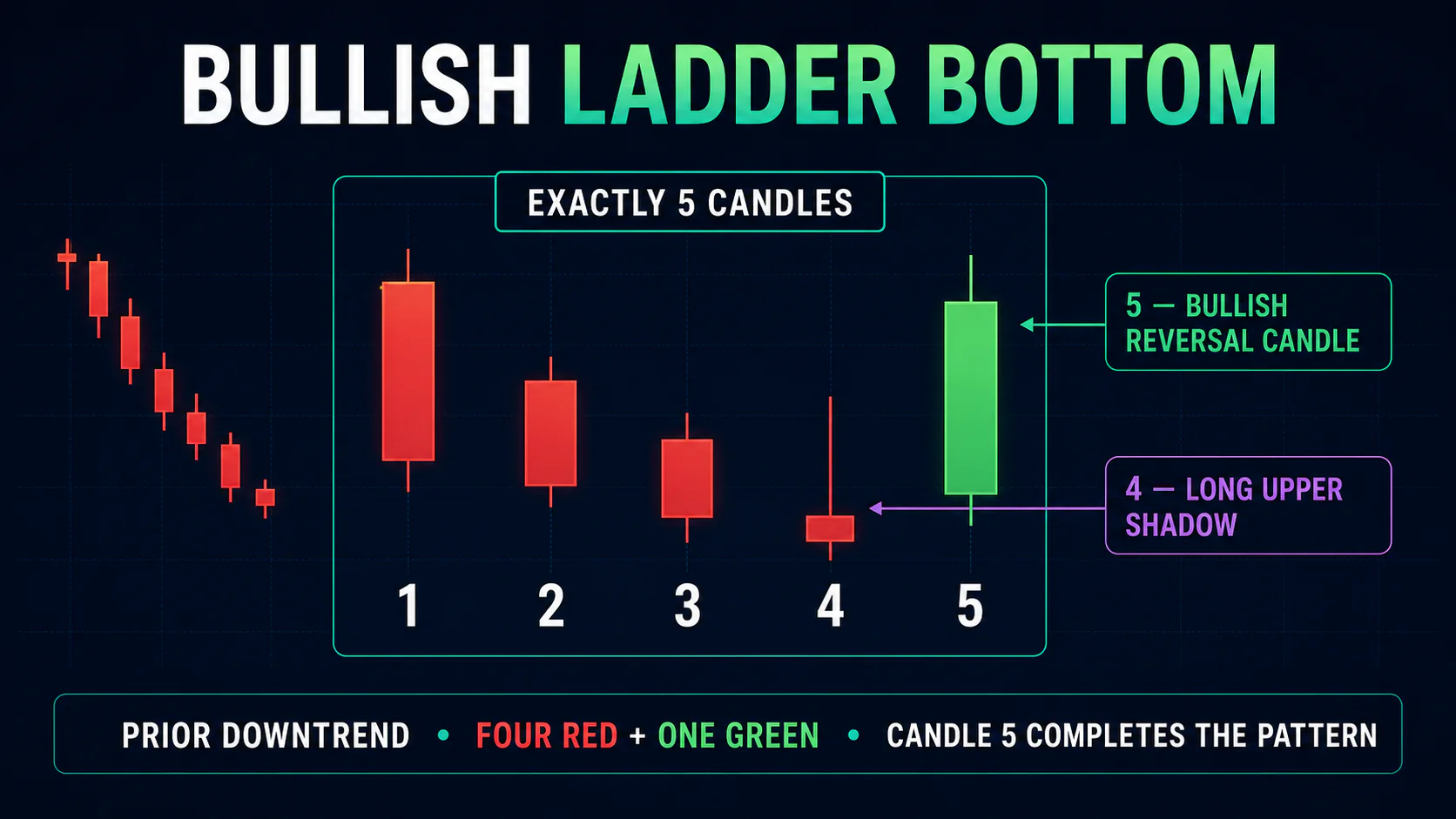
First three candles: long black candles, each closing lower than the one before, stepping the price down like rungs of a ladder. Volume is often elevated, reflecting intensifying selling.
Fourth candle: still black, but it develops a distinct upper shadow — an intraday rally attempt that fails to hold by the close. The candle's real body can be small and sits near the low of its range, but the wick above it is the key tell that buyers are starting to contest the decline.
Fifth candle: a bullish candle that opens above the fourth candle's body, ideally with a gap up, and closes decisively higher, confirming that buyers have taken control.
Trend context: the pattern only carries weight after a genuine, extended downtrend — the three-candle "ladder" needs real prior selling to reverse.
Market Psychology
The first three candles show sellers pressing their advantage session after session, each close lower than the last. The fourth candle's upper shadow is the pattern's turning point: buyers manage to push price up intraday for the first time, even though sellers still win the session on a closing basis. That failed rally attempt is a sign that selling pressure is running low on conviction. The fifth candle confirms it — an opening gap above the fourth candle's body and a strong close show buyers have taken over completely.
Trading the Pattern
Entry
Enter at or near the close of the fifth candle once the gap up and higher close confirm the pattern. More conservative traders wait for a break above the fifth candle's high before committing.
Stop Loss
Place stops below the low of the fourth candle — a break below that level undoes the exhaustion signal the pattern depends on. A stop below the low of the entire five-candle pattern is a wider, more conservative alternative.
Targets
Project the height of the five-candle pattern upward from the fifth candle's close as a starting estimate, and use Fibonacci retracements of the preceding downtrend — 38.2%, 50%, and 61.8% — as progressive resistance levels to watch.
Confirmation and Indicators
Volume expansion on the fifth candle relative to the rest of the pattern adds confidence that the reversal reflects real buying interest. Because the first three candles typically drive momentum indicators to oversold extremes, watch for RSI or stochastic readings turning up from deeply oversold territory alongside the fourth and fifth candles — that combination reinforces the exhaustion-then-reversal story the pattern is built on.
Common Mistakes
Skipping the upper-shadow check: a fourth candle without a real upper shadow is missing the pattern's key exhaustion signal, even if the rest of the sequence looks similar.
Ignoring the ladder requirement: the first three candles need genuinely progressive lower closes; three black candles that overlap heavily don't build the same selling narrative.
Entering before the fifth candle confirms: the pattern isn't complete until the gap up and higher close occur — trading the setup during the fourth candle is premature.
Trading it without an extended downtrend: without real prior selling pressure to reverse, the five-candle shape doesn't carry the same significance.
FAQs
What is the key feature of the fourth candle?
Its upper shadow. Even though it's still a black candle, an intraday push higher that fails to hold shows selling losing conviction — that's the detail that separates a Ladder Bottom from three or four candles of plain continued decline.
Does the fifth candle need to gap up?
A gap up is the classic and strongest form. Some looser interpretations accept a fifth candle that simply opens and closes well above the fourth candle without a true gap, though the signal is somewhat weaker without one.
How rare is this pattern?
Very rare. The specific combination of three progressively lower closes, a fourth candle with a genuine upper shadow, and a confirming gap-up fifth candle doesn't line up often.
How is Ladder Bottom different from Three Black Crows?
Three Black Crows describes three declining black candles on its own, typically read as bearish continuation. Ladder Bottom extends that same three-candle decline with two additional candles — the upper-shadow candle and the confirming reversal candle — that together turn it into a bullish reversal signal.
Should I trade it without waiting for the fifth candle?
No. The reversal isn't confirmed until the fifth candle closes higher; acting on the first four candles alone means trading a pattern that hasn't completed.
Conclusion
Bullish Ladder Bottom lays out selling exhaustion in stages: three candles of intensifying decline, a fourth candle where buyers first show up and fail, and a fifth candle where they finally take control. It's rare enough that most traders will see only occasional genuine examples, but the sequence is a useful reminder to watch for a failed rally attempt inside an otherwise bearish candle — it's often the earliest visible sign that a downtrend is running out of sellers.